
We read your photo as:
SECTION B - STRAIGHT LINE GEOMETRY; APPLICATION Question 2 -
ScanSolve AI Answer
Step-by-step solution
5 stepsProvide the reason for statement 2.1.1.
The diagram shows two angles, and , that lie on a straight line. Angles on a straight line sum to .
Reason 2.1.1: Angles on a straight line.
Provide the reason for statement 2.1.2.
The diagram shows four angles, , around a central point where two lines intersect. The sum of angles around a point is .
Reason 2.1.2: Angles around a point (or angles in a revolution).
Provide the reason for statement 2.1.3.
The diagram shows two parallel lines, PQ and RS, intersected by a transversal. Angles and are interior angles on the same side of the transversal. These are also known as co-interior angles. Co-interior angles between parallel lines are supplementary (add up to ).
Reason 2.1.3: Co-interior angles are supplementary (PQ || RS).
Provide the reason for statement 2.1.4.
The diagram shows two parallel lines, PQ and RS, intersected by a transversal. Angles and are alternate interior angles. Alternate interior angles between parallel lines are equal.
Reason 2.1.4: Alternate interior angles are equal (PQ || RS).
Provide the reason for statement 2.1.5.
The diagram shows two parallel lines, RS and TU, intersected by a transversal. Angles and are corresponding angles. Corresponding angles between parallel lines are equal.
Reason 2.1.5: Corresponding angles are equal (RS || TU).
Still stuck on this one?
Ask a follow-up, and the answer starts from this question.
More Mathematics Questions
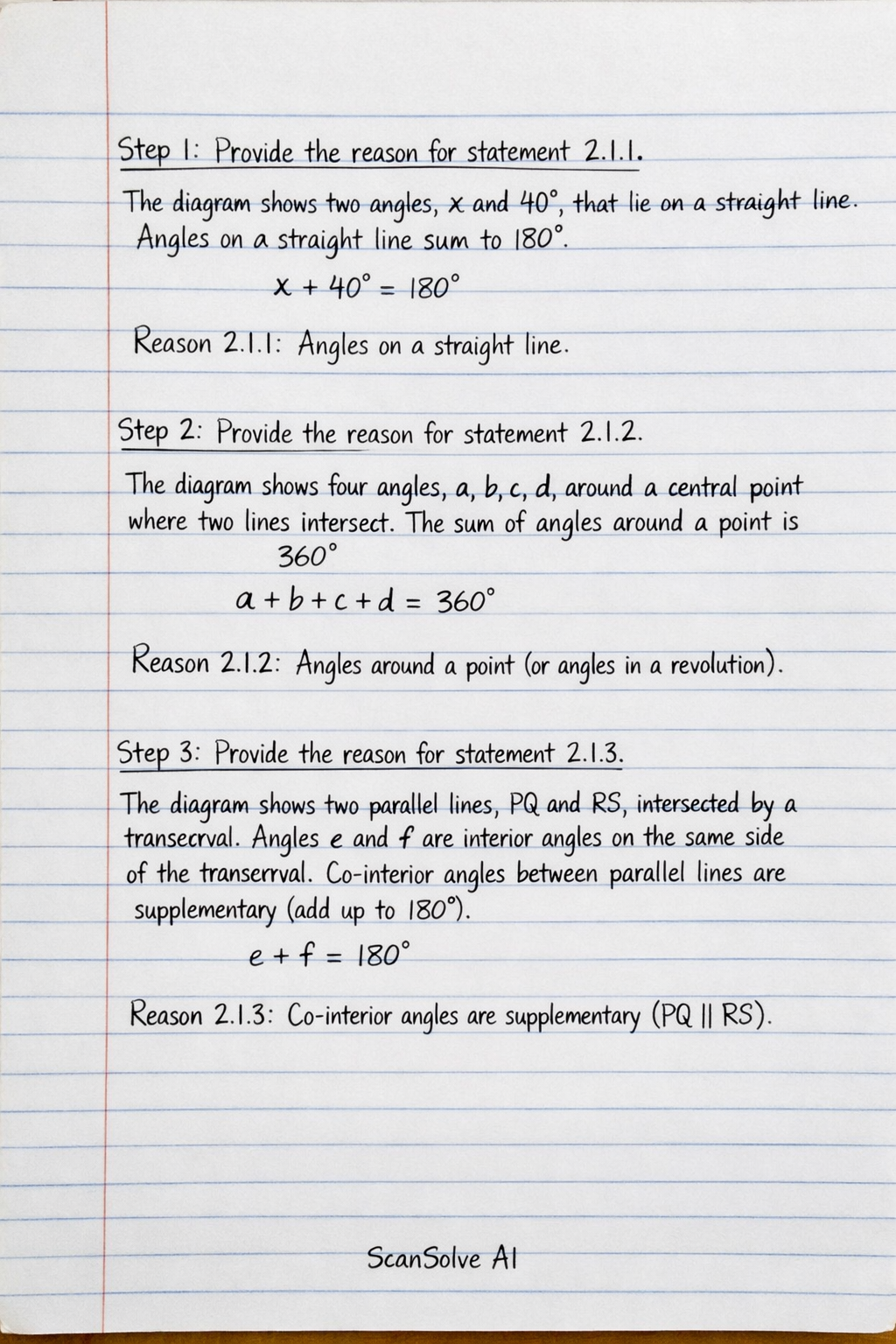
Handwritten Step-by-Step Solution
Get this as a handwritten image on WhatsApp — like a tutor wrote it for you.
Try on WhatsApp