
We read your photo as:
Describe these houses in terms of 2-D shapes and 3D objects. Use words such as: 3D objects, edges, faces, 2-D shapes, vertices.
ScanSolve AI Answer
Answer
Here's a description of the houses in terms of 2-D shapes and 3D objects, along with the number of faces, edges, and vertices for their components.
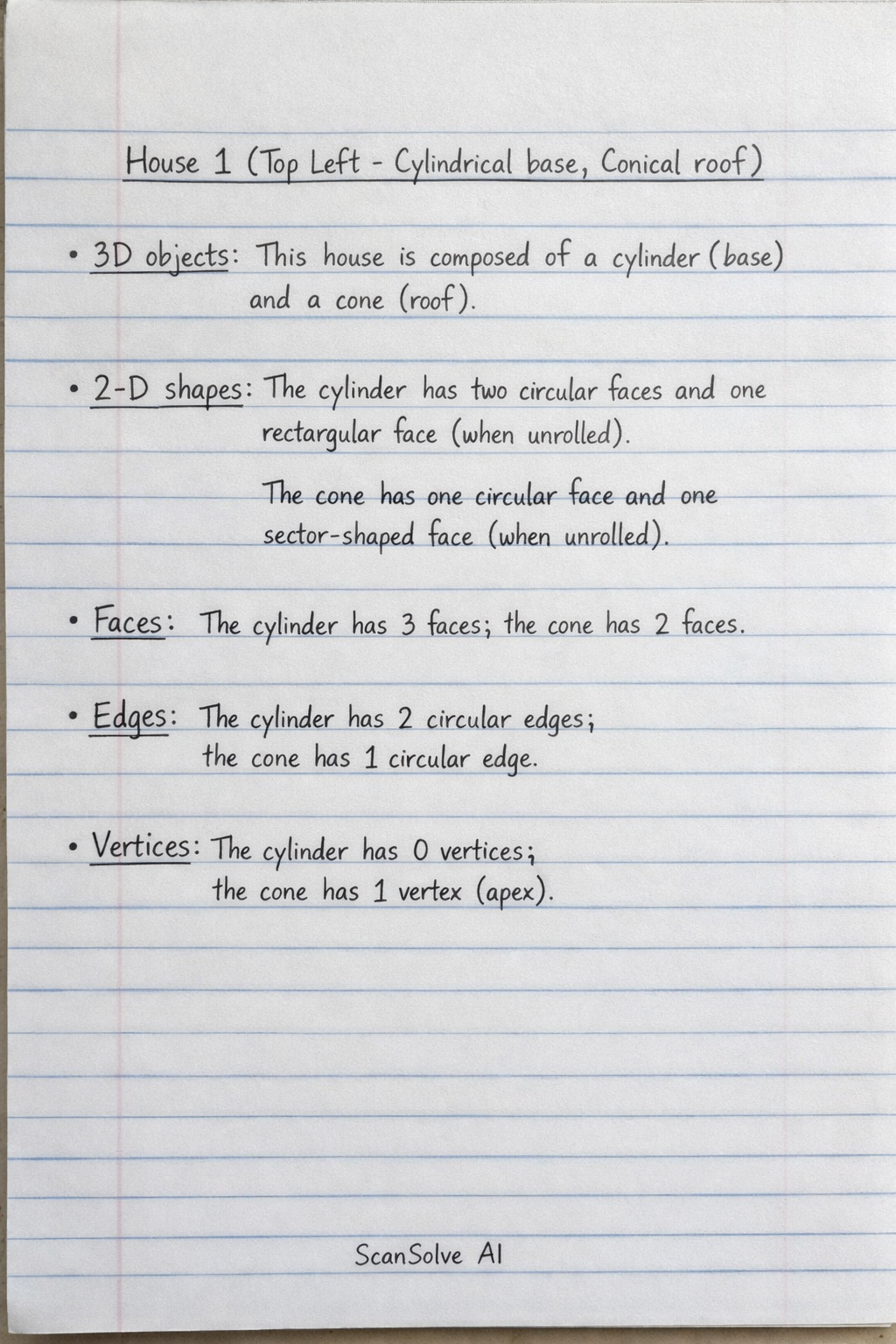
House 1 (Top Left - Cylindrical base, Conical roof)
- 3D objects: This house is composed of a cylinder (base) and a cone (roof).
- 2-D shapes: The cylinder has two circular faces and one rectangular face (when unrolled). The cone has one circular face and one sector-shaped face (when unrolled).
- Faces: The cylinder has 3 faces; the cone has 2 faces.
- Edges: The cylinder has 2 circular edges; the cone has 1 circular edge.
- Vertices: The cylinder has 0 vertices; the cone has 1 vertex (apex).
House 2 (Top Right - Cylindrical base, Octagonal Pyramid roof)
- 3D objects: This house is composed of a cylinder (base) and an octagonal pyramid (roof).
- 2-D shapes: The cylinder has two circular faces and one rectangular face (when unrolled). The octagonal pyramid has one octagonal base and eight triangular faces.
- Faces: The cylinder has 3 faces; the octagonal pyramid has 9 faces.
- Edges: The cylinder has 2 circular edges; the octagonal pyramid has 16 edges.
- Vertices: The cylinder has 0 vertices; the octagonal pyramid has 9 vertices.
House 3 & 4 (Middle and Bottom - Rectangular Prism base, Triangular Prism roof)
- 3D objects: Each of these houses is composed of a rectangular prism (base) and a triangular prism (roof).
- 2-D shapes: The rectangular prism has six rectangular faces. The triangular prism has two triangular faces and three rectangular faces.
- Faces: The rectangular prism has 6 faces; the triangular prism has 5 faces.
- Edges: The rectangular prism has 12 edges; the triangular prism has 9 edges.
- Vertices: The rectangular prism has 8 vertices; the triangular prism has 6 vertices.
Designing a house:
To determine how many different houses can be designed, we identify the unique types of 3D objects available for wall structures (bases) and roof structures.
- Unique Wall Structure Types:
- Rectangular Prism (including the open one)
- Triangular Prism
- Unique Roof Structure Types:
- Square Pyramid
- Rectangular Prism
- Triangular Prism
The number of different houses is the product of the number of unique wall structure types and the number of unique roof structure types.
Number of different houses = (Number of wall structure types) (Number of roof structure types)
Number of different houses =
You can design different houses.
Try one yourself
A new problem that tests the same skill.
Still stuck on this one?
Ask a follow-up, and the answer starts from this question.
More Mathematics Questions
Handwritten Step-by-Step Solution
Get this as a handwritten image on WhatsApp — like a tutor wrote it for you.
Try on WhatsApp