
We read your photo as:
Prove the trigonometric identities: 1) tan θ sin θ + cos θ = sec θ 2) 1/tan θ + tan θ = 1/(sin θ cos θ)
ScanSolve AI Answer
Step-by-step solution
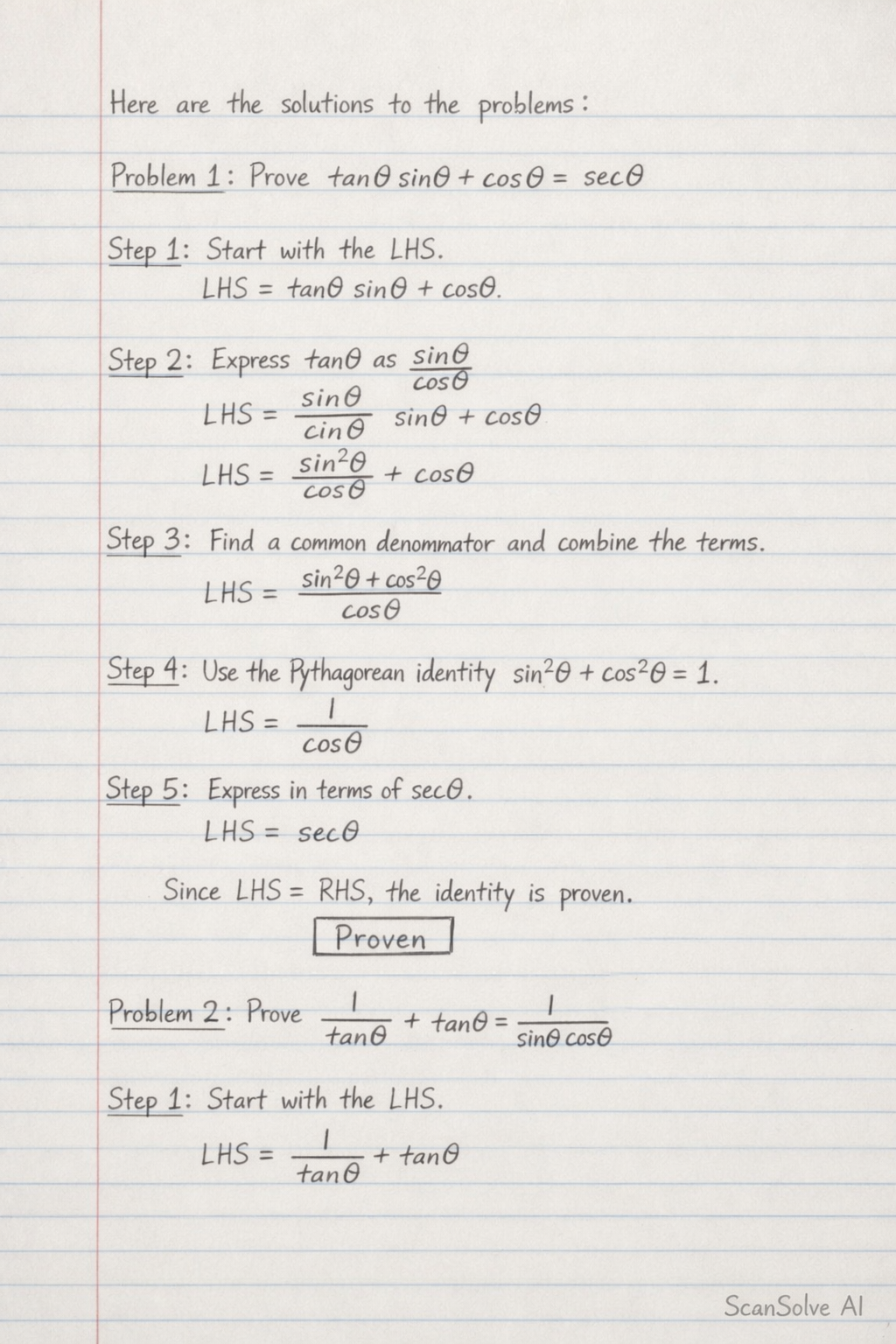
12 stepsHere are the solutions to the problems:
: Prove
Start with the Left Hand Side (LHS).
Express as .
Find a common denominator and combine the terms.
Use the Pythagorean identity .
Express in terms of .
Since LHS = RHS, the identity is proven.
: Prove
Start with the Left Hand Side (LHS).
Express as and as .
Find a common denominator, which is .
Combine the terms.
Use the Pythagorean identity .
Since LHS = RHS, the identity is proven.
: If , prove that or .
Given .
Use the identity to find .
Consider two cases for .
-
Case 1: (A is in Quadrant I)
- Calculate :
- Substitute values into the expression :
-
Case 2: (A is in Quadrant II)
- Calculate :
- Substitute values into the expression :
Thus, can be 2 or .
**: If is in the fourth quadrant and , find the value of $\frac{13 \sin \theta + 5 \sec \theta}{5 \tan \theta
-
Still stuck on this one?
Ask a follow-up, and the answer starts from this question.
More Mathematics Questions
Handwritten Step-by-Step Solution
Get this as a handwritten image on WhatsApp — like a tutor wrote it for you.
Try on WhatsApp