
We read your photo as:
Two bells at Gombe Junior School ring at intervals of 30 minutes and 40 minutes respectively. If the two bells ring at 7:30 am for the first time, at what time will they ring together again?
ScanSolve AI Answer
Answers
3 partsStep-by-step solution
13 stepsHere are the solutions to the questions:
Part b· 2 steps
Find the total number of litres containers A and B hold.
Identify the capacities of containers A and B.
From the image, container A holds 5 litres and container B holds 30 litres.
Calculate the total capacity.
The total number of litres containers A and B hold is .
Part c
If container A is used to draw water from container B, how many such containers (A) are needed to draw all the water from B?
Identify the capacities.
Capacity of container A = 5 litres.
Capacity of container B = 30 litres.Calculate the number of containers A needed.
You would need of type A to draw all the water from container B.
Part 27
Two bells at Gombe Junior School ring at intervals of 30 minutes and 40 minutes respectively. If the two bells ring at 7:30 am for the first time, at what time will they ring together again?
Find the Least Common Multiple (LCM) of the ringing intervals.
The intervals are 30 minutes and 40 minutes.
Prime factorization of 30:
Prime factorization of 40:
The LCM is found by taking the highest power of each prime factor:Convert the LCM from minutes to hours.
Add the time interval to the initial ringing time.
The bells first rang together at 7:30 am.
The bells will ring together again at .
Part 28· 6 steps
Using a ruler, a pencil and a pair of compasses, construct a square ABCD where line AB = 5cm.
Draw a line segment AB of length 5 cm using a ruler.
At point A, construct a perpendicular line to AB.
Place the compass point at A, draw an arc that intersects AB. From the intersection point, draw another arc above AB. Repeat from another point on AB to create a second arc that intersects the first, forming a perpendicular line.
With the compass point at A and radius 5 cm, draw an arc on the perpendicular line.
Mark the intersection point as D. This ensures AD = 5 cm.
With the compass point at D and radius 5 cm, draw an arc.
With the compass point at B and radius 5 cm, draw another arc that intersects the arc drawn in Step 4.
Mark the intersection point as C.
Join points B to C and D to C using a ruler.
The resulting figure ABCD will be a square with sides of 5 cm.
Try one yourself
A new problem that tests the same skill.
Still stuck on this one?
Ask a follow-up, and the answer starts from this question.
More Mathematics Questions
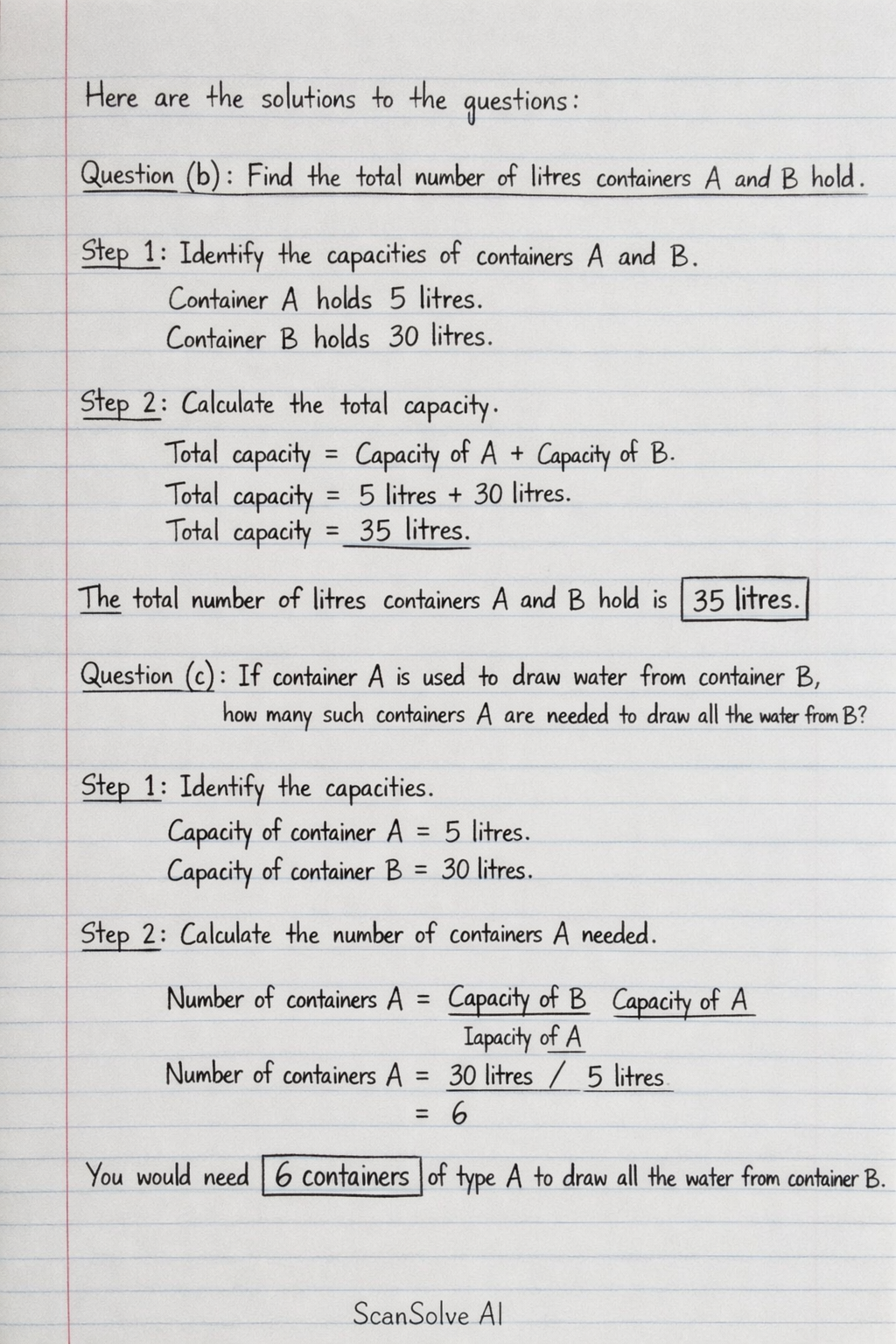
Handwritten Step-by-Step Solution
Get this as a handwritten image on WhatsApp — like a tutor wrote it for you.
Try on WhatsApp