
We read your photo as:
Two bells ring at intervals of 9, 15, and 21 minutes. If they last rang together at 11:00 p.m., when did they last ring together?
ScanSolve AI Answer
Step-by-step solution
13 stepsHere are the solutions to the problems.
:
Find the prime factorization of each interval.
The intervals are 9 minutes, 15 minutes, and 21 minutes.
Calculate the Least Common Multiple (LCM) of the intervals.
The LCM represents the time in minutes after which all bells will ring together again.
Convert the LCM from minutes to hours and minutes.
The bells will next ring together at 11:00 p.m.
To find when they last rang together, subtract the LCM from 11:00 p.m.
Converting back to 12-hour format:
The bells had last rang together at .
:
Calculate the nominal area of the rectangle.
Length
Width
Nominal Area .Determine the maximum possible dimensions due to the 5% error.
The error in each measurement is 5%.
Maximum length .
Maximum width .Calculate the maximum possible area.
Calculate the maximum absolute error in the area.
Calculate the maximum percentage error in the area.
The maximum percentage error in the area of the rectangle is .
:
Use the property that the sum of an interior angle and its corresponding exterior angle of a polygon is .
Given interior angle
Given exterior angleSolve the equation for .
Calculate the measure of the exterior angle.
Exterior angle .
Find the number of sides () of the polygon.
For a regular polygon, the sum of the exterior angles is , and each exterior angle is .
The number of sides of the polygon is .
Still stuck on this one?
Ask a follow-up, and the answer starts from this question.
More Mathematics Questions
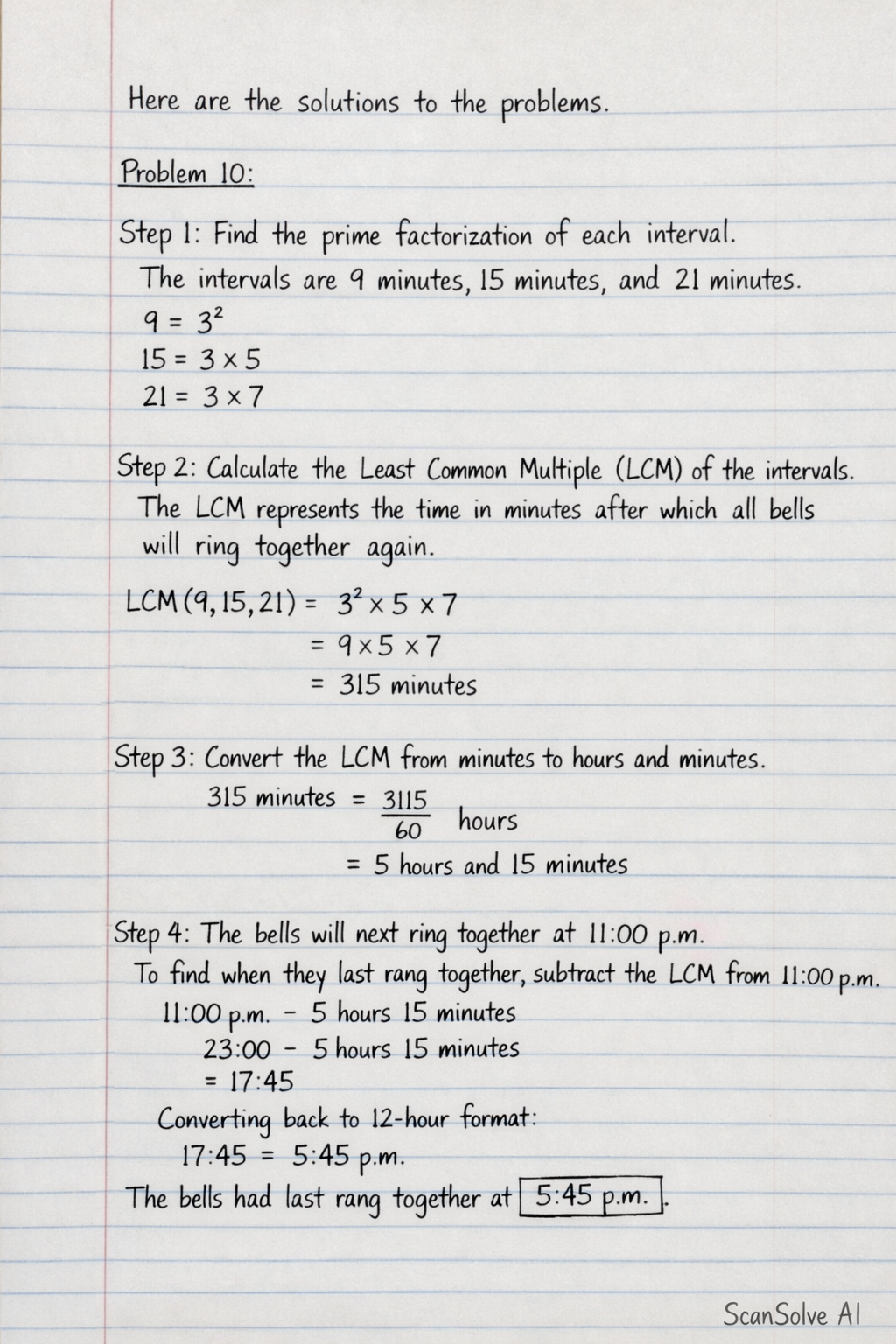
Handwritten Step-by-Step Solution
Get this as a handwritten image on WhatsApp — like a tutor wrote it for you.
Try on WhatsApp