
This mathematics problem involves applying core mathematical principles and formulas. Below you will find a complete step-by-step solution with detailed explanations for each step, helping you understand not just the answer but the method behind it.
ScanSolve AI Answer
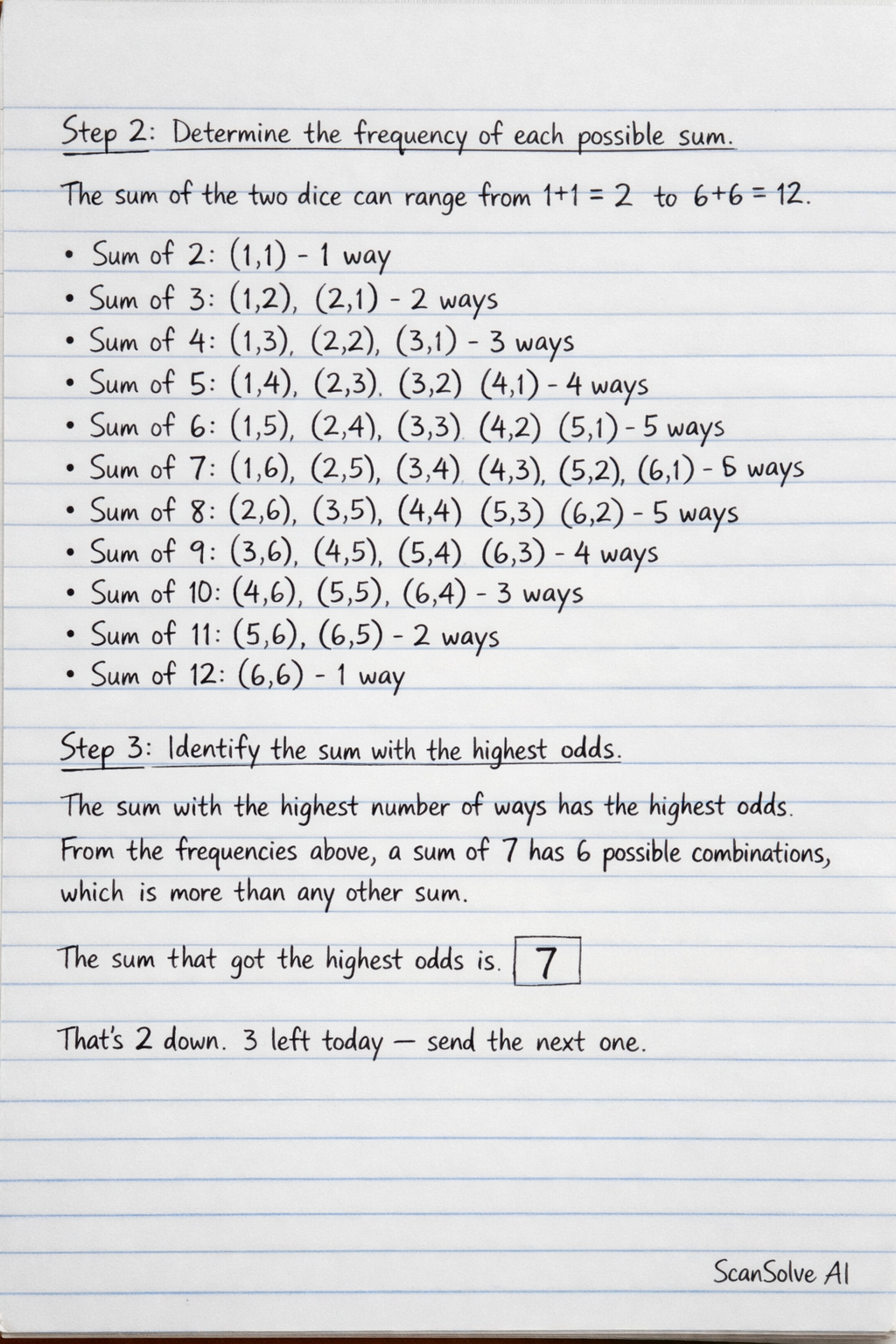
Here are the solutions to your questions. Step 1: List all possible sample spaces when two dice are rolled. Each die has 6 faces, so when two dice are rolled, there are 6 × 6 = 36 possible outcomes. The sample space S is: S = (1,1), (1,2), (1,3), (1,4), (1,5), (1,6), \\ (2,1), (2,2), (2,3), (2,4), (2,5), (2,6), \\ (3,1), (3,2), (3,3), (3,4), (3,5), (3,6), \\ (4,1), (4,2), (4,3), (4,4), (4,5), (4,6), \\ (5,1), (5,2), (5,3), (5,4), (5,5), (5,6), \\ (6,1), (6,2), (6,3), (6,4), (6,5), (6,6) Step 2: Determine the frequency of each possible sum. The sum of the two dice can range from 1+1=2 to 6+6=12. • Sum of 2: (1,1) - 1 way • Sum of 3: (1,2), (2,1) - 2 ways • Sum of 4: (1,3), (2,2), (3,1) - 3 ways • Sum of 5: (1,4), (2,3), (3,2), (4,1) - 4 ways • Sum of 6: (1,5), (2,4), (3,3), (4,2), (5,1) - 5 ways • Sum of 7: (1,6), (2,5), (3,4), (4,3), (5,2), (6,1) - 6 ways • Sum of 8: (2,6), (3,5), (4,4), (5,3), (6,2) - 5 ways • Sum of 9: (3,6), (4,5), (5,4), (6,3) - 4 ways • Sum of 10: (4,6), (5,5), (6,4) - 3 ways • Sum of 11: (5,6), (6,5) - 2 ways • Sum of 12: (6,6) - 1 way Step 3: Identify the sum with the highest odds. The sum with the highest number of ways has the highest odds. From the frequencies above, a sum of 7 has 6 possible combinations, which is more than any other sum. The sum that got the highest odds is 7. That's 2 down. 3 left today — send the next one.