
We read your photo as:
Two parallel lines are cut by transversal. If one angle is 75°, how many angles of 105° are form?
ScanSolve AI Answer
Answer
Step-by-step solution
3 stepsUnderstand the angles formed by parallel lines and a transversal.
When two parallel lines are cut by a transversal, a total of eight angles are formed. These angles will either be equal to the given angle or supplementary to it.
Calculate the supplementary angle.
Given one angle is . The angles that are supplementary to it will add up to .
So, the other type of angle formed is .
Determine the number of angles.
Out of the eight angles formed, four will be equal to the given angle (), and the other four will be equal to its supplementary angle (). This is because there are two sets of vertically opposite angles at each intersection, and corresponding angles are equal.
Therefore, there are 4 angles of formed.
The number of angles of formed is .
Try one yourself
A new problem that tests the same skill.
Still stuck on this one?
Ask a follow-up, and the answer starts from this question.
More Mathematics Questions
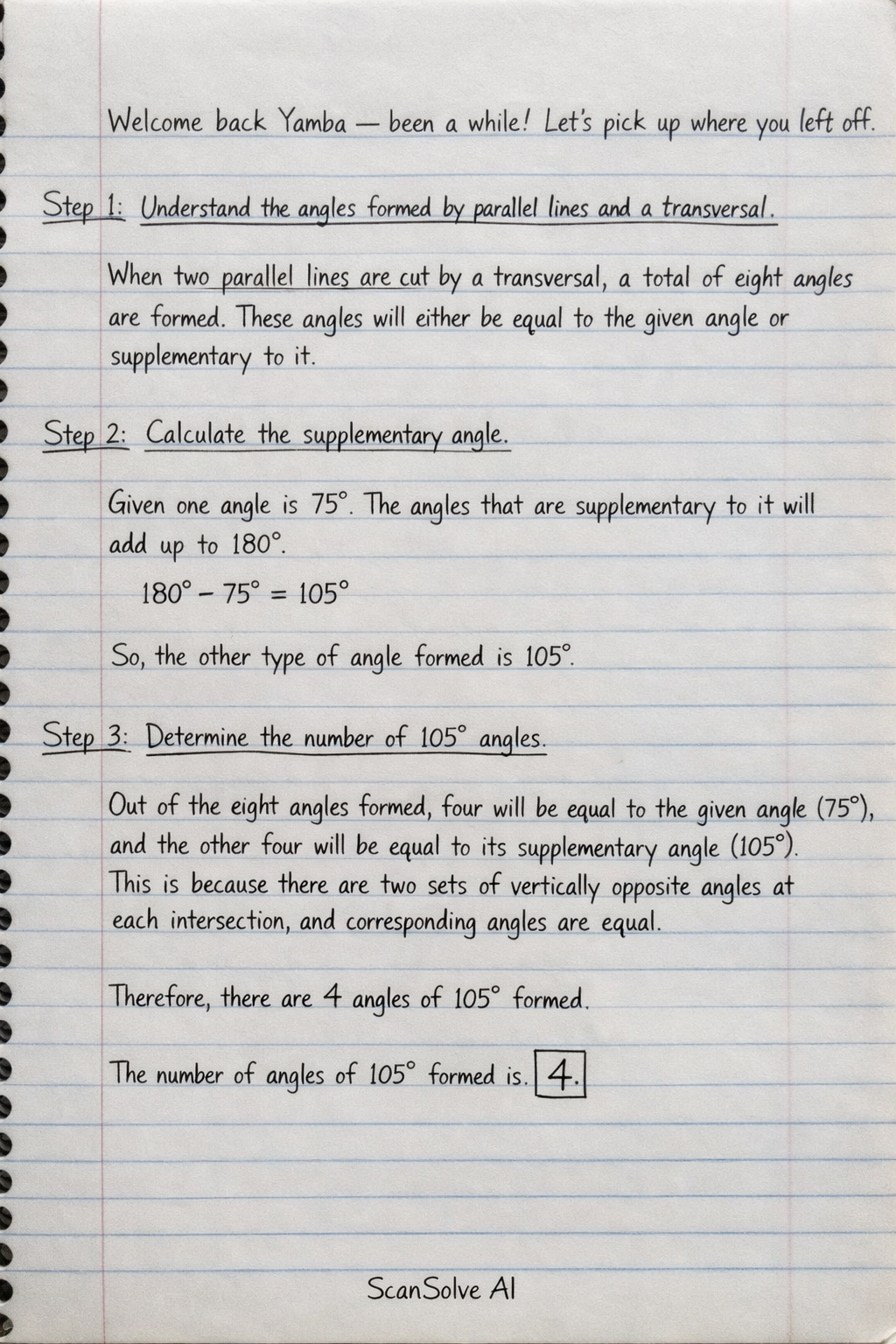
Handwritten Step-by-Step Solution
Get this as a handwritten image on WhatsApp — like a tutor wrote it for you.
Try on WhatsApp