
We read your photo as:
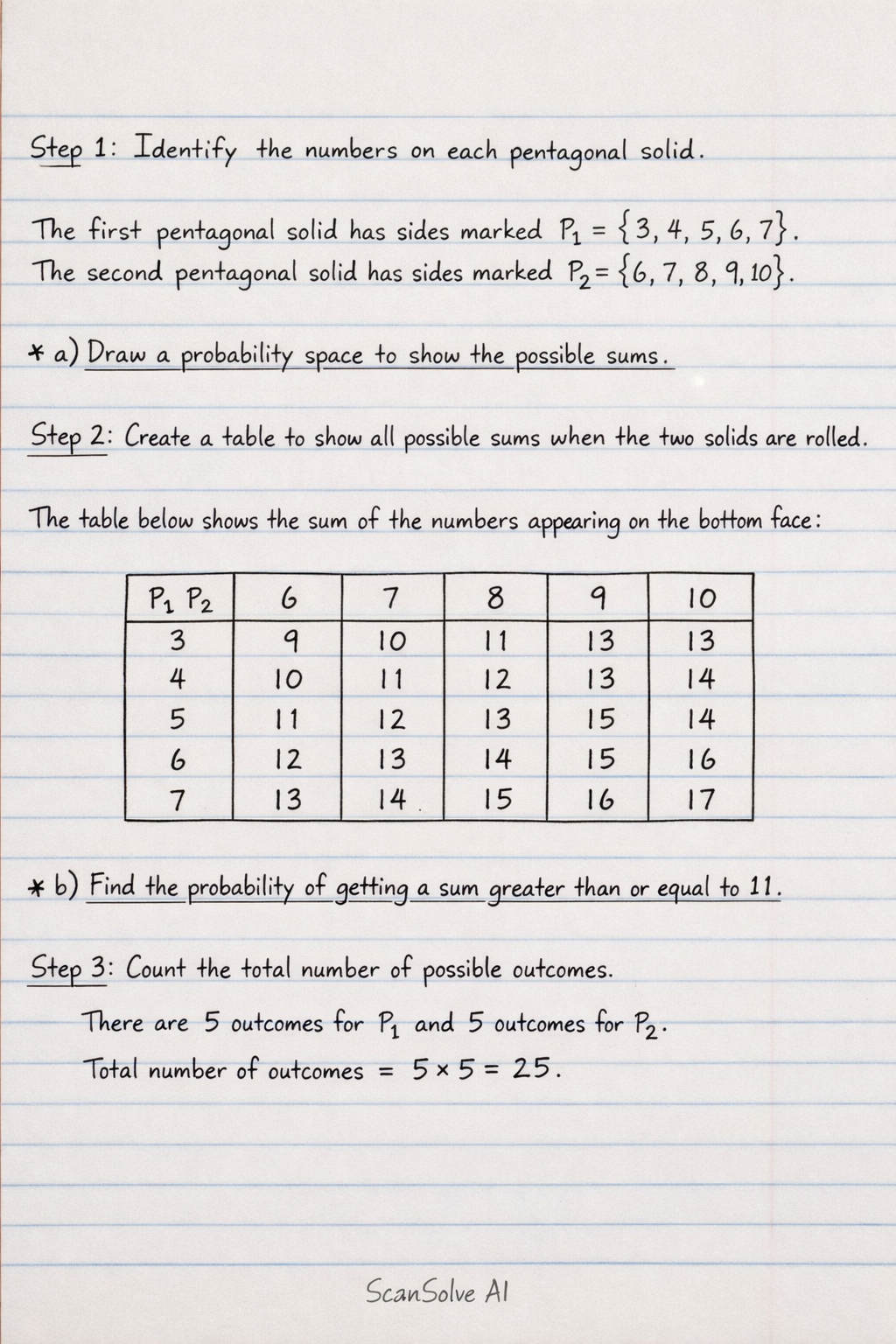
Two pentagonal solids with faces numbered 3-7 and 6-10 are rolled. What is the probability of getting a sum greater than or equal to 11?
ScanSolve AI Answer
Answers
2 partsStep-by-step solution
10 stepsStep 1: Identify the numbers on each pentagonal solid.
The first pentagonal solid has sides marked .
The second pentagonal solid has sides marked .
Part a· 1 step
Draw a probability space to show the possible sums.
Create a table to show all possible sums when the two solids are rolled.
The table below shows the sum of the numbers appearing on the bottom face.
Part b
Find the probability of getting a sum greater than or equal to 11.
Count the total number of possible outcomes.
There are 5 outcomes for and 5 outcomes for .
Total number of outcomes = .Count the number of outcomes where the sum is greater than or equal to 11.
From the table:
- For : Sums are (3 outcomes)
- For : Sums are (4 outcomes)
- For : Sums are (5 outcomes)
- For : Sums are (5 outcomes)
- For : Sums are (5 outcomes) Number of favorable outcomes = .
Calculate the probability.
The probability of getting a sum greater than or equal to 11 is .
Part 12
Identify the given information.
Diameter of the soccer ball = 30 cm.
The ball is placed at a corner of a rectangular room.Calculate the radius of the ball.
Determine the coordinates of the center of the ball.
When the ball is placed in a corner, it touches the three mutually perpendicular planes (floor and two walls). The center of the ball will be at a distance equal to its radius from each of these planes.
If the corner of the room is at the origin $(0,0,0)$, the center of the ball will be at $(r, r, r)$.
So, the center of the ball is at $(15, 15, 15)$.Calculate the distance from the corner of the room to the center of the ball.
Using the distance formula in 3D:
Here, (corner) and (center of ball).
Calculate the shortest distance from the ball to the corner of the room.
The shortest distance from the surface of the ball to the corner is the distance from the center of the ball to the corner minus the radius of the ball.
Using :
Round the answer to 2 significant figures.
The shortest distance of the ball from the corner of the room is .
Try one yourself
A new problem that tests the same skill.
Still stuck on this one?
Ask a follow-up, and the answer starts from this question.
More Mathematics Questions
Handwritten Step-by-Step Solution
Get this as a handwritten image on WhatsApp — like a tutor wrote it for you.
Try on WhatsApp