
We read your photo as:
Two statements p and q are given by p: Comfort studies hard. q: She will pass the examination. Write out the following propositions in simple English. (c) p => q (d) ~p => ~q (e) ~(p => q)
Mathematics
ScanSolve AI Answer
Voici les propositions écrites en anglais simple :
Les énoncés donnés sont :
: Comfort studies hard. (Comfort étudie beaucoup.)
: She will pass the examination. (Elle réussira l'examen.)
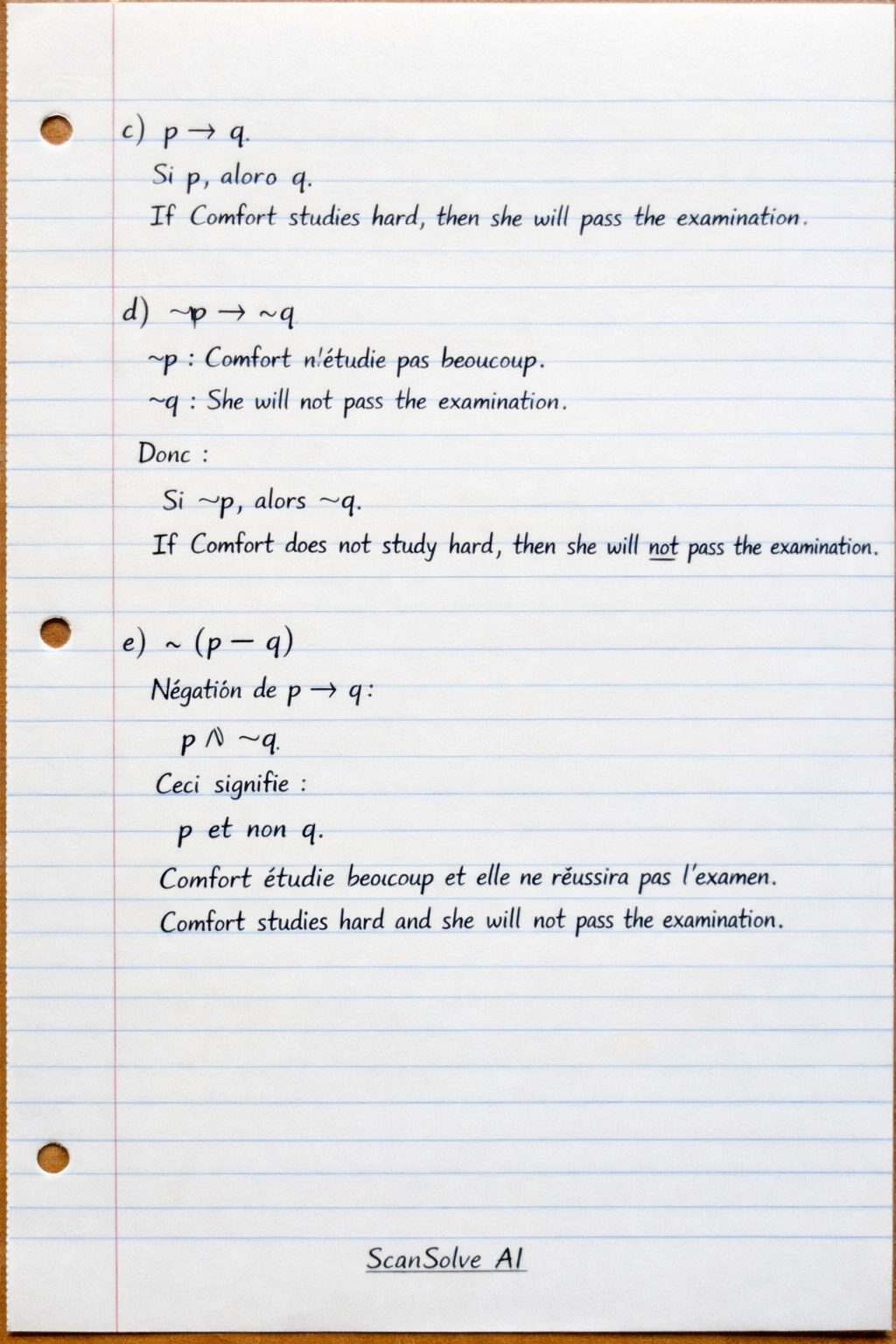
c)
Ceci signifie "si , alors ".
- If Comfort studies hard, then she will pass the examination.
d)
signifie "Comfort does not study hard" (Comfort n'étudie pas beaucoup).
signifie "She will not pass the examination" (Elle ne réussira pas l'examen).
- If Comfort does not study hard, then she will not pass the examination.
e)
La négation d'une implication est logiquement équivalente à .
Ceci signifie " et non ".
- Comfort studies hard and she will not pass the examination.
Was this helpful?
Still stuck on this one?
Ask a follow-up, and the answer starts from this question.
Got a different question?Ask your own question
More Mathematics Questions
QShow that (p q) and p q are logically equivalent.QShow that eg(p o q) and p ext and not q are logically equivalent.QConsider these statements: p: The weather is not cloudy; q: It is not going to rain. If p => q…QGive a reason for each statement: a) Q1 = T, b) Q2 = P2QP(A)=0.12, P(B)=0.18, P(C)=0.25, P(D)=0.45. What is the probability of not landing in D? 39. If p is…
Browse by topic:Discrete Math
Handwritten Step-by-Step Solution
Get this as a handwritten image on WhatsApp — like a tutor wrote it for you.
Try on WhatsApp