
We read your photo as:
Consider these statements: p: The weather is not cloudy; q: It is not going to rain. If p => q, which of the following is a valid conclusion?
Mathematics
ScanSolve AI Answer
Step-by-step solution
3 stepsIdentify the given statements and the implication.
The given statements are:
: The weather is not cloudy.
: It is not going to rain.
The implication is , which means "If the weather is not cloudy, then it is not going to rain."Determine the negations of the statements.
The negation of is : The weather is cloudy.
The negation of is : It is going to rain.Apply the rule of contrapositive.
A valid conclusion from an implication is its contrapositive, which is .
Substituting the statements:
means "If it is going to rain, then the weather is cloudy."A valid conclusion is:
Was this helpful?
Still stuck on this one?
Ask a follow-up, and the answer starts from this question.
Got a different question?Ask your own question
More Mathematics Questions
QTwo statements p and q are given by p: Comfort studies hard. q: She will pass the examination. Write…QWhat is the negation of the compound statement (p q)?QGive a reason for each statement: a) Q1 = T, b) Q2 = P2QP(A)=0.12, P(B)=0.18, P(C)=0.25, P(D)=0.45. What is the probability of not landing in D? 39. If p is…QShow that eg(p o q) and p ext and not q are logically equivalent.
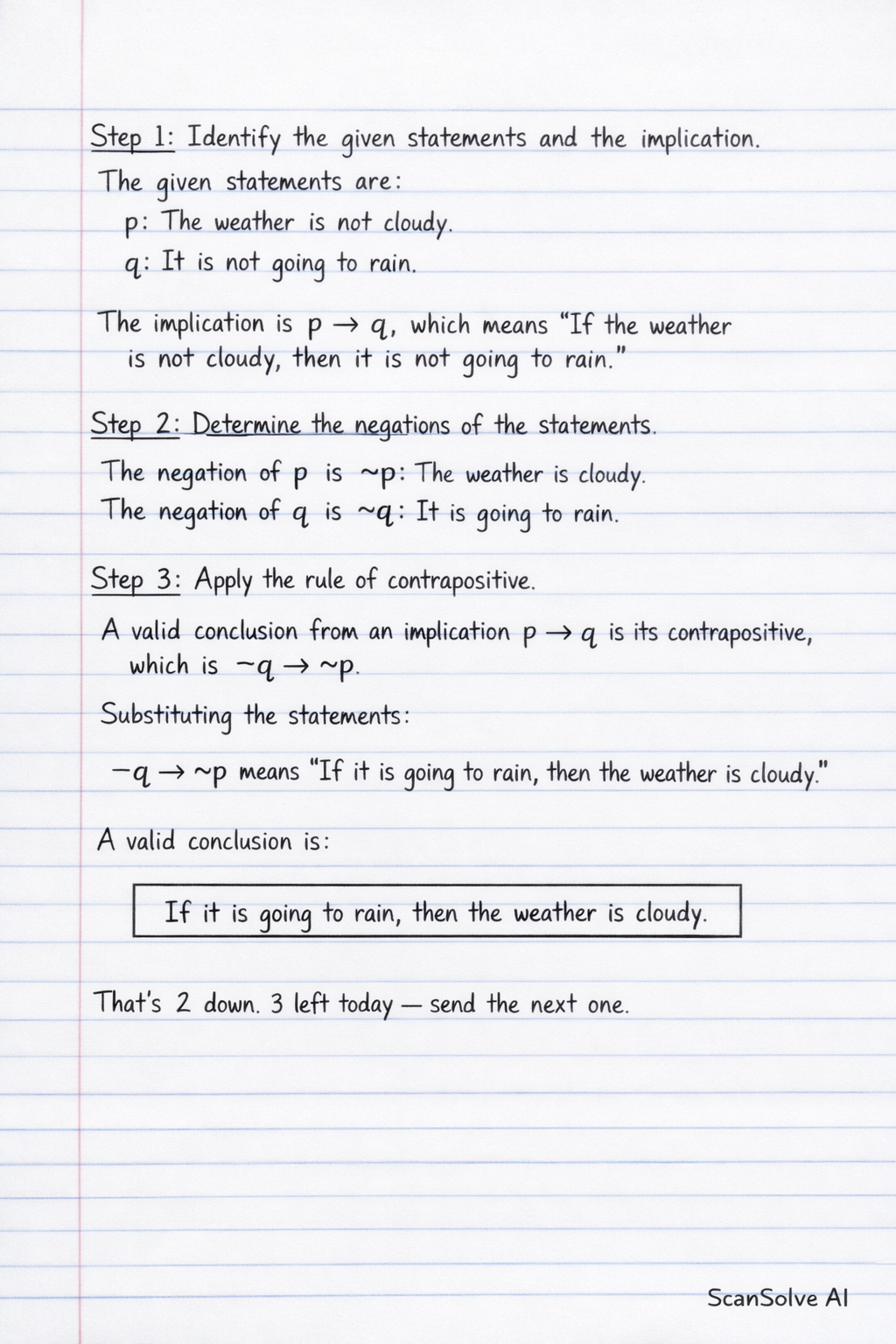
Handwritten Step-by-Step Solution
Get this as a handwritten image on WhatsApp — like a tutor wrote it for you.
Try on WhatsApp