

This biology question covers important biological concepts and processes. The step-by-step explanation below helps you understand the underlying mechanisms and reasoning.
ScanSolve AI Answer
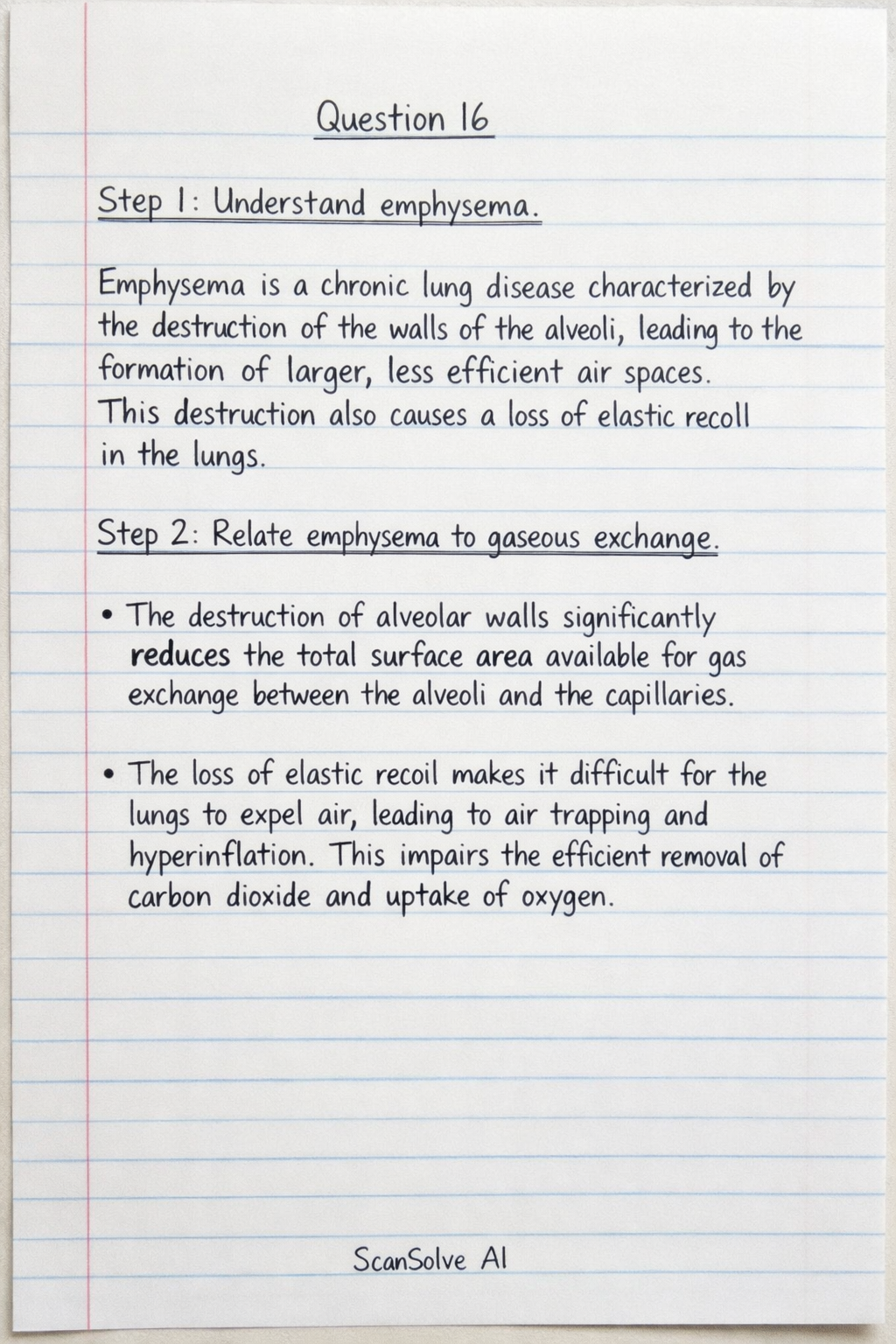
Question 16 Step 1: Understand emphysema. Emphysema is a chronic lung disease characterized by the destruction of the walls of the alveoli, leading to the formation of larger, less efficient air spaces. This destruction also causes a loss of elastic recoil in the lungs. Step 2: Relate emphysema to gaseous exchange. The destruction of alveolar walls significantly reduces the total surface area* available for gas exchange between the alveoli and the capillaries. The loss of elastic recoil* makes it difficult for the lungs to expel air, leading to air trapping and hyperinflation. This impairs the efficient removal of carbon dioxide and uptake of oxygen. Step 3: Evaluate the options. a) Increased alveolar surface area: This is incorrect; emphysema causes a decrease* in alveolar surface area. b) Loss of elastic recoil and destruction of alveolar walls: This accurately describes the primary pathological changes in emphysema that lead to impaired gas exchange. The destruction of alveolar walls directly reduces the surface area, and the loss of elastic recoil impairs ventilation. c) Increased thickness of the respiratory membrane: While some inflammation may occur, the primary structural change in emphysema is destruction, not thickening, of the alveolar walls. d) Excess surfactant production: This is incorrect; surfactant production is not typically in excess in emphysema. Answer: Loss of elastic recoil and destruction of alveolar walls (b) b Question 17 Step 1: Define physiological dead space. Physiological dead space is the portion of the tidal volume that does not participate in gas exchange. It includes anatomical dead space (air in the conducting airways) and alveolar dead space (ventilated alveoli that are not perfused with blood). Step 2: Understand COPD and its effect on dead space. In chronic obstructive pulmonary disease (COPD), particularly emphysema, there is destruction of alveolar walls and associated capillaries. This leads to areas of the lung that are ventilated but poorly or not perfused, creating an uneven ventilation-perfusion (V/Q) ratio. These ventilated but unperfused areas contribute to increased alveolar dead space, thereby elevating the total physiological dead space. Step 3: Evaluate the options. a) Increased tidal volume: While tidal volume can be altered in COPD, it is not the direct cause of increased physiological dead space. b) Reduced anatomical dead space: Anatomical dead space is generally not reduced in COPD. c) Uneven ventilation and perfusion: This is a hallmark of COPD and directly leads to increased physiological dead space due to V/Q mismatch. d) Increased hemoglobin concentration: This can be a compensatory response to chronic hypoxemia in COPD but does not cause increased dead space. Answer: Uneven ventilation and perfusion (c) c Question 18 Step 1: Understand cardiogenic shock. Cardiogenic shock is a condition where the heart's ability to pump blood is severely impaired, leading to a significant reduction in cardiac output. Step 2: Relate cardiogenic shock to dead space ventilation. Reduced cardiac output means less blood is pumped to the pulmonary circulation. This results in reduced pulmonary capillary perfusion. If alveoli are ventilated but receive insufficient blood flow, they cannot participate in gas exchange and become alveolar dead space. Therefore, dead space ventilation increases. Step 3: Evaluate the options. a) Reduced pulmonary capillary perfusion: This is a direct consequence of reduced cardiac output in cardiogenic shock and leads to increased alveolar dead space. b) Reduced alveolar ventilation: While overall ventilation might be affected, the increase in dead space ventilation* is specifically due to the perfusion deficit. c) Increased anatomical airway length: This is not a feature of cardiogenic shock. d) Increased oxygen consumption: While metabolic demands can change, this is not the direct cause of increased dead space ventilation. Answer: Reduced pulmonary capillary perfusion (a) a Question 19 The options for Question 19 are not visible in the provided image. Therefore, the question cannot be answered completely.