
We read your photo as:
Calculate the upper quartile of car speeds and the number of cars exceeding 35 km/h using the provided cumulative frequency data.
ScanSolve AI Answer
Step-by-step solution
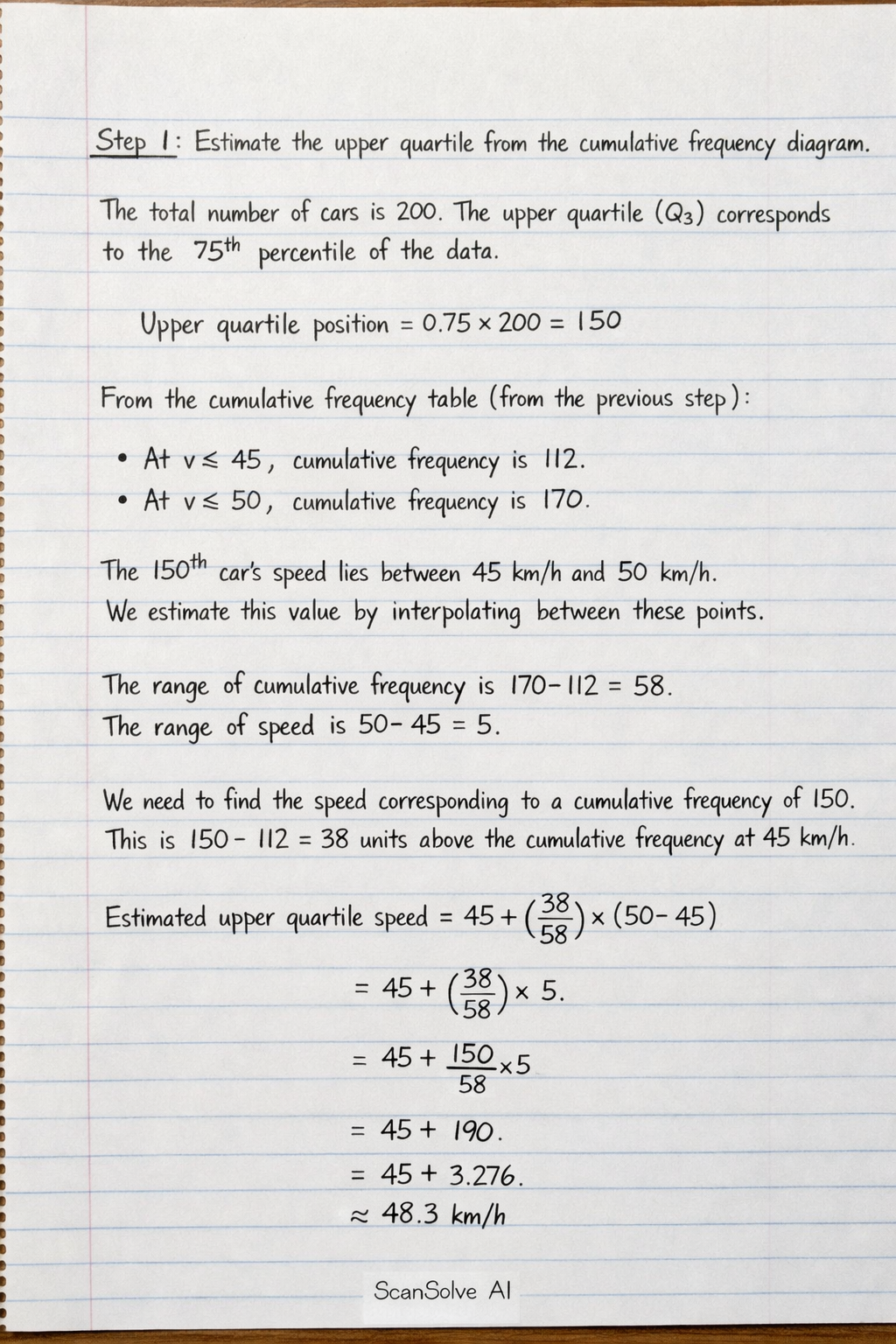
3 stepsEstimate the upper quartile from the cumulative frequency diagram.
The total number of cars is 200. The upper quartile (Q3) corresponds to the percentile of the data.
From the cumulative frequency table (from the previous step):
- At , cumulative frequency is 112.
- At , cumulative frequency is 170. The car's speed lies between 45 km/h and 50 km/h. We estimate this value by interpolating between these points. The range of cumulative frequency is . The range of speed is . We need to find the speed corresponding to a cumulative frequency of 150. This is units above the cumulative frequency at 45 km/h.
Estimate the number of cars with a speed greater than 35 km/h.
First, find the cumulative frequency at 35 km/h from the diagram.
From the cumulative frequency table:- At , cumulative frequency is 16.
- At , cumulative frequency is 50. The speed 35 km/h lies between 20 km/h and 40 km/h. We estimate the cumulative frequency by interpolating. The range of speed is . The range of cumulative frequency is . We need to find the cumulative frequency at 35 km/h. This is units above 20 km/h.
This means approximately 41.5 cars have a speed less than or equal to 35 km/h. The number of cars with a speed greater than 35 km/h is the total number of cars minus the number of cars with speed less than or equal to 35 km/h.
Since the number of cars must be an integer, we round this to the nearest whole number.
Find the probability that two randomly chosen cars both have a speed greater than 50 km/h.
First, determine the number of cars with a speed greater than 50 km/h.
From the cumulative frequency table, the cumulative frequency for is 170.
So, the number of cars with speed km/h is .
The probability that the first car chosen has a speed greater than 50 km/h is:After choosing one such car, there are 29 cars left with a speed greater than 50 km/h, and 199 total cars remaining.
The probability that the second car chosen also has a speed greater than 50 km/h (given the first did) is:The probability that both cars have a speed greater than 50 km/h is the product of these probabilities:
Rounding to 3 significant figures:
b)
iii)
a) The upper quartile is . (Estimated from interpolation)
b) The number of cars with a speed greater than 35 km/h is . (Estimated from interpolation)
c) The probability that they both have a speed greater than 50 km/h is .
Still stuck on this one?
Ask a follow-up, and the answer starts from this question.
More Mathematics Questions
Handwritten Step-by-Step Solution
Get this as a handwritten image on WhatsApp — like a tutor wrote it for you.
Try on WhatsApp