We read your photo as:

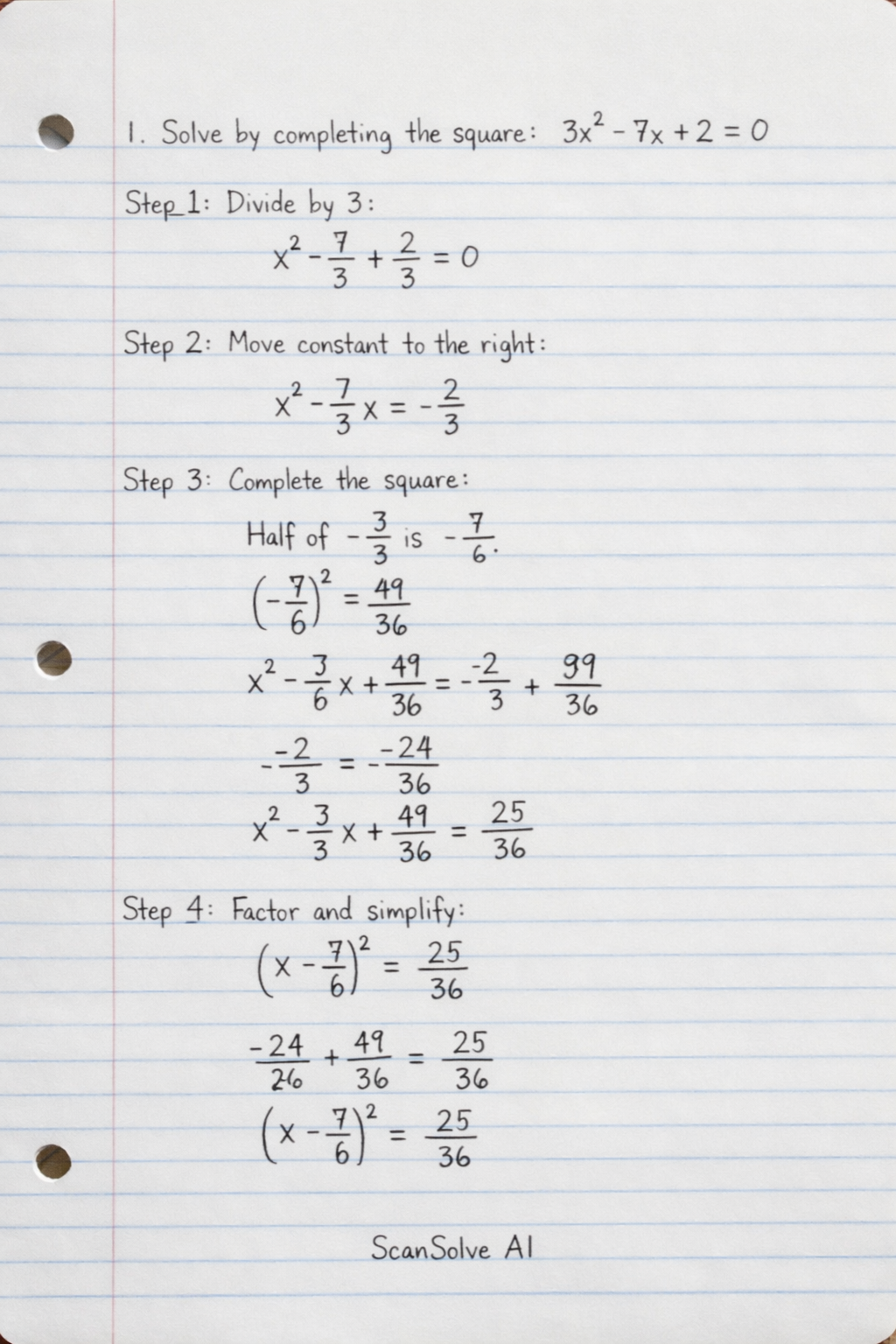
Use completing square method to solve the equation, 3x2 − 7x + 2 = 0.

Mathematics

ScanSolve AI Answer

Step-by-step solution

20 steps

Here are the solutions to the problems:

1. Use completing square method to solve the equation, 3x2−7x+2=03x^2 - 7x + 2 = 0.

  1. Divide the entire equation by the coefficient of x2x^2, which is 3.

    x2−73x+23=0x^2 - \frac{7}{3}x + \frac{2}{3} = 0
  2. Move the constant term to the right side of the equation.

    x2−73x=−23x^2 - \frac{7}{3}x = -\frac{2}{3}
  3. Complete the square on the left side.

    Take half of the coefficient of xx, square it, and add it to both sides.
    The coefficient of xx is −73-\frac{7}{3}. Half of it is −76-\frac{7}{6}. Squaring it gives (−76)2=4936(-\frac{7}{6})^2 = \frac{49}{36}.

    x2−73x+4936=−23+4936x^2 - \frac{7}{3}x + \frac{49}{36} = -\frac{2}{3} + \frac{49}{36}
  4. Factor the left side as a perfect square and simplify the right side.

    (x−76)2=−2×123×12+4936\left(x - \frac{7}{6}\right)^2 = -\frac{2 \times 12}{3 \times 12} + \frac{49}{36} (x−76)2=−2436+4936\left(x - \frac{7}{6}\right)^2 = -\frac{24}{36} + \frac{49}{36} (x−76)2=2536\left(x - \frac{7}{6}\right)^2 = \frac{25}{36}
  5. Take the square root of both sides.

    x−76=±2536x - \frac{7}{6} = \pm\sqrt{\frac{25}{36}} x−76=±56x - \frac{7}{6} = \pm\frac{5}{6}
  6. Solve for xx.

    x=76±56x = \frac{7}{6} \pm \frac{5}{6}

    For the positive root:

    x1=76+56=126=2x_1 = \frac{7}{6} + \frac{5}{6} = \frac{12}{6} = 2

    For the negative root:

    x2=76−56=26=13x_2 = \frac{7}{6} - \frac{5}{6} = \frac{2}{6} = \frac{1}{3}

    The solutions are x=2 or x=13\boxed{x=2 \text{ or } x=\frac{1}{3}}.

    2. Solve for xx, (23)2x×36x=64(\frac{2}{3})^{2x} \times 36^x = 64.

  7. Express all bases as powers of prime numbers or common bases.

    (23)2x×(62)x=26\left(\frac{2}{3}\right)^{2x} \times (6^2)^x = 2^6 (23)2x×62x=26\left(\frac{2}{3}\right)^{2x} \times 6^{2x} = 2^6
  8. Rewrite 62x6^{2x} as (2×3)2x(2 \times 3)^{2x} and apply the exponent to each factor.

    (23)2x×(2×3)2x=26\left(\frac{2}{3}\right)^{2x} \times (2 \times 3)^{2x} = 2^6 (23)2x×22x×32x=26\left(\frac{2}{3}\right)^{2x} \times 2^{2x} \times 3^{2x} = 2^6
  9. Distribute the exponent $2x$ in the first term.

    22x32x×22x×32x=26\frac{2^{2x}}{3^{2x}} \times 2^{2x} \times 3^{2x} = 2^6
  10. Cancel out the 32x3^{2x} terms.

    22x×22x=262^{2x} \times 2^{2x} = 2^6
  11. Use the exponent rule am×an=am+na^m \times a^n = a^{m+n}.

    22x+2x=262^{2x+2x} = 2^6 24x=262^{4x} = 2^6
  12. Since the bases are equal, equate the exponents and solve for xx.

    4x=64x = 6 x=64x = \frac{6}{4} x=32x = \frac{3}{2}

    The solution is x=32\boxed{x=\frac{3}{2}}.

    3. The figure below shows a triangle PQR given that PQ = PR = 12cm, TR = 4cm, ST = 6cm and ST is parallel to QR. Calculate the perimeter of the quadrilateral QRTS.

  13. Identify the given lengths and properties.

    PQ=12PQ = 12 cm
    PR=12PR = 12 cm
    TR=4TR = 4 cm
    ST=6ST = 6 cm
    ST∥QRST \parallel QR

  14. Determine the length of PTPT.

    Since PR=PT+TRPR = PT + TR, we have:

    12 cm=PT+4 cm12 \text{ cm} = PT + 4 \text{ cm} PT=12−4=8 cmPT = 12 - 4 = 8 \text{ cm}
  15. Use the property of similar triangles.

    Since ST∥QRST \parallel QR, triangle PSTPST is similar to triangle PQRPQR (△PST∼△PQR\triangle PST \sim \triangle PQR).
    The ratio of corresponding sides is equal:

    PSPQ=PTPR=STQR\frac{PS}{PQ} = \frac{PT}{PR} = \frac{ST}{QR}
  16. Calculate the ratio PTPR\frac{PT}{PR}.

    PTPR=8 cm12 cm=23\frac{PT}{PR} = \frac{8 \text{ cm}}{12 \text{ cm}} = \frac{2}{3}
  17. Find the length of PSPS using the ratio.

    PSPQ=23\frac{PS}{PQ} = \frac{2}{3} PS12 cm=23\frac{PS}{12 \text{ cm}} = \frac{2}{3} PS=23×12 cm=8 cmPS = \frac{2}{3} \times 12 \text{ cm} = 8 \text{ cm}
  18. Find the length of SQSQ.

    Since PQ=PS+SQPQ = PS + SQ, we have:

    12 cm=8 cm+SQ12 \text{ cm} = 8 \text{ cm} + SQ SQ=12−8=4 cmSQ = 12 - 8 = 4 \text{ cm}
  19. Find the length of QRQR using the ratio.

    STQR=23\frac{ST}{QR} = \frac{2}{3} 6 cmQR=23\frac{6 \text{ cm}}{QR} = \frac{2}{3} 2×QR=6 cm×32 \times QR = 6 \text{ cm} \times 3 2QR=18 cm2 QR = 18 \text{ cm} QR=182=9 cmQR = \frac{18}{2} = 9 \text{ cm}
  20. Calculate the perimeter of the quadrilateral QRTSQRTS.

    The perimeter is the sum of its sides: QR+RT+TS+SQQR + RT + TS + SQ.

    Perimeter=9 cm+4 cm+6 cm+4 cm\text{Perimeter} = 9 \text{ cm} + 4 \text{ cm} + 6 \text{ cm} + 4 \text{ cm} Perimeter=23 cm\text{Perimeter} = 23 \text{ cm}

    The perimeter of quadrilateral QRTS is 23 cm\boxed{23 \text{ cm}}.

Was this helpful?

Still stuck on this one?

Ask a follow-up, and the answer starts from this question.

Got a different question?Ask your own question
Handwritten step-by-step solution preview

Handwritten Step-by-Step Solution

Get this as a handwritten image on WhatsApp — like a tutor wrote it for you.

Try on WhatsApp