This mathematics problem involves applying core mathematical principles and formulas. Below you will find a complete step-by-step solution with detailed explanations for each step, helping you understand not just the answer but the method behind it.
ScanSolve AI Answer
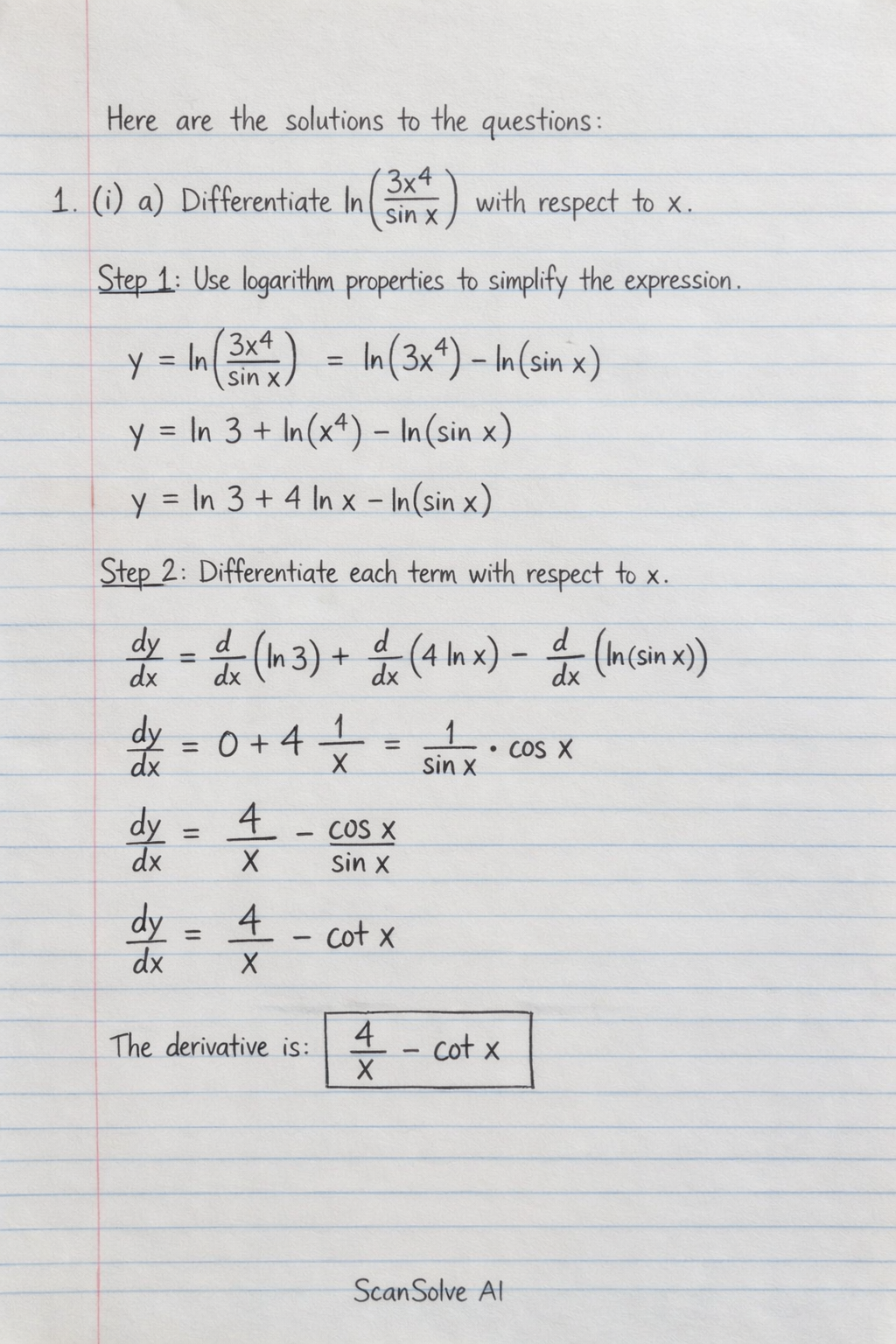
Here are the solutions to the questions:
1. (i) a) Differentiate $\ln\left(\frac{3x^4}{\sin x}\right)$ with respect to $x$.
Step 1: Use logarithm properties to simplify the expression.
$$y = \ln\left(\frac{3x^4}{\sin x}\right) = \ln(3x^4) - \ln(\sin x)$$
$$y = \ln 3 + \ln(x^4) - \ln(\sin x)$$
$$y = \ln 3 + 4\ln x - \ln(\sin x)$$
Step 2: Differentiate each term with respect to $x$.
$$\frac{dy}{dx} = \frac{d}{dx}(\ln 3) + \frac{d}{dx}(4\ln x) - \frac{d}{dx}(\ln(\sin x))$$
$$\frac{dy}{dx} = 0 + 4\left(\frac{1}{x}\right) - \left(\frac{1}{\sin x} \cdot \cos x\right)$$
$$\frac{dy}{dx} = \frac{4}{x} - \frac{\cos x}{\sin x}$$
$$\frac{dy}{dx} = \frac{4}{x} - \cot x$$
The derivative is $\boxed{\frac{4}{x} - \cot x}$.
1. (i) b) A curve is defined parametrically by $x = t^3$, $y = t\left(1 - \frac{1}{4}t^3\right)$. Find the equation of the tangent to the curve at the point where $t = -1$.
Step 1: Find the coordinates $(x_0, y_0)$ of the point of tangency when $t = -1$.
$$x_0 = (-1)^3 = -1$$
$$y_0 = (-1)\left(1 - \frac{1}{4}(-1)^3\right) = (-1)\left(1 - \frac{1}{4}(-1)\right) = (-1)\left(1 + \frac{1}{4}\right) = (-1)\left(\frac{5}{4}\right) = -\frac{5}{4}$$
The point is $\left(-1, -\frac{5}{4}\right)$.
Step 2: Find $\frac{dx}{dt}$ and $\frac{dy}{dt}$.
$$x = t^3 \implies \frac{dx}{dt} = 3t^2$$
$$y = t - \frac{1}{4}t^4 \implies \frac{dy}{dt} = 1 - \frac{1}{4}(4t^3) = 1 - t^3$$
Step 3: Find the gradient $\frac{dy}{dx}$ using the chain rule $\frac{dy}{dx} = \frac{dy/dt}{dx/dt}$.
$$\frac{dy}{dx} = \frac{1 - t^3}{3t^2}$$
Step 4: Evaluate the gradient at $t = -1$.
$$m = \left.\frac{dy}{dx}\right|_{t=-1} = \frac{1 - (-1)^3}{3(-1)^2} = \frac{1 - (-1)}{3(1)} = \frac{1+1}{3} = \frac{2}{3}$$
Step 5: Use the point-slope form of a line $y - y_0 = m(x - x_0)$.
$$y - \left(-\frac{5}{4}\right) = \frac{2}{3}(x - (-1))$$
$$y + \frac{5}{4} = \frac{2}{3}(x + 1)$$
Step 6: Clear denominators and rearrange into general form. Multiply by 12:
$$12\left(y + \frac{5}{4}\right) = 12\left(\frac{2}{3}(x + 1)\right)$$
$$12y + 15 = 8(x + 1)$$
$$12y + 15 = 8x + 8$$
$$8x - 12y + 8 - 15 = 0$$
$$8x - 12y - 7 = 0$$
The equation of the tangent is $\boxed{8x - 12y - 7 = 0}$.
1. (ii) a) Resolve $\frac{6}{(1+2x)(3-x)}$ into partial fractions.
Step 1: Set up the partial fraction decomposition.
$$\frac{6}{(1+2x)(3-x)} = \frac{A}{1+2x} + \frac{B}{3-x}$$
Step 2: Multiply both sides by $(1+2x)(3-x)$ to clear denominators
Use logarithm properties to simplify the expression.
|Mathematics
Use logarithm properties to simplify the expression.
ScanSolve AI Answer
Here are the solutions to the questions:
1. (i) a) Differentiate ln(sinx3x4) with respect to x.
Step 1: Use logarithm properties to simplify the expression.
y=ln(sinx3x4)=ln(3x4)−ln(sinx)y=ln3+ln(x4)−ln(sinx)y=ln3+4lnx−ln(sinx)
Step 2: Differentiate each term with respect to x.
dxdy=dxd(ln3)+dxd(4lnx)−dxd(ln(sinx))dxdy=0+4(x1)−(sinx1⋅cosx)dxdy=x4−sinxcosxdxdy=x4−cotx
The derivative is x4−cotx.
1. (i) b) A curve is defined parametrically by x=t3, y=t(1−41t3). Find the equation of the tangent to the curve at the point where t=−1.
Step 1: Find the coordinates (x0,y0) of the point of tangency when t=−1.
x0=(−1)3=−1y0=(−1)(1−41(−1)3)=(−1)(1−41(−1))=(−1)(1+41)=(−1)(45)=−45
The point is (−1,−45).
Step 2: Find dtdx and dtdy.
x=t3⟹dtdx=3t2y=t−41t4⟹dtdy=1−41(4t3)=1−t3
Step 3: Find the gradient dxdy using the chain rule dxdy=dx/dtdy/dt.
dxdy=3t21−t3
Step 4: Evaluate the gradient at t=−1.
m=dxdyt=−1=3(−1)21−(−1)3=3(1)1−(−1)=31+1=32
Step 5: Use the point-slope form of a line y−y0=m(x−x0).
y−(−45)=32(x−(−1))y+45=32(x+1)
Step 6: Clear denominators and rearrange into general form. Multiply by 12:
12(y+45)=12(32(x+1))12y+15=8(x+1)12y+15=8x+88x−12y+8−15=08x−12y−7=0
The equation of the tangent is 8x−12y−7=0.
1. (ii) a) Resolve (1+2x)(3−x)6 into partial fractions.
Step 1: Set up the partial fraction decomposition.
(1+2x)(3−x)6=1+2xA+3−xB
Step 2: Multiply both sides by (1+2x)(3−x) to clear denominators
Need help with your own homework?
Get instant step-by-step solutions to any question. Free to start.