
We read your photo as:
Use TABLE 2 above to match the definitions with the terminology below.
ScanSolve AI Answer
Step-by-step solution
4 stepsSort the data set.
The data set from the previous question, representing the amount of time spent (in minutes) by 32 customers, is:
18, 25, 30, 15, 12, 28, 35, 22, 10, 40, 17, 20, 23, 32, 27, 19
21, 26, 31, 16, 13, 29, 36, 24, 11, 41, 18, 21, 24, 33, 28, 20Sorted data (n=32):
10, 11, 12, 13, 15, 16, 17, 18, 18, 19, 20, 20, 21, 21, 22, 23, 24, 24, 25, 26, 27, 28, 28, 29, 30, 31, 32, 33, 35, 36, 40, 41Calculate the percentage of quick shoppers (1.2.3).
Quick shoppers are customers who spent 20 minutes or less.
From the sorted data, the values are: 10, 11, 12, 13, 15, 16, 17, 18, 18, 19, 20, 20.
There are 12 quick shoppers.
Total number of customers = 32.Identify an outlier in the data set (1.2.4).
To identify an outlier, we can use the 2-standard deviation rule.
First, calculate the mean () and standard deviation ().
Sum of all values () = 752
Number of values (n) = 32The sum of squared differences from the mean () = 2218 (calculated in thought process).
Outliers are typically values that fall outside the range of .
Lower bound =
Upper bound =
Any value less than 6.584 or greater than 40.416 is considered an outlier.
Looking at the sorted data, the value 41 is greater than 40.416.
The outlier is .Match the definitions with the terminology (1.3).
Using TABLE 2: TERMINOLOGY USED IN MATHEMATICAL LITERACY.
- 1.3.1 Mode: Value or values appearing most often in a data set. This matches definition G.
- 1.3.2 50%: The even chance probability. This matches definition F.
- 1.3.3 Median: Middle value in an ordered data set. This matches definition A.
- 1.3.4 Mean: Sum of all values divided by the number of values. This matches definition B.
- 1.3.5 IQR (Interquartile Range): The spread of the middle 50% of the data. This matches definition C.
- 1.3.6 Breakeven point: The income received from the item sold and the cost price of the item are the same. This matches definition E.
The matches are:
1.3.1
1.3.2
1.3.3
1.3.4
1.3.5
1.3.6
Still stuck on this one?
Ask a follow-up, and the answer starts from this question.
More Mathematics Questions
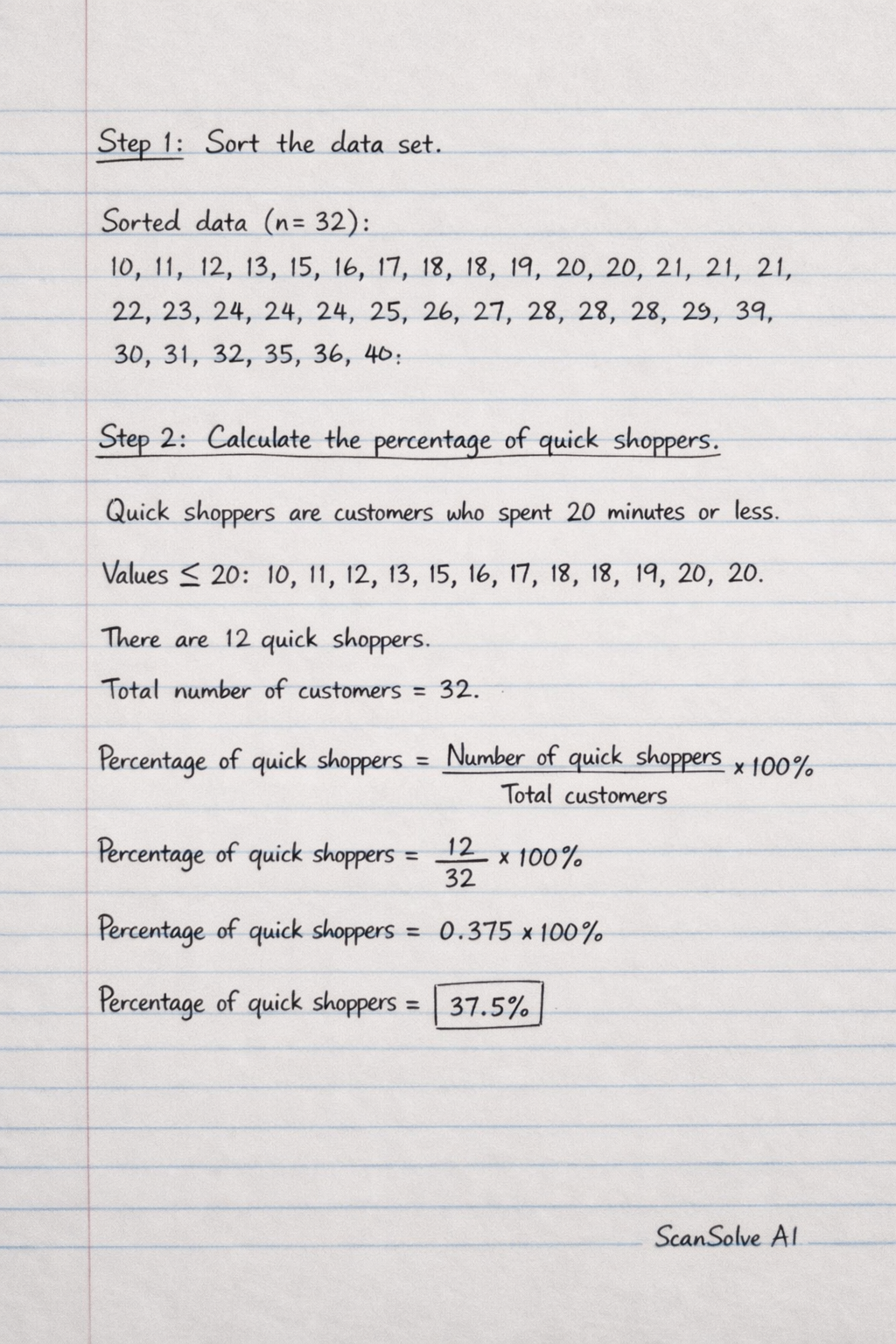
Handwritten Step-by-Step Solution
Get this as a handwritten image on WhatsApp — like a tutor wrote it for you.
Try on WhatsApp