
We read your photo as:
Use the associative property to solve the following equations: a) [(-6) + (4 + 2)], b) [3 + 7 + (-5)], c) [(6 + 4) + (-2)], d) [(-3) + 7 + 5], e) [(-4) + (6 + 2)], f) [3 + (-7) + 5]
Mathematics
ScanSolve AI Answer
Step-by-step solution
30 stepsHere are the calculations using the associative property:
Part a· 3 steps
Apply the associative property to regroup the terms.
Perform the addition inside the first parenthesis.
Perform the final addition.
Part b· 3 steps
Apply the associative property to regroup the terms.
Perform the addition inside the parenthesis.
Perform the final addition.
Part c· 3 steps
Apply the associative property to regroup the terms.
Perform the addition inside the parenthesis.
Perform the final addition.
Part d· 3 steps
Apply the associative property to regroup the terms.
Perform the addition inside the parenthesis.
Perform the final addition.
Part e· 3 steps
Apply the associative property to regroup the terms.
Perform the addition inside the first parenthesis.
Perform the final addition.
Part f· 3 steps
Apply the associative property to regroup the terms.
Perform the addition inside the parenthesis.
Perform the final addition.
Part g· 3 steps
Apply the associative property to regroup the terms.
Perform the addition inside the first parenthesis.
Perform the final addition.
Part h· 3 steps
Apply the associative property to regroup the terms.
Perform the addition inside the parenthesis.
Perform the final addition.
Part h(i)· 6 steps
Apply the associative property to regroup the terms.
Perform the addition inside the first parenthesis.
Perform the final addition.
*j)
Apply the associative property to regroup the terms.
Perform the addition inside the first parenthesis.
Perform the final addition.
Was this helpful?
Still stuck on this one?
Ask a follow-up, and the answer starts from this question.
Got a different question?Ask your own question
More Mathematics Questions
QUse the associative property to calculate the following: a) [(−6) + (4 + 2)] b) [3 + 7 + (−5)] c)…QUse the associative property to evaluate the following expressions: a) [(−6) + (4 + 2)] b) [3 + 7…QApply the associative property of addition to solve for the final value in the following problems…QSolve the following arithmetic expressions: a) −6 + (4 + 2) b) 3 + 7 + (−5) c) −2 + (6 + 4) d) −3…QEvaluate the following expressions: a) −4(2+1) b) −5(3+6) c) 4(−2+1) d) 5(−3+6) e) 4(2+−1) f)…
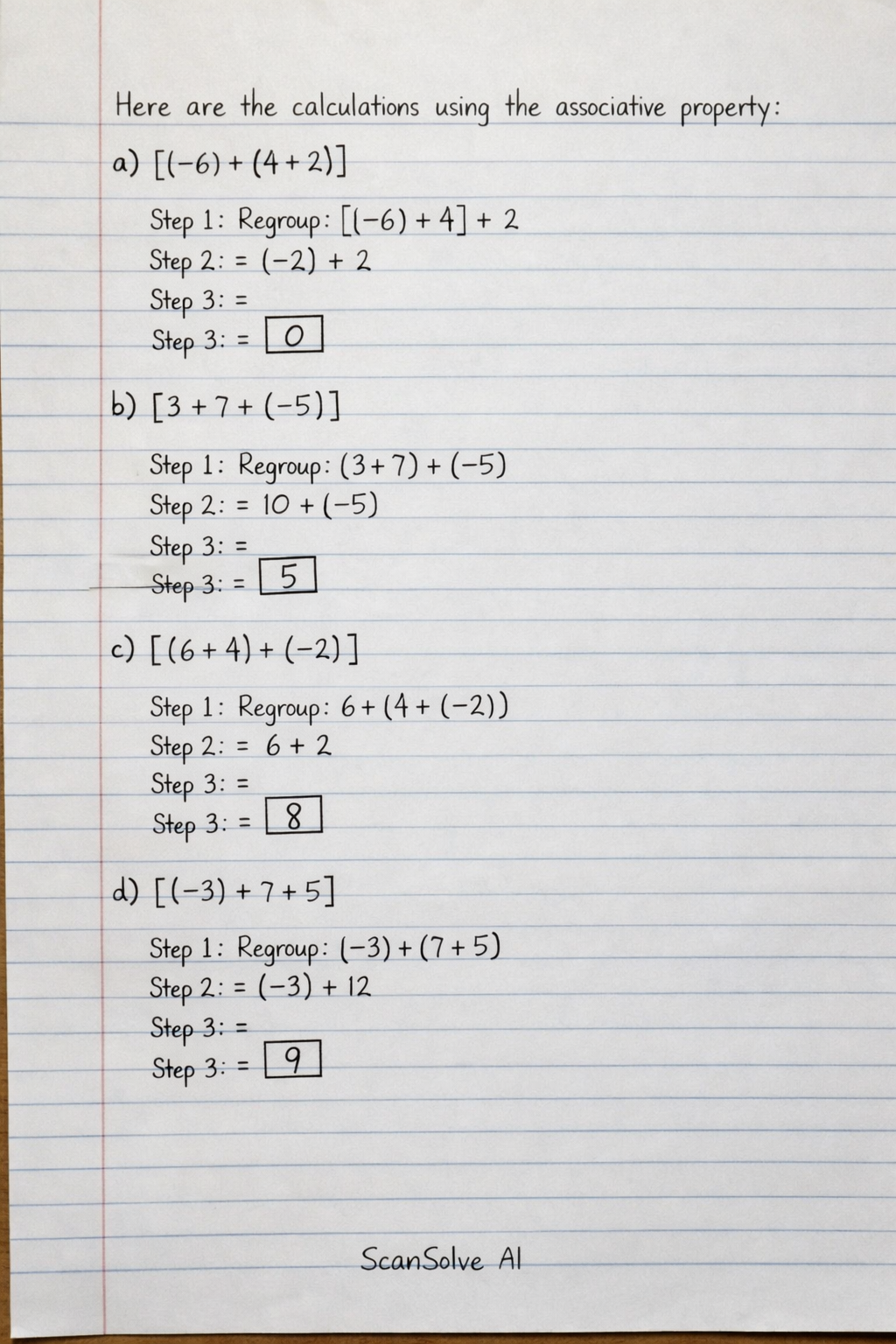
Handwritten Step-by-Step Solution
Get this as a handwritten image on WhatsApp — like a tutor wrote it for you.
Try on WhatsApp