
We read your photo as:
Use the example below to answer questions 26 - 29:
ScanSolve AI Answer
Answer
Step-by-step solution
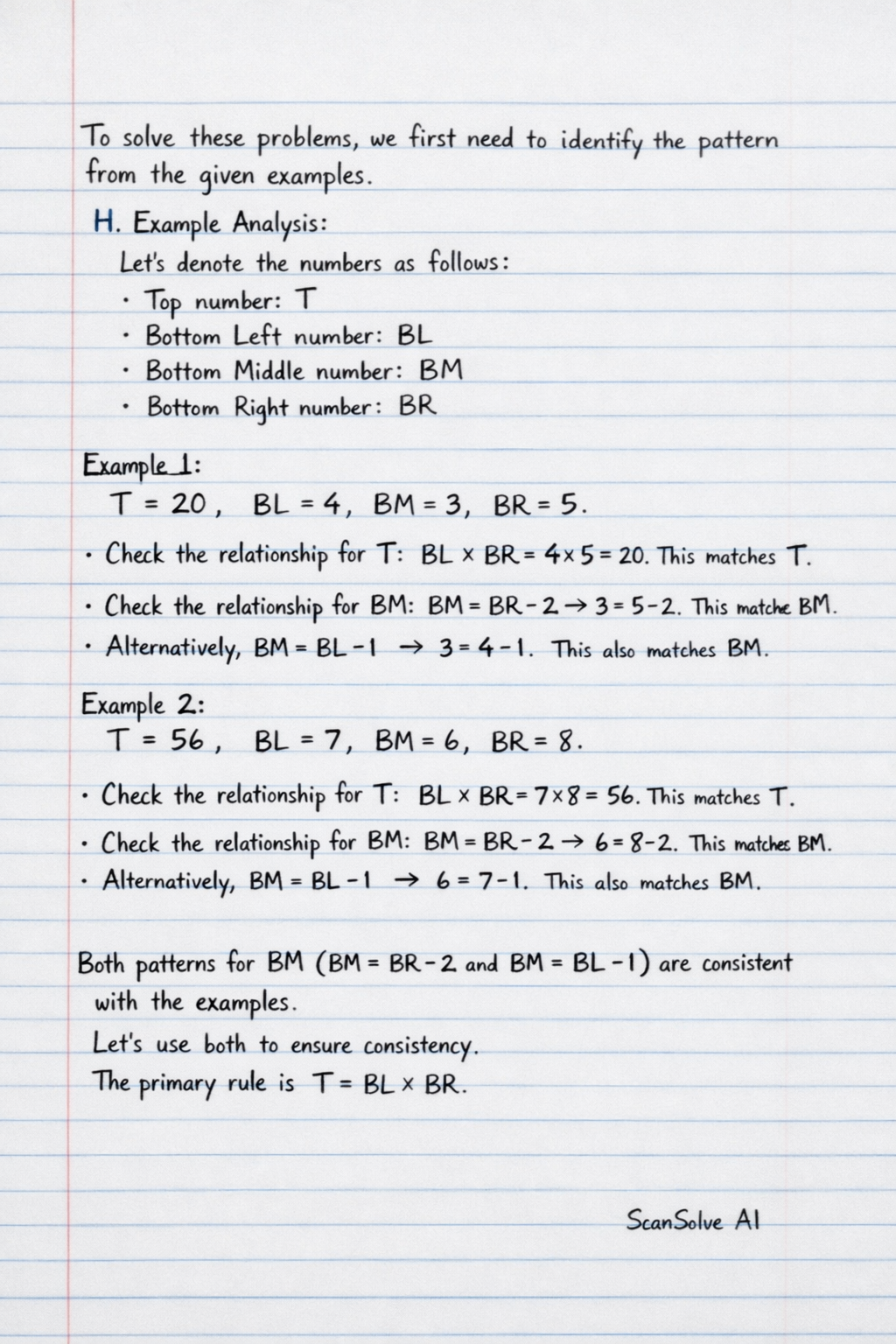
4 stepsTo solve these problems, we first need to identify the pattern from the given examples.
H. Example Analysis:
Let's denote the numbers as follows:
- Top number:
- Bottom Left number:
- Bottom Middle number:
- Bottom Right number:
Example 1:
, , , .
- Check the relationship for : . This matches .
- Check the relationship for : . This matches .
- Alternatively, . This also matches .
Example 2:
, , , .
- Check the relationship for : . This matches .
- Check the relationship for : . This matches .
- Alternatively, . This also matches .
Both patterns for ( and ) are consistent with the examples. Let's use both to ensure consistency. The primary rule is .
Solve Question 26
Given: , , . Find .
Using the rule :Let's verify with the rule: . This is consistent.
Also, . This is also consistent.
The missing number is 6.
The correct option is B.Solve Question 27
Given: , , . Find .
Using the rule :Let's verify with the rule: . This is consistent.
Also, . This is also consistent.
The missing number is 4.
The correct option is C.Solve Question 28
Given: , . Find .
First, find using the rule: :This is consistent.
Now, find using :Now, use the rule :
The missing number is 2.
The correct option is C.Solve Question 29
Given: , , . Find .
First, verify the rule: . This is consistent.
Now, find using the rule :Alternatively, find using the rule :
Both patterns consistently lead to .
However, the provided options for question 29 are A. 1, B. 4, C. 6, D. 8, E. 9. The calculated answer 7 is not among the options. This indicates a potential error in the question or the provided options. Since I must choose from the given options, and 7 is not available, I cannot provide a definitive answer from the choices based on the established pattern.Given the constraint to select an option, and the clear pattern leading to 7, there might be a misinterpretation or a flaw in the question's options. If forced to choose, and assuming there's a slight deviation or a different, less obvious pattern, it's impossible to determine without further information. However, based on the consistent pattern derived from the examples, the answer is 7. Since 7 is not an option, I cannot select a correct option.
Let's assume there's a typo in the question and the question mark was meant to be at the top, then the answer would be . But it's clearly at the middle bottom.
If the question intended for the middle number to be a distractor, then its value cannot be determined. But the question asks for it.Given the strict instructions to select an option, and the derived answer 7 not being present, I will state that the derived answer is 7 and that it is not among the options.
The missing number is 7. As 7 is not among the given options (A. 1, B. 4, C. 6, D. 8, E. 9), there might be an error in the question or the options provided.
Try one yourself
A new problem that tests the same skill.
Still stuck on this one?
Ask a follow-up, and the answer starts from this question.
More Mathematics Questions
Handwritten Step-by-Step Solution
Get this as a handwritten image on WhatsApp — like a tutor wrote it for you.
Try on WhatsApp