
We read your photo as:
Use the above samples to answer questions 49-50
ScanSolve AI Answer
Answer
Step-by-step solution
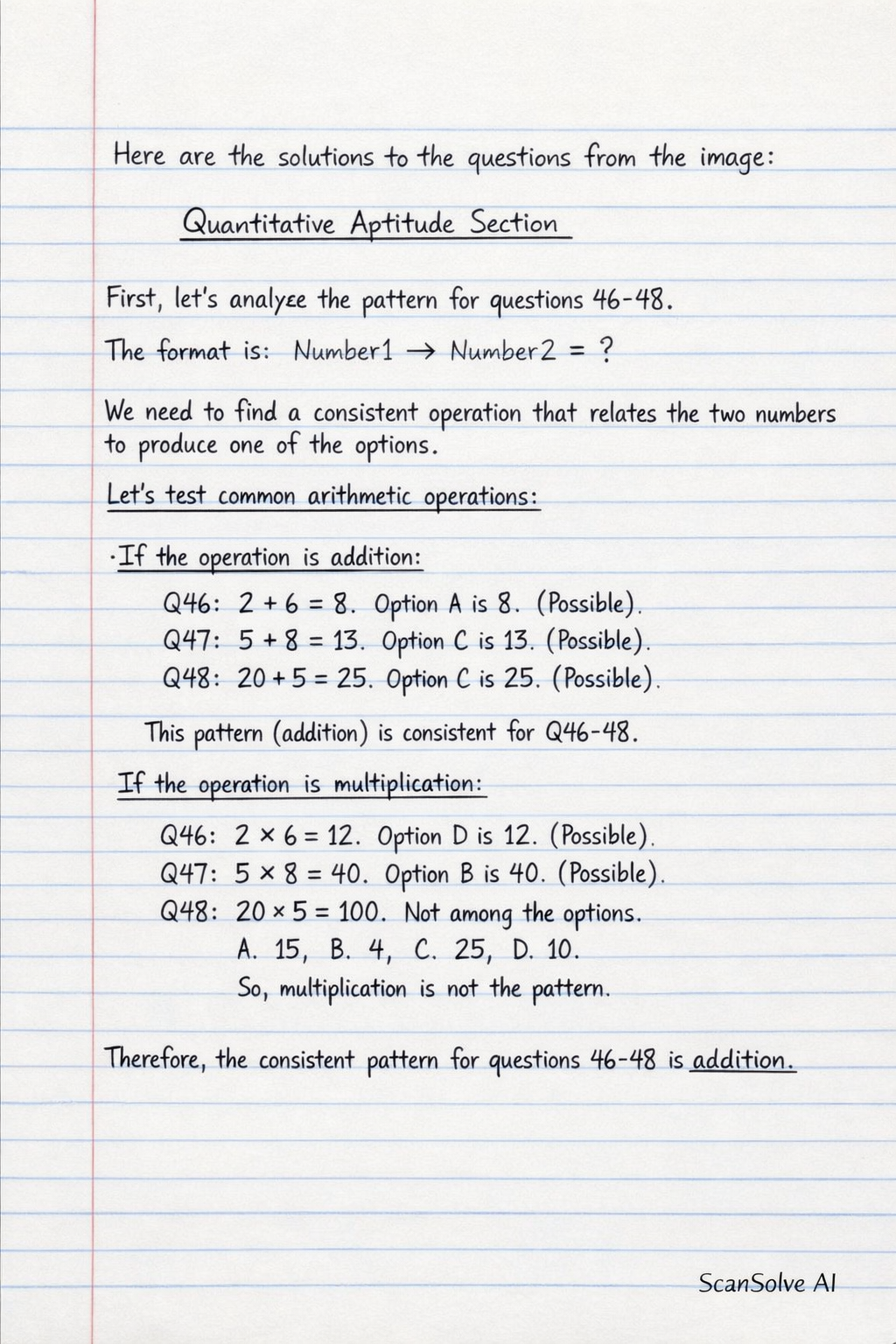
5 stepsHere are the solutions to the questions from the image:
Quantitative Aptitude Section
First, let's analyze the pattern for questions 46-48. The format is Number1 [arrow] Number2 = ?. We need to find a consistent operation that relates the two numbers to produce one of the options.
Let's test common arithmetic operations:
-
If the operation is addition:
- Q46: . Option A is 8. (Possible)
- Q47: . Option C is 13. (Possible)
- Q48: . Option C is 25. (Possible) This pattern (addition) is consistent for Q46-48.
-
If the operation is multiplication:
- Q46: . Option D is 12. (Possible)
- Q47: . Option B is 40. (Possible)
- Q48: . This is not among the options (A.15, B.4, C.25, D.10). So, multiplication is not the pattern.
Therefore, the consistent pattern for questions 46-48 is addition.
Now, let's apply this pattern to questions 49-50, as the instruction states "Use the above samples to answer questions 49-50". This implies Q46-48 are the samples.
46. 2 -> 6 = ?
Apply the addition pattern.
The correct option is A.
47. 5 <- 8 = ?
Apply the addition pattern.
The correct option is C.
48. 20 <- 5 = ?
Apply the addition pattern.
The correct option is C.
49. ? -> 63
Apply the addition pattern.
The format
? -> 63implies that the missing number (let's call it ) is added to some other number to get 63, or is the result of adding 63 to some number. Given the options are single numbers, it's most likely that is the number that, when added to another number, results in 63. However, the question is incomplete as it doesn't provide the other number or the final result.
Given the options, and the common structure of these types of problems, it's possible that the question implies a missing number in a sequence where the sum is 63, or that 63 is the result of some operation involving the missing number and another implicit number.
Without a clear second number or result, we cannot definitively solve this using the addition pattern from Q46-48.
However, if we consider the sample Q45, it shows numbers like 3, 7, 28, 16, 49. If we assume a pattern of multiplication where the first number times a factor gives the second number, and the options are the first number:
If .
Let's look at the options: A.8, B.9, C.6, D.7.
If (Option B), then .
If (Option D), then .
This suggests a multiplication pattern might be at play for Q49-50, separate from Q46-48, or the question is flawed.
Given the ambiguity, and the fact that Q45 is a "sample" for Q49-50, let's look for a pattern in Q45.
Q45: 3, 7, 28, 16, 49. Arrows: . Central: 49.
The relationship is notable. Also .
If the pattern for is .
For Q49:? -> 63. If .
For Q50:18 <- ? = 6. This means . This matches option C for Q50.
If for Q50, then the multiplier is 6.
Applying to Q49: . This is not an option.
This confirms the samples are inconsistent.Let's assume the question
? -> 63implies that?is a factor of 63, and we need to pick one from the options.
Factors of 63 are 1, 3, 7, 9, 21, 63.
Options: A.8 (not a factor), B.9 (factor), C.6 (not a factor), D.7 (factor).
Both 7 and 9 are factors. This doesn't uniquely identify the answer.Given the strong consistency of addition for Q46-48, and the instruction to use "the above samples", it is most likely that the pattern is addition, and Q49 is a missing term in an addition problem.
If? -> 63means where is the missing number and is some other number. This is still incomplete.
However, if the question implies that is the number that, when added to itself, gives 63, then . Not an option.Let's assume the question
? -> 63is asking for a number that, when multiplied by a common factor from the sample, gives 63.
If we look at Q45, .
If we look at the options for Q49, and assume the arrow means multiplication by 7:
If , then .
This matches option B.Let's test this "multiply by 7" pattern for Q50.
Q50:18 <- ? = 6. This means (if?is the first number) or (if?is the result).
If , . Not an option.
If , . Not an option.The questions are poorly designed due to inconsistent patterns across the "samples".
However, if we are forced to choose the best fit for Q49, and assuming a multiplication pattern related to the 7 and 49 in Q45:
If , then .50. 18 <- ? = 6
Let's assume the pattern is
Number1 * Number2 = Result, and the arrow indicates the direction of the operation.could mean .
This matches option C.
English Language Section
51. The passage tells us that ____
The passage states: "A good number of them kept crawling on the ground, having lost their wings." This refers to the winged termites.- A. the evening of that day was dull, (Not directly stated)
- B. there was a great storm in the afternoon (Not stated)
- C. birds ate up the winged termites (Not stated, only that they lost wings)
- D. the Children woke to fine morning (Not stated)
The provided passage snippet is incomplete. It only shows "A good number of them kept crawling on the ground, having lost their wings." Without the full passage, it's impossible to definitively answer this question. However, based on the snippet, the most direct implication is about the termites. None of the options are directly supported by the visible text. If the question refers to the full passage (which is not fully visible), the answer would be in the unseen part.
Let's assume the full passage implies something about the termites losing their wings.
The visible text says "A good number of them kept crawling on the ground, having lost their wings."
This implies that the termites lost their wings.
Let's re-evaluate the options based on common knowledge about termites and the visible text.
If "them" refers to termites, then the statement "having lost their wings" is a direct fact about them.
Option C: "birds ate up the winged termites" - this is a common occurrence, but not stated in the visible text.
Option D: "the Children woke to fine morning" - this is not related to the visible text.Given the options, and the visible text "having lost their wings", it's possible the passage describes the termites losing their wings. If there was an option like "termites lost their wings", that would be the most direct. Since there isn't, and the options are about the passage telling us that, we need to infer.
Let's assume the full passage is available and the question is valid. Without the full passage, I cannot provide a definitive answer.
52. The Children played and shouted because ____
Again, the passage snippet is incomplete. The visible text does not mention children playing or shouting. Therefore, I cannot answer this question definitively.
Try one yourself
A new problem that tests the same skill.
Still stuck on this one?
Ask a follow-up, and the answer starts from this question.
More Mathematics Questions
Handwritten Step-by-Step Solution
Get this as a handwritten image on WhatsApp — like a tutor wrote it for you.
Try on WhatsApp