
We read your photo as:
The measurement of a copy farm were projected in a field notebook as shown below. Draw the map of the farm using the scale 1cm rep 100m.
ScanSolve AI Answer
Answer
Step-by-step solution
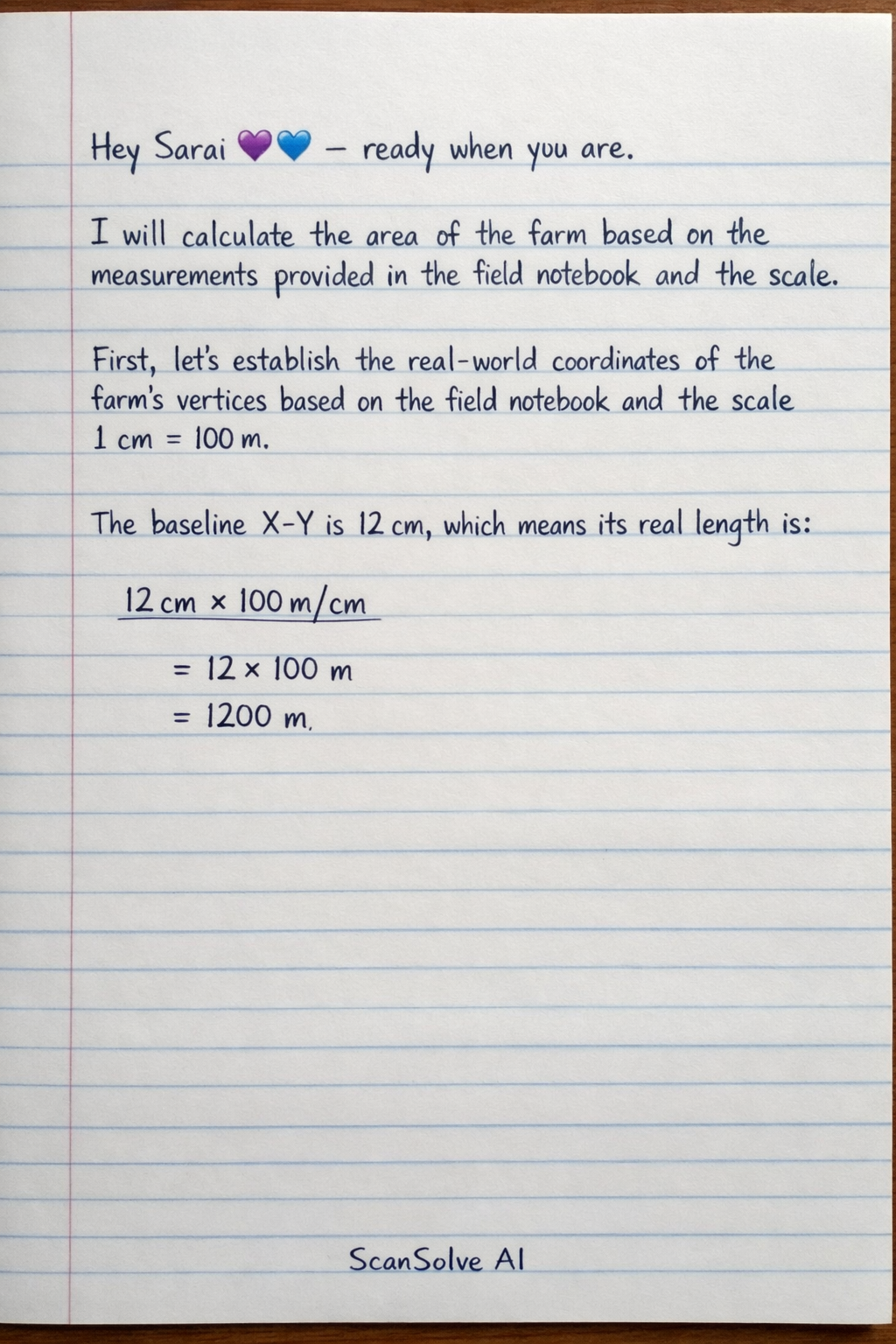
4 stepsI will calculate the area of the farm based on the measurements provided in the field notebook and the scale. The student's work shows a method of dividing the farm into triangles and trapezoids. I will verify these calculations.
First, let's establish the real-world coordinates of the farm's vertices based on the field notebook and the scale . The baseline X-Y is , which means its real length is .
Let X be at and Y be at on the baseline.
The table provides offsets:
- Point A: from X along the baseline, offset. Assuming it's below the baseline as per the drawing: .
- Point B: from X along the baseline, offset. Assuming it's above the baseline: .
- Point C: from Y towards X (so from X), offset. Assuming it's above the baseline: .
- Point D: from Y towards X (so from X), offset. Assuming it's below the baseline: .
The area of the farm (polygon A-B-C-D) can be calculated by summing the signed areas of the trapezoids formed by the vertices and their projections onto the baseline.
Area = Area(trapezoid ) + Area(trapezoid ) + Area(trapezoid ) + Area(trapezoid ) + Area(trapezoid ) + Area(trapezoid ).
Areas above the baseline are positive, and areas below are negative.
Let's calculate each part:
-
Area (i): Triangle Base , Height .
-
Area (ii): Trapezoid Parallel sides , . Height .
-
Area (iii): Triangle Base , Height .
-
Area (iv): Triangle Base , Height .
-
Area (v): Trapezoid Parallel sides , . Height .
-
Area (vi): Triangle Base , Height .
Now, sum the areas above the baseline and subtract the sum of areas below the baseline.
Areas above baseline:
Areas below baseline:
Total Area =
Total Area =
Total Area =
Total Area =
The student's individual calculations are:
A(i) = (This matches my )
A(ii) = (This does not match any of my calculated areas directly from the table values)
A(iii) = (This does not match)
A(iv) = (This does not match)
A(v) = (This does not match)
A(vi) = (This matches my )
The student's total area is . This indicates that the student used different dimensions for some of the shapes than what is derived from the table. The student's drawing has different dimensions than the table values when converted to the same scale. For example, point A in the table is but in the drawing it is which means .
Given the discrepancy, I will provide the solution based on the table values and the standard method for calculating area from offsets, as this is the most accurate interpretation of the problem statement.
Determine the coordinates of the vertices.
Using the scale and the baseline X-Y of ():
Calculate the areas of the shapes above the baseline.
These are the areas of the trapezoids/triangles formed by points B and C and their projections onto the baseline.
- Area of triangle :
- Area of trapezoid :
- Area of triangle :
Total area above baseline: .
Calculate the areas of the shapes below the baseline.
These are the areas of the trapezoids/triangles formed by points A and D and their projections onto the baseline.
- Area of triangle :
- Area of trapezoid :
- Area of triangle :
Total area below baseline: .
Calculate the total area of the farm.
The total area of the farm is the sum of the areas above the baseline minus the sum of the areas below the baseline.
Try one yourself
A new problem that tests the same skill.
Still stuck on this one?
Ask a follow-up, and the answer starts from this question.
More Mathematics Questions
Handwritten Step-by-Step Solution
Get this as a handwritten image on WhatsApp — like a tutor wrote it for you.
Try on WhatsApp