Can you use the log on question 1

Mathematics

ScanSolve AI Answer

Answers

2 parts
a(i)

x≈13.7869x \approx 13.7869

a(iii)

t≈2.0089 or t≈−1.0089t \approx 2.0089 \text{ or } t \approx -1.0089

Step-by-step solution

14 steps

You're asking for a demonstration of how logarithms are used in Question 1, perhaps with a different base or a clearer explanation of the properties.

Let's re-examine the parts of Question 1 where logarithms are applied.


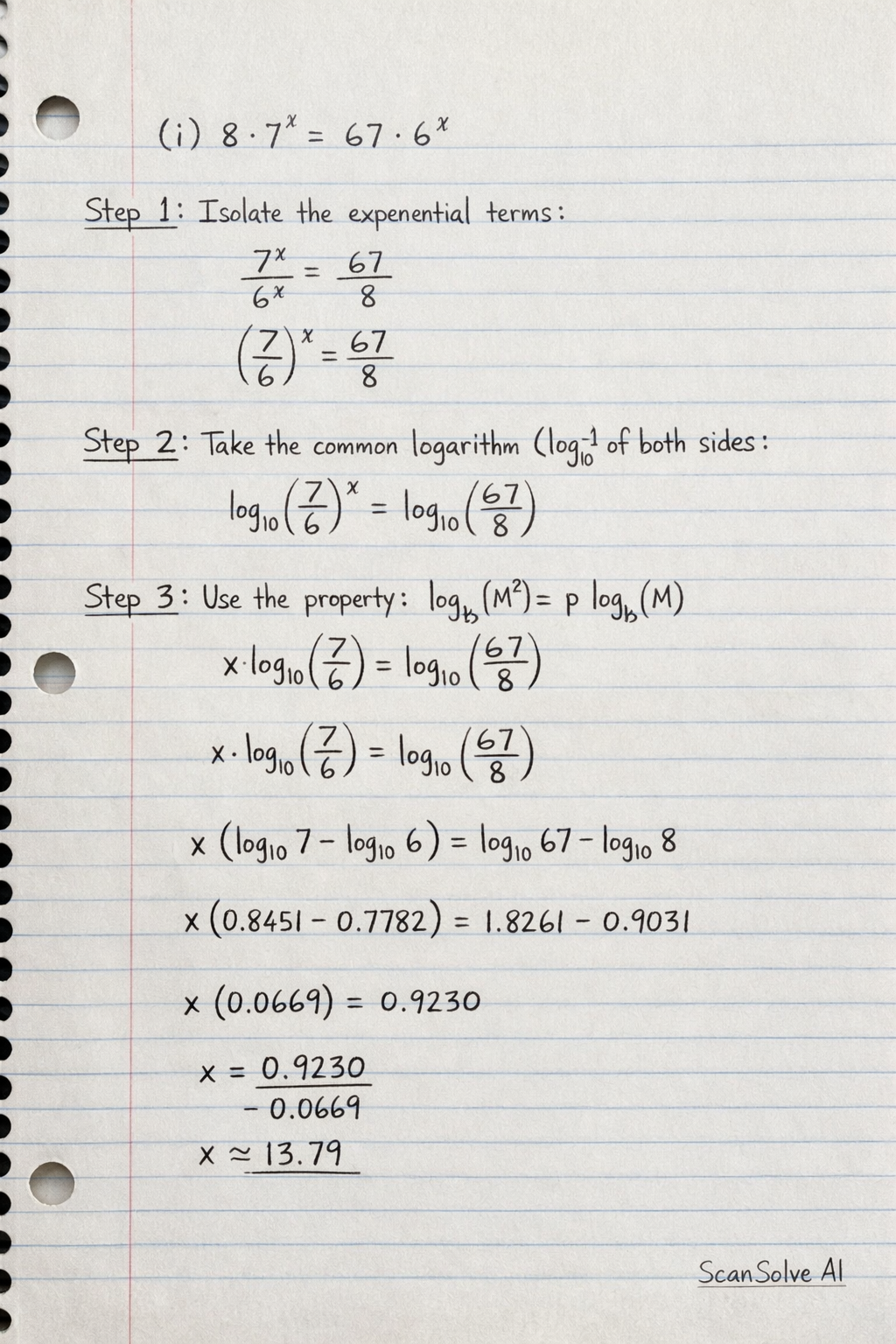
Part a(i)· 5 steps

8⋅7x=67⋅6x8 \cdot 7^x = 67 \cdot 6^x

Solve the following equations

In the original solution, we used the natural logarithm (ln⁡\ln). We can use any base logarithm, such as the common logarithm (log⁡10\log_{10}), and the result will be the same.

  1. Isolate the exponential terms.

    7x6x=678\frac{7^x}{6^x} = \frac{67}{8} (76)x=678\left(\frac{7}{6}\right)^x = \frac{67}{8}
  2. Take the common logarithm (log⁡10\log_{10}) of both sides.

    log⁡10((76)x)=log⁡10(678)\log_{10}\left(\left(\frac{7}{6}\right)^x\right) = \log_{10}\left(\frac{67}{8}\right)
  3. Use the logarithm property log⁡b(Mp)=plog⁡b(M)\log_b(M^p) = p \log_b(M) to bring the exponent xx down.

    xlog⁡10(76)=log⁡10(678)x \log_{10}\left(\frac{7}{6}\right) = \log_{10}\left(\frac{67}{8}\right)
  4. Use the logarithm property log⁡b(MN)=log⁡b(M)−log⁡b(N)\log_b\left(\frac{M}{N}\right) = \log_b(M) - \log_b(N) to expand the terms.

    x(log⁡10(7)−log⁡10(6))=log⁡10(67)−log⁡10(8)x (\log_{10}(7) - \log_{10}(6)) = \log_{10}(67) - \log_{10}(8)
  5. Solve for xx.

    x=log⁡10(67)−log⁡10(8)log⁡10(7)−log⁡10(6)x = \frac{\log_{10}(67) - \log_{10}(8)}{\log_{10}(7) - \log_{10}(6)} x≈1.8260748−0.90309000.8450980−0.7781513x \approx \frac{1.8260748 - 0.9030900}{0.8450980 - 0.7781513} x≈0.92298480.0669467x \approx \frac{0.9229848}{0.0669467} x≈13.7869\boxed{x \approx 13.7869}

    This result is identical to the one obtained using natural logarithms, demonstrating that the choice of logarithm base does not affect the final answer.


Part a(ii)· 3 steps

log⁡3(3x−1)−log⁡3(1−7x)=2\log_3(3x-1) - \log_3(1-7x) = 2

This question is already in terms of logarithms. The key steps involving logarithms were:

  1. Quotient Rule for Logarithms

    We used the property log⁡bM−log⁡bN=log⁡b(MN)\log_b M - \log_b N = \log_b \left(\frac{M}{N}\right) to combine the two logarithmic terms into a single one:

    log⁡3(3x−11−7x)=2\log_3\left(\frac{3x-1}{1-7x}\right) = 2
  2. Definition of Logarithm

    We converted the logarithmic equation into an exponential equation using the definition log⁡bY=Z  ⟺  Y=bZ\log_b Y = Z \iff Y = b^Z:

    3x−11−7x=32\frac{3x-1}{1-7x} = 3^2

    This allowed us to eliminate the logarithm and solve for xx algebraically.

  3. Domain Check

    We checked the domain of the original logarithmic expressions, which requires the arguments of the logarithms to be positive (3x−1>03x-1 > 0 and 1−7x>01-7x > 0). This step is crucial for logarithmic equations to ensure that any solutions found are valid. In this case, it led to the conclusion that there was no solution.


Part a(iii)

t≈2.0089 or t≈−1.0089t \approx 2.0089 \text{ or } t \approx -1.0089

72t−50(7t)+7=07^{2t} - 50(7^t) + 7 = 0

In the original solution, after solving the quadratic equation for y=7ty = 7^t, we used natural logarithms to solve for tt. We can again use common logarithms (log⁡10\log_{10}) for this step.

We found two solutions for yy:

y1=25+618≈49.8596y_1 = 25 + \sqrt{618} \approx 49.8596 y2=25−618≈0.1404y_2 = 25 - \sqrt{618} \approx 0.1404

Case 1: 7t=25+6187^t = 25 + \sqrt{618}

  1. Take the common logarithm (log⁡10\log_{10}) of both sides.

    log⁡10(7t)=log⁡10(25+618)\log_{10}(7^t) = \log_{10}(25 + \sqrt{618})
  2. Use the logarithm property log⁡b(Mp)=plog⁡b(M)\log_b(M^p) = p \log_b(M).

    tlog⁡10(7)=log⁡10(25+618)t \log_{10}(7) = \log_{10}(25 + \sqrt{618})
  3. Solve for tt.

    t=log⁡10(25+618)log⁡10(7)t = \frac{\log_{10}(25 + \sqrt{618})}{\log_{10}(7)} t≈log⁡10(49.8596)log⁡10(7)t \approx \frac{\log_{10}(49.8596)}{\log_{10}(7)} t≈1.697730.84510t \approx \frac{1.69773}{0.84510} t1≈2.0089t_1 \approx 2.0089

    Case 2: 7t=25−6187^t = 25 - \sqrt{618}

  4. Take the common logarithm (log⁡10\log_{10}) of both sides.

    log⁡10(7t)=log⁡10(25−618)\log_{10}(7^t) = \log_{10}(25 - \sqrt{618})
  5. Use the logarithm property log⁡b(Mp)=plog⁡b(M)\log_b(M^p) = p \log_b(M).

    tlog⁡10(7)=log⁡10(25−618)t \log_{10}(7) = \log_{10}(25 - \sqrt{618})
  6. Solve for tt.

    t=log⁡10(25−618)log⁡10(7)t = \frac{\log_{10}(25 - \sqrt{618})}{\log_{10}(7)} t≈log⁡10(0.1404)log⁡10(7)t \approx \frac{\log_{10}(0.1404)}{\log_{10}(7)} t≈−0.852610.84510t \approx \frac{-0.85261}{0.84510} t2≈−1.0089t_2 \approx -1.0089 t≈2.0089 or t≈−1.0089\boxed{t \approx 2.0089 \text{ or } t \approx -1.0089}

    Again, the results are consistent with the natural logarithm approach.

    The choice of logarithm base (e.g., ln⁡\ln or log⁡10\log_{10}) for solving exponential equations does not change the final numerical answer, as long as you apply the logarithm consistently to both sides of the equation.

Was this helpful?

Try one yourself

A new problem that tests the same skill.

Still stuck on this one?

Ask a follow-up, and the answer starts from this question.

Got a different question?Ask your own question
Handwritten step-by-step solution preview

Handwritten Step-by-Step Solution

Get this as a handwritten image on WhatsApp — like a tutor wrote it for you.

Try on WhatsApp