We read your photo as:

Use the pie-chart below to answer the questions that follow. (a) Find the value of Y. (b) If chicken and Turkeys are 517, find the total number of birds.

Mathematics

ScanSolve AI Answer

Answers

2 parts
a

140∘140^\circ

b
846
4

Step-by-step solution

8 steps

Part a· 2 steps

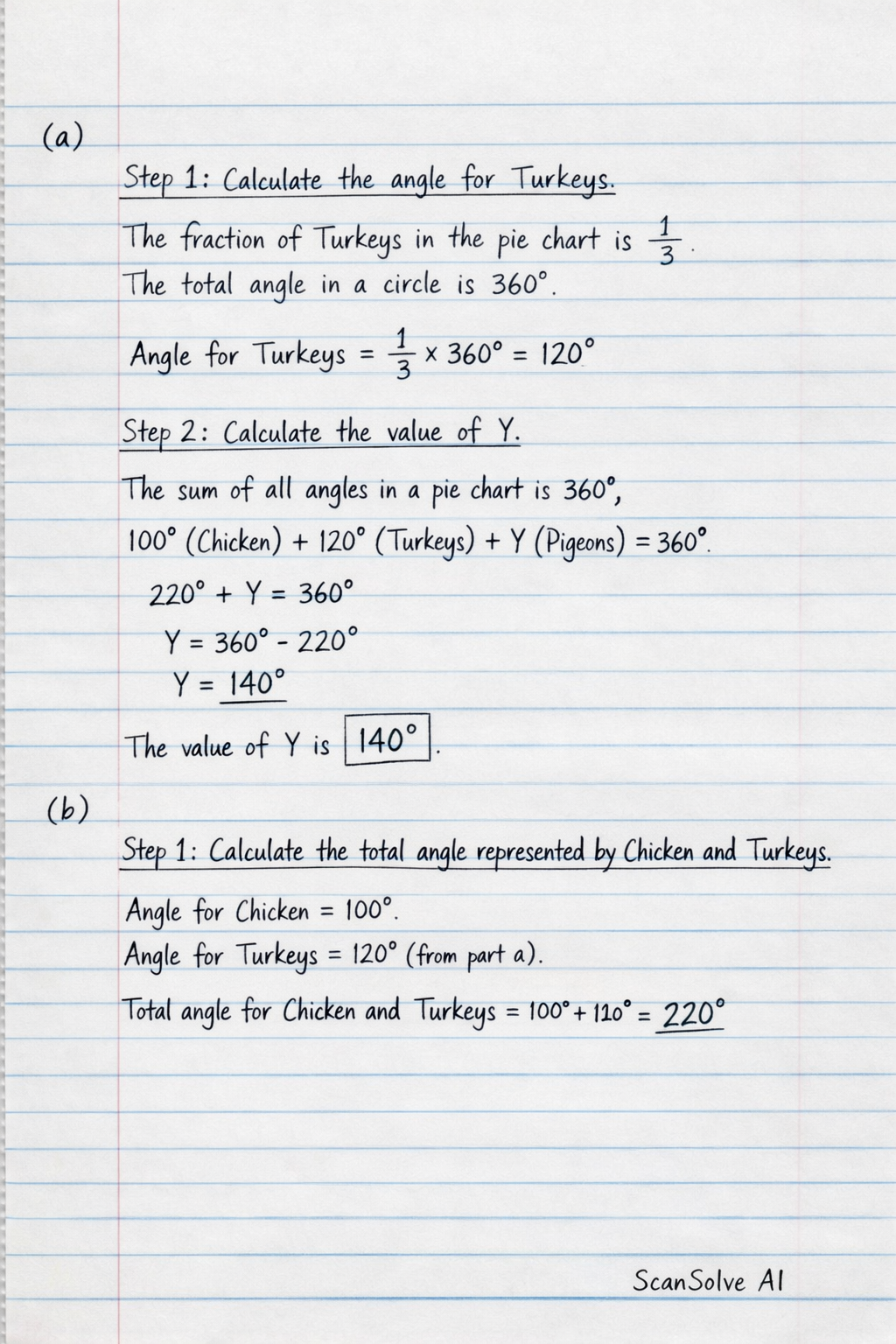
  1. Calculate the angle for Turkeys.

    The fraction of Turkeys in the pie chart is 13\frac{1}{3}. The total angle in a circle is 360∘360^\circ.

    Angle for Turkeys=13×360∘=120∘\text{Angle for Turkeys} = \frac{1}{3} \times 360^\circ = 120^\circ
  2. Calculate the value of Y.

    The sum of all angles in a pie chart is 360∘360^\circ.

    100∘(Chicken)+120∘(Turkeys)+Y(Pigeons)=360∘100^\circ (\text{Chicken}) + 120^\circ (\text{Turkeys}) + Y (\text{Pigeons}) = 360^\circ 220∘+Y=360∘220^\circ + Y = 360^\circ Y=360∘−220∘Y = 360^\circ - 220^\circ Y=140∘Y = 140^\circ

    The value of Y is 140∘\boxed{140^\circ}.

Part b846

  1. Calculate the total angle represented by Chicken and Turkeys.

    Angle for Chicken =100∘= 100^\circ.
    Angle for Turkeys =120∘= 120^\circ (from part a).

    Total angle for Chicken and Turkeys=100∘+120∘=220∘\text{Total angle for Chicken and Turkeys} = 100^\circ + 120^\circ = 220^\circ
  2. Find the total number of birds.

    We are given that the number of Chicken and Turkeys is 517, which corresponds to 220∘220^\circ. Let the total number of birds be NN. The total angle is 360∘360^\circ.

    Number of Chicken and TurkeysTotal number of birds=Angle for Chicken and TurkeysTotal angle\frac{\text{Number of Chicken and Turkeys}}{\text{Total number of birds}} = \frac{\text{Angle for Chicken and Turkeys}}{\text{Total angle}} 517N=220∘360∘\frac{517}{N} = \frac{220^\circ}{360^\circ} N=517×360220N = \frac{517 \times 360}{220} N=517×1811N = \frac{517 \times 18}{11} N=47×18N = 47 \times 18 N=846N = 846

    The total number of birds is 846\boxed{846}.

    24.

  3. Calculate the total initial cost.

    Cost of 30 watermelons =30×sh. 10,000=sh. 300,000= 30 \times \text{sh. } 10,000 = \text{sh. } 300,000.
    Transportation cost =sh. 45,000= \text{sh. } 45,000.

    Total Cost=sh. 300,000+sh. 45,000=sh. 345,000\text{Total Cost} = \text{sh. } 300,000 + \text{sh. } 45,000 = \text{sh. } 345,000
  4. Calculate the net selling price per good watermelon.

    Selling price per good watermelon =sh. 12,000= \text{sh. } 12,000.
    Tax per good watermelon =5% of sh. 10,000=0.05×sh. 10,000=sh. 500= 5\% \text{ of sh. } 10,000 = 0.05 \times \text{sh. } 10,000 = \text{sh. } 500.

    Net selling price per good watermelon=sh. 12,000−sh. 500=sh. 11,500\text{Net selling price per good watermelon} = \text{sh. } 12,000 - \text{sh. } 500 = \text{sh. } 11,500
  5. Set up the equation for loss.

    Let xx be the number of spoilt watermelons.
    Number of good watermelons =30−x= 30 - x.
    Total Revenue =(30−x)×sh. 11,500= (30 - x) \times \text{sh. } 11,500.
    Loss = Total Cost - Total Revenue.
    Given Loss =sh. 46,000= \text{sh. } 46,000.

    sh. 46,000=sh. 345,000−(30−x)×sh. 11,500\text{sh. } 46,000 = \text{sh. } 345,000 - (30 - x) \times \text{sh. } 11,500
  6. Solve the equation for xx.

    11,500(30−x)=345,000−46,00011,500(30 - x) = 345,000 - 46,000 11,500(30−x)=299,00011,500(30 - x) = 299,000 30−x=299,00011,50030 - x = \frac{299,000}{11,500} 30−x=299011530 - x = \frac{2990}{115} 30−x=2630 - x = 26 x=30−26x = 30 - 26 x=4x = 4

    The number of watermelons that got spoilt during transportation is 4\boxed{4}.

Was this helpful?

Try one yourself

A new problem that tests the same skill.

Still stuck on this one?

Ask a follow-up, and the answer starts from this question.

Got a different question?Ask your own question
Handwritten step-by-step solution preview

Handwritten Step-by-Step Solution

Get this as a handwritten image on WhatsApp — like a tutor wrote it for you.

Try on WhatsApp