

This mathematics problem involves applying core mathematical principles and formulas. Below you will find a complete step-by-step solution with detailed explanations for each step, helping you understand not just the answer but the method behind it.
ScanSolve AI Answer
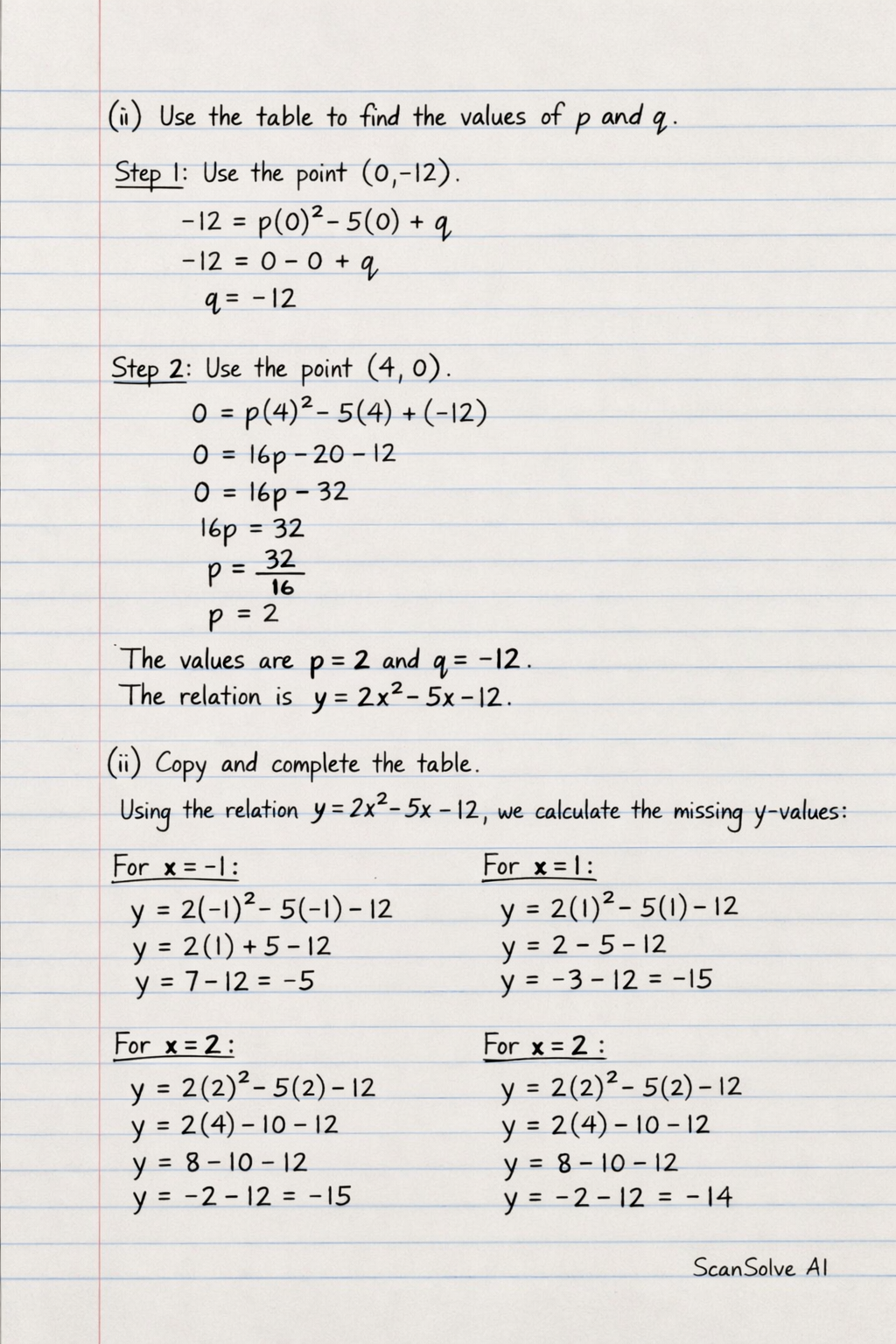
a) (i) Use the table to find the values of p and q. Step 1: Use the point (0, -12) from the table and substitute x=0 and y=-12 into the relation y = px^2 - 5x + q. -12 = p(0)^2 - 5(0) + q -12 = 0 - 0 + q q = -12 Step 2: Use another point from the table, for example (4, 0), and substitute x=4, y=0, and q=-12 into the relation y = px^2 - 5x + q. 0 = p(4)^2 - 5(4) + (-12) 0 = 16p - 20 - 12 0 = 16p - 32 16p = 32 p = (32)/(16) p = 2 The values are p=2 and q=-12. The relation is y = 2x^2 - 5x - 12. (ii) Copy and complete the table. Using the relation y = 2x^2 - 5x - 12, we calculate the missing y-values: For x=-1: y = 2(-1)^2 - 5(-1) - 12 y = 2(1) + 5 - 12 y = 2 + 5 - 12 y = 7 - 12 = -5 For x=1: y = 2(1)^2 - 5(1) - 12 y = 2(1) - 5 - 12 y = 2 - 5 - 12 y = -3 - 12 = -15 For x=2: y = 2(2)^2 - 5(2) - 12 y = 2(4) - 10 - 12 y = 8 - 10 - 12 y = -2 - 12 = -14 For x=3: y = 2(3)^2 - 5(3) - 12 y = 2(9) - 15 - 12 y = 18 - 15 - 12 y = 3 - 12 = -9 The completed table is: | x | -3 | -2 | -1 | 0 | 1 | 2 | 3 | 4 | 5 | |---|----|----|----|---|---|---|---|---|---| | y | 21 | 6 | -5 | -12 | -15 | -14 | -9 | 0 | 13 | b) Using scales of 2cm to 1 unit on the x-axis and 2 cm to 5 units on the y-axis, draw the graph of the relation for -3 x 5. Step 1: Draw the x-axis and y-axis on graph paper. Step 2: Mark the x-axis from -3 to 5, with each 2 cm representing 1 unit. Step 3: Mark the y-axis to cover the range of y-values (from -15 to 21), with each 2 cm representing 5 units. Step 4: Plot the points from the completed table: (-3, 21), (-2, 6), (-1, -5), (0, -12), (1, -15), (2, -14), (3, -9), (4, 0), (5, 13). Step 5: Draw a smooth curve connecting all the plotted points. This curve represents the graph of y = 2x^2 - 5x - 12. c) Use the graph to find: (i) y when x = 1.8 To find y when x=1.8 from the graph, locate x=1.8 on the x-axis. Move vertically from x=1.8 to intersect the curve. From the intersection point, move horizontally to the y-axis to read the corresponding y-value. Using the equation y = 2x^2 - 5x - 12: y = 2(1.8)^2 - 5(1.8) - 12 y = 2(3.24) - 9 - 12 y = 6.48 - 9 - 12 y = 6.48 - 21 y = -14.52 From the graph, y would be approximately -14.5. (ii) x when y = -8 To find x when y=-8 from the graph, locate y=-8 on the y-axis. Move horizontally from y=-8 to intersect the curve. From the intersection points, move vertically to the x-axis to read the corresponding x-values. Using the equation y = 2x^2 - 5x - 12: -8 = 2x^2 - 5x - 12 0 = 2x^2 - 5x - 4 Using the quadratic formula x = -b ± sqrt(b^2 - 4ac)2a: x = -(-5) ± sqrt((-5)^2 - 4(2)(-4))2(2) x = 5 ± sqrt(25 + 32)4 x = 5 ± sqrt(57)4 x_1 = 5 + sqrt(57)4 ≈ (5 + 7.5498)/(4) ≈ (12.5498)/(4) ≈ 3.137 x_2 = 5 - sqrt(57)4 ≈ (5 - 7.5498)/(4) ≈ (-2.5498)/(4) ≈ -0.637 From the graph, x would be approximately 3.1 or -0.6. That's 2 down. 3 left today — send the next one.