
We read your photo as:
Using the divisibility test, determine which of the following numbers are exactly divisible by 7: 525, 798, 836, 3696, 5706.
ScanSolve AI Answer
Step-by-step solution
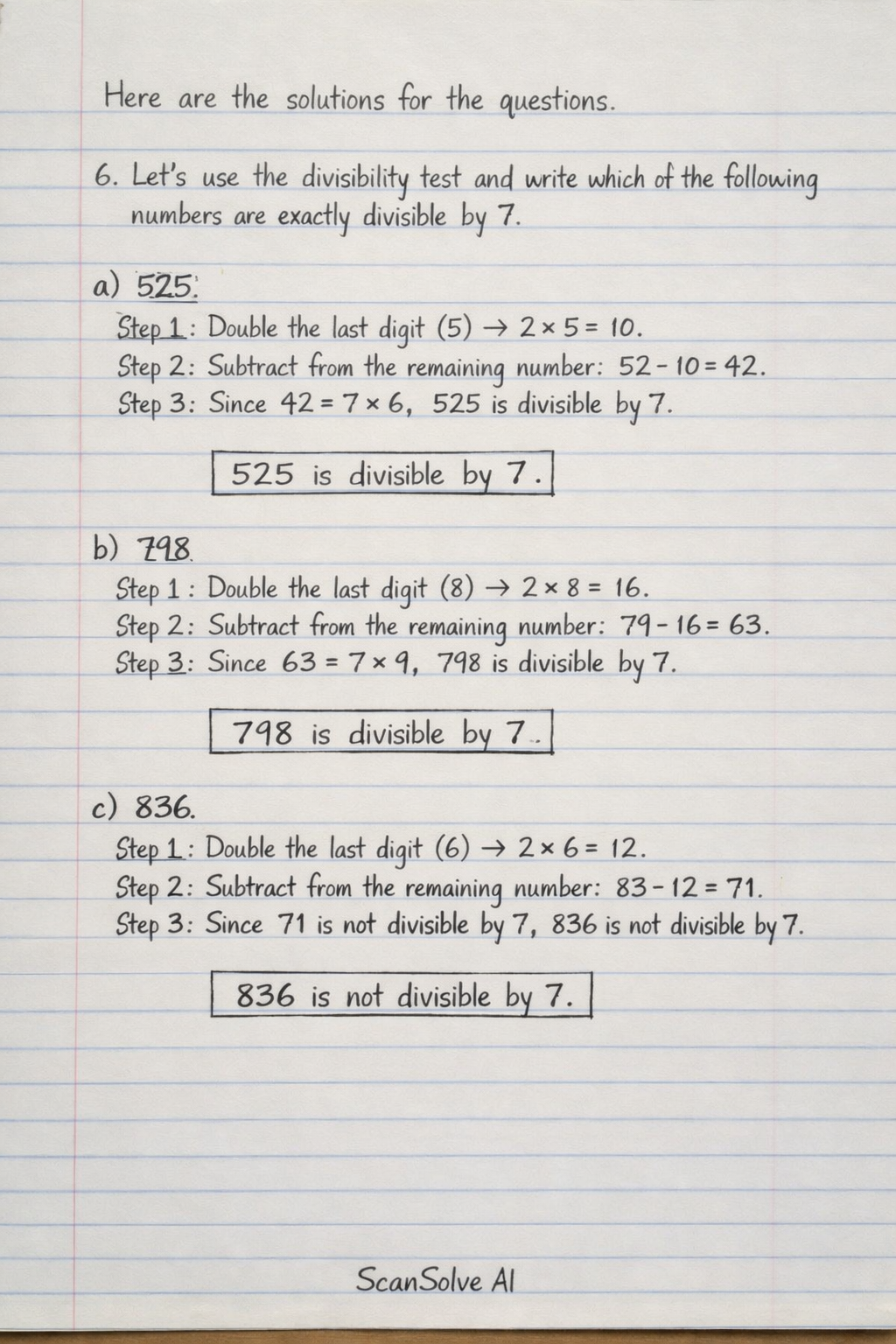
29 stepsHere are the solutions for the questions.
6. Let's use the divisibility test and write which of the following numbers are exactly divisible by 7.
a) 525
Double the last digit (5) to get .
Subtract this from the remaining number (52)
.
Since 42 is divisible by 7 (), 525 is divisible by 7.
b) 798
Double the last digit (8) to get .
Subtract this from the remaining number (79)
.
Since 63 is divisible by 7 (), 798 is divisible by 7.
c) 836
Double the last digit (6) to get .
Subtract this from the remaining number (83)
.
Since 71 is not divisible by 7, 836 is not divisible by 7.
d) 3696
Double the last digit (6) to get .
Subtract this from the remaining number (369)
.
Repeat for 357.
Double the last digit (7) to get .
Subtract this from the remaining number (35)
.
Since 21 is divisible by 7 (), 3696 is divisible by 7.
e) 5706
Double the last digit (6) to get .
Subtract this from the remaining number (570)
.
Repeat for 558.
Double the last digit (8) to get .
Subtract this from the remaining number (55)
.
Since 39 is not divisible by 7, 5706 is not divisible by 7.
7. Let's apply the rule of test of divisibility and write which of the following numbers are divisible by 11.
a) 6358
Calculate the alternating sum of the digits, starting from the rightmost digit.
Since 0 is divisible by 11, 6358 is divisible by 11.
b) 2845
Calculate the alternating sum of the digits.
Since 7 is not divisible by 11, 2845 is not divisible by 11.
c) 71852
Calculate the alternating sum of the digits.
Since 10 is not divisible by 11, 71852 is not divisible by 11.
d) 258995
Calculate the alternating sum of the digits.
Since 0 is divisible by 11, 258995 is divisible by 11.
e) 999666
Calculate the alternating sum of the digits.
Since -3 is not divisible by 11, 999666 is not divisible by 11.
8. Write all the possible factors of these pairs of numbers. Circle the common factors and select the highest common factor.
a) 8 and 12
Factors of 8: 1, 2, 4, 8
Factors of 12: 1, 2, 3, 4, 6, 12
Common factors:
Highest Common Factor (HCF):b) 12 and 18
Factors of 12: 1, 2, 3, 4, 6, 12
Factors of 18: 1, 2, 3, 6, 9, 18
Common factors:
Highest Common Factor (HCF):c) 16 and 24
Factors of 16: 1, 2, 4, 8, 16
Factors of 24: 1, 2, 3, 4, 6, 8, 12, 24
Common factors:
Highest Common Factor (HCF):d) 28 and 42
Factors of 28: 1, 2, 4, 7, 14, 28
Factors of 42: 1, 2, 3, 6, 7, 14, 21, 42
Common factors:
Highest Common Factor (HCF):9. Write the first ten multiples of these pairs of numbers. Circle the common multiples and select the lowest common multiple.
a) 6 and 8
Multiples of 6: 6, 12, 18, 24, 30, 36, 42, 48, 54, 60
Multiples of 8: 8, 16, 24, 32, 40, 48, 56, 64, 72, 80
Common multiples:
Lowest Common Multiple (LCM):b) 6 and 9
Multiples of 6: 6, 12, 18, 24, 30, 36, 42, 48, 54, 60
Multiples of 9: 9, 18, 27, 36, 45, 54, 63, 72, 81, 90
Common multiples: $\text{18,
Still stuck on this one?
Ask a follow-up, and the answer starts from this question.
More Mathematics Questions
Handwritten Step-by-Step Solution
Get this as a handwritten image on WhatsApp — like a tutor wrote it for you.
Try on WhatsApp