
We read your photo as:
Using the provided data, estimate the quantity of lubricant required in 2025 when machines are planned to work for 8 x 10⁵ hours. Calculate the slope (b) and y-intercept (a) for the linear regression
ScanSolve AI Answer
Answers
3 partsStep-by-step solution
11 stepshere's the complete solution for Question 2:
Part 2
The table provides data for "Quantity of lubricant x gallons" and "Total machine hours x hrs". Let be the quantity of lubricant in gallons and be the total machine hours in hrs.
| Period | ( gallons) | ( hrs) | ||
|---|---|---|---|---|
| 2024 | 29 | 15 | 435 | 225 |
| 2023 | 23 | 10 | 230 | 100 |
| 2022 | 16 | 6 | 96 | 36 |
| 2021 | 11 | 4 | 44 | 16 |
| 2020 | 5 | 2 | 10 | 4 |
| Sum | ||||
Part i
Estimate the quantity of lubricant to be required in Year 2025 when the machines are planned to work for a total of Hours.
Calculate the slope () for the linear regression equation .
Calculate the y-intercept () for the linear regression equation.
Formulate the regression equation and determine the value of for 2025.
The regression equation is .
The total machine hours for 2025 are hours. Since is in hours, we convert:Estimate the quantity of lubricant () for 2025.
Since is in gallons, the quantity of lubricant is gallons.
The estimated quantity of lubricant required in Year 2025 is .
Part ii
For the 2026 & beyond, the lubricating oil consumption is to be pegged at gallons per annum. What is the expected total production hour for the machine per annum for the period?
Set the lubricant consumption () to the given value.
The lubricating oil consumption is gallons, so in our units.
Use the regression equation to find the corresponding total machine hours ().
Convert back to total production hours.
Since is in hrs, the total production hour is hrs.
The expected total production hour is .
Part iii
How many oilers will be required in year 2025? If each Oiler works at the rate of 100 gallons/hour. Assume 250 working day per annum & 8 hours per day. Use factor for Oiler = 0.8.
Determine the total lubricant required in 2025.
From part (i), the total lubricant required in 2025 is gallons, which is 147,777.7 gallons.
Calculate the total effective working hours for one Oiler per annum.
Total working days per annum = 250 days
Hours per day = 8 hours
Total hours per Oiler per annum = .Calculate the effective lubricant handling capacity of one Oiler per annum.
Rate of work for one Oiler = 100 gallons/hour.
Factor for Oiler = 0.8.
Effective rate of work = .
Effective gallons an Oiler can handle per annum = .Calculate the number of oilers required.
Since you cannot have a fraction of an Oiler, we round up to the nearest whole number.
The number of oilers required in year 2025 is .
Try one yourself
A new problem that tests the same skill.
Still stuck on this one?
Ask a follow-up, and the answer starts from this question.
More Mathematics Questions
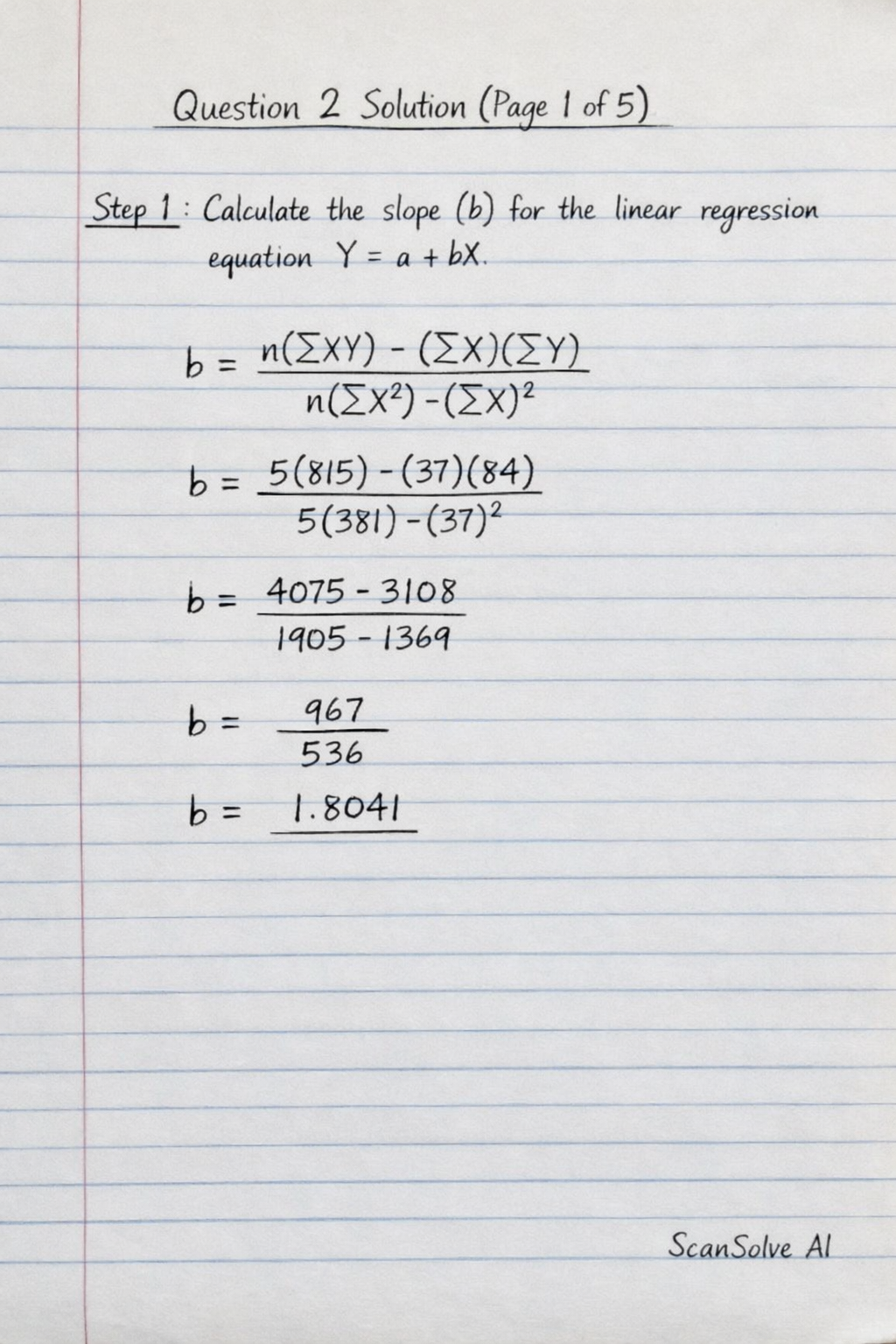
Handwritten Step-by-Step Solution
Get this as a handwritten image on WhatsApp — like a tutor wrote it for you.
Try on WhatsApp