
We read your photo as:
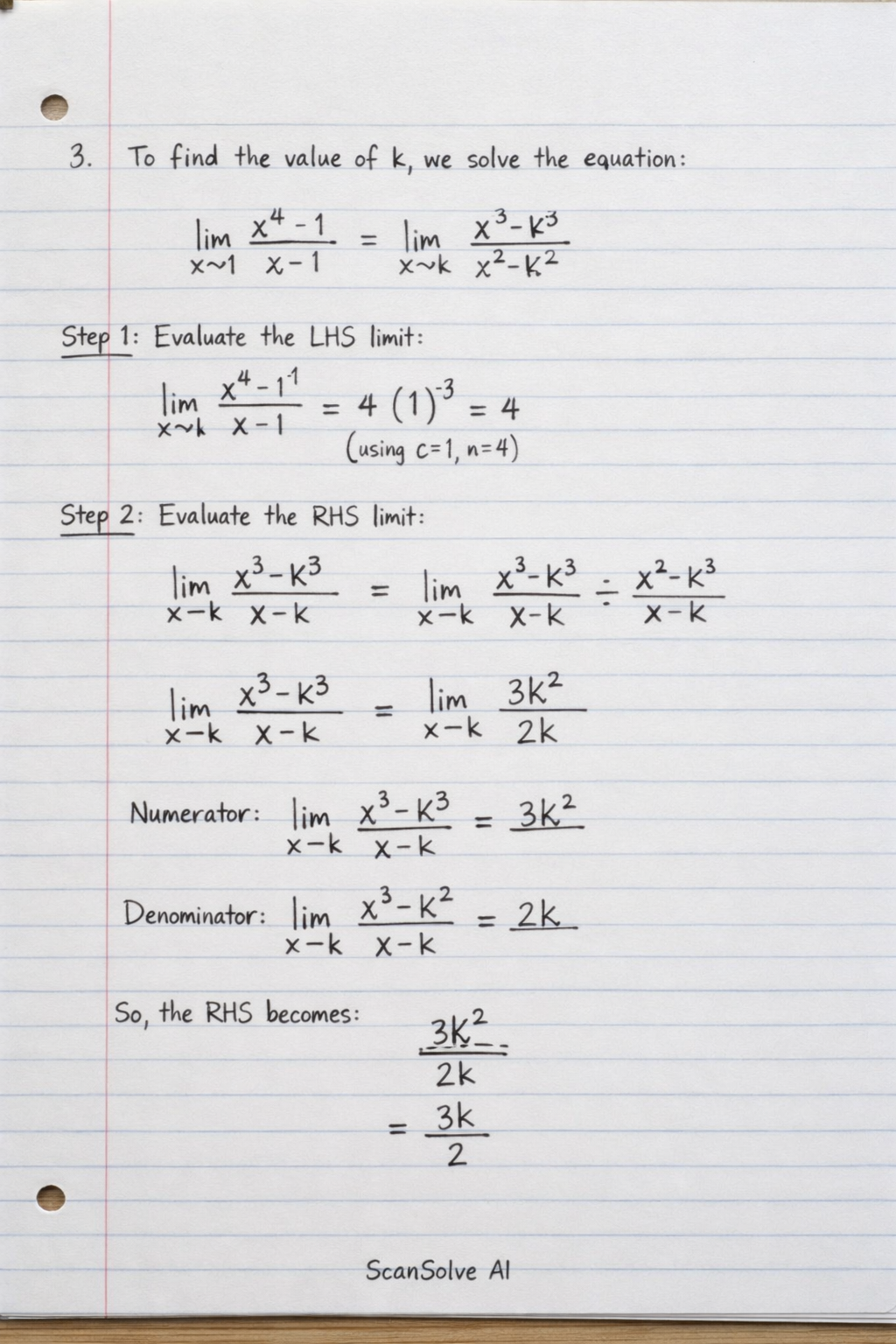
Find the value of k: limx->1 (x4 - 1)/(x − 1) = limx->k (x3 - k3)/(x2 - k2)
Mathematics
ScanSolve AI Answer
Answer
Step-by-step solution
6 stepshere are the solutions to the limit problems.
- We need to find the value of given the equality:
Evaluate the left-hand side (LHS) limit.
The LHS is in the form $\lim_{x \to c} \frac{x^n - c^n}{x - c} = n c^{n-1}$. Here, $c=1$ and $n=4$. $$ \lim_{x \to 1} \frac{x^4 - 1^4}{x - 1} = 4 \cdot (1)^{4-1} = 4 \cdot 1^3 = 4 $$Evaluate the right-hand side (RHS) limit.
The RHS is an indeterminate form $\frac{0}{0}$ when $x=k$. We can rewrite it by dividing the numerator and denominator by $(x-k)$: $$ \lim_{x \to k} \frac{x^3 - k^3}{x^2 - k^2} = \lim_{x \to k} \frac{\frac{x^3 - k^3}{x - k}}{\frac{x^2 - k^2}{x - k}} $$ Apply the limit formula $\lim_{x \to c} \frac{x^n - c^n}{x - c} = n c^{n-1}$ to both the numerator and the denominator. Numerator: $\lim_{x \to k} \frac{x^3 - k^3}{x - k} = 3k^{3-1} = 3k^2$. Denominator: $\lim_{x \to k} \frac{x^2 - k^2}{x - k} = 2k^{2-1} = 2k$. So, the RHS becomes: $$ \frac{3k^2}{2k} $$ Assuming $k \ne 0$, we can simplify this to $\frac{3k}{2}$. If $k=0$, the RHS would be $\lim_{x \to 0} \frac{x^3}{x^2} = \lim_{x \to 0} x = 0$, which is not equal to the LHS (4). Thus, $k \ne 0$.Equate the LHS and RHS and solve for .
$$ 4 = \frac{3k}{2} $$ $$ 8 = 3k $$ $$ k = \frac{8}{3} $$ The value of $k$ is $\boxed{\frac{8}{3}}$.4. We need to find the possible values of given the equality:
Rewrite the limit expression to match the standard form.
The limit is an indeterminate form $\frac{0}{0}$ when $x=-a$. We use the formula $\lim_{x \to c} \frac{x^n - c^n}{x - c} = n c^{n-1}$. Since $n=9$ is an odd number, $a^9 = -(-a)^9$. So, $x^9 + a^9 = x^9 - (-a)^9$. Also, $x+a = x - (-a)$. Therefore, the limit can be written as: $$ \lim_{x \to -a} \frac{x^9 - (-a)^9}{x - (-a)} $$Apply the limit formula.
Here, $c = -a$ and $n = 9$. The limit is $9 \cdot (-a)^{9-1} = 9 \cdot (-a)^8$. Since any non-zero number raised to an even power is positive, $(-a)^8 = a^8$. So, the limit evaluates to $9a^8$.Equate the result to the given value and solve for .
$$
9a^8 = 9
$$
$$
a^8 = 1
$$
To find $a$, we take the eighth root of both sides. Since the exponent is even, there will be two real solutions (positive and negative).
$$
a = \pm \sqrt[8]{1}
$$
$$
a = \pm 1
$$
The possible values of $a$ are $\boxed{\pm 1}$.
Was this helpful?
Try one yourself
A new problem that tests the same skill.
Still stuck on this one?
Ask a follow-up, and the answer starts from this question.
Got a different question?Ask your own question
More Mathematics Questions
QDetermine the value(s) of x for which k convergesQFind the lim_x→2 (x2-4)/(x−2)QFind the value of k for which the limit of the piecewise function exists and evaluate the given…QLimx -> 3 (x + 2)(x − 5) limx -> 1 (x + 1) / (x + 2) limx -> −1 (x − 1) / (x + 2) limx -> 3 (x − 3)…QFind the value of the following limits: 5. lim (x->2) [1/(x(x−2)2) − 1/(x2-3x+2)]; 6. lim (x->1)…
Handwritten Step-by-Step Solution
Get this as a handwritten image on WhatsApp — like a tutor wrote it for you.
Try on WhatsApp