Find the value of the unknown sides in each of the following right angled triangles. Use trigonometric ratios to find the size of the angle marked theta and beta in each of the following right-angled triangles.

Mathematics
Find the value of the unknown sides in each of the following right angled triangles. Use trigonometric ratios to find the size of the angle marked theta and beta in each of the following right-angled triangles.

ScanSolve AI Answer

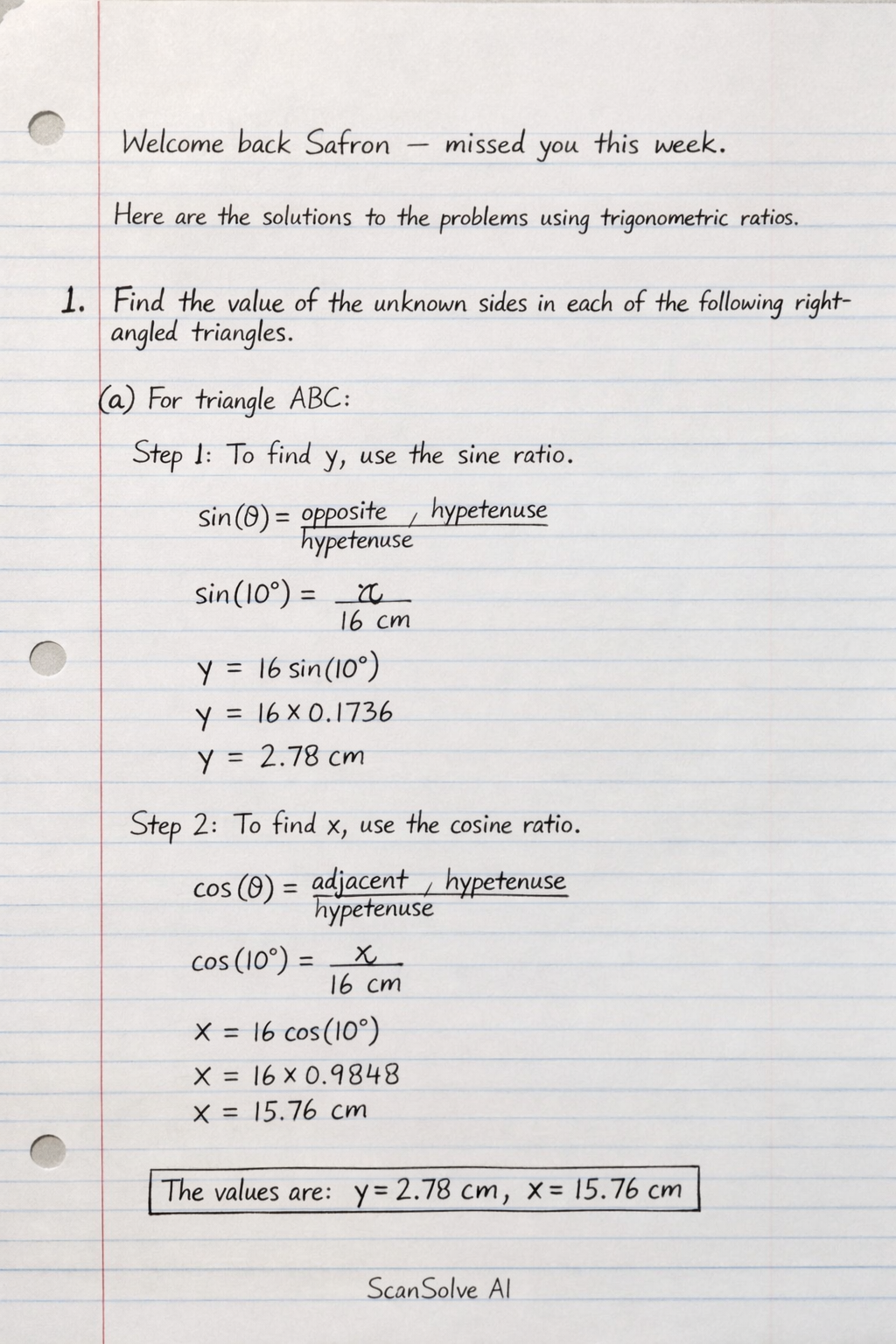
Here are the solutions to the problems using trigonometric ratios.

1. Find the value of the unknown sides in each of the following right-angled triangles.

a) For triangle ABC: Step 1: To find yy, use the sine ratio. sin(θ)=oppositehypotenuse\sin(\theta) = \frac{\text{opposite}}{\text{hypotenuse}} sin(10)=y16 cm\sin(10^\circ) = \frac{y}{16 \text{ cm}} y=16sin(10)y = 16 \sin(10^\circ) y16×0.1736y \approx 16 \times 0.1736 y2.78 cmy \approx 2.78 \text{ cm} Step 2: To find xx, use the cosine ratio. cos(θ)=adjacenthypotenuse\cos(\theta) = \frac{\text{adjacent}}{\text{hypotenuse}} cos(10)=x16 cm\cos(10^\circ) = \frac{x}{16 \text{ cm}} x=16cos(10)x = 16 \cos(10^\circ) x16×0.9848x \approx 16 \times 0.9848 x15.76 cmx \approx 15.76 \text{ cm} The values are: y2.78 cm,x15.76 cm\boxed{y \approx 2.78 \text{ cm}, x \approx 15.76 \text{ cm}}

b) For triangle XYZ: Step 1: To find aa, use the sine ratio. sin(θ)=oppositehypotenuse\sin(\theta) = \frac{\text{opposite}}{\text{hypotenuse}} sin(35)=5 cma\sin(35^\circ) = \frac{5 \text{ cm}}{a} a=5 cmsin(35)a = \frac{5 \text{ cm}}{\sin(35^\circ)} a50.5736a \approx \frac{5}{0.5736} a8.72 cma \approx 8.72 \text{ cm} Step 2: To find bb, use the tangent ratio. tan(θ)=oppositeadjacent\tan(\theta) = \frac{\text{opposite}}{\text{adjacent}} tan(35)=5 cmb\tan(35^\circ) = \frac{5 \text{ cm}}{b} b=5 cmtan(35)b = \frac{5 \text{ cm}}{\tan(35^\circ)} b50.7002b \approx \frac{5}{0.7002} b7.14 cmb \approx 7.14 \text{ cm} The values are: a8.72 cm,b7.14 cm\boxed{a \approx 8.72 \text{ cm}, b \approx 7.14 \text{ cm}}

c) For triangle PQR: Step 1: To find yy, use the sine ratio. sin(θ)=oppositehypotenuse\sin(\theta) = \frac{\text{opposite}}{\text{hypotenuse}} sin(60)=6 cmy\sin(60^\circ) = \frac{6 \text{ cm}}{y} y=6 cmsin(60)y = \frac{6 \text{ cm}}{\sin(60^\circ)} y60.8660y \approx \frac{6}{0.8660} y6.93 cmy \approx 6.93 \text{ cm} Step 2: To find xx, use the tangent ratio. tan(θ)=oppositeadjacent\tan(\theta) = \frac{\text{opposite}}{\text{adjacent}} tan(60)=6 cmx\tan(60^\circ) = \frac{6 \text{ cm}}{x} x=6 cmtan(60)x = \frac{6 \text{ cm}}{\tan(60^\circ)} x61.7321x \approx \frac{6}{1.7321} x3.46 cmx \approx 3.46 \text{ cm} The values are: x3.46 cm,y6.93 cm\boxed{x \approx 3.46 \text{ cm}, y \approx 6.93 \text{ cm}}

d) For triangle KLM: Step 1: To find xx, use the sine ratio. sin(θ)=oppositehypotenuse\sin(\theta) = \frac{\text{opposite}}{\text{hypotenuse}} sin(68.7)=x25 cm\sin(68.7^\circ) = \frac{x}{25 \text{ cm}} x=25sin(68.7)x = 25 \sin(68.7^\circ) x25×0.9318x \approx 25 \times 0.9318 x23.30 cmx \approx 23.30 \text{ cm} Step 2: To find yy, use the cosine ratio. cos(θ)=adjacenthypotenuse\cos(\theta) = \frac{\text{adjacent}}{\text{hypotenuse}} cos(68.7)=y25 cm\cos(68.7^\circ) = \frac{y}{25 \text{ cm}} y=25cos(68.7)y = 25 \cos(68.7^\circ) y25×0.3633y \approx 25 \times 0.3633 y9.08 cmy \approx 9.08 \text{ cm} The values are: x23.30 cm,y9.08 cm\boxed{x \approx 23.30 \text{ cm}, y \approx 9.08 \text{ cm}}

2. Use trigonometric ratios to find the size of the angle marked θ\theta and β\beta in each of the following right-angled triangles.

a) For the first triangle: Step 1: To find θ\theta, use the tangent ratio. tan(θ)=oppositeadjacent\tan(\theta) = \frac{\text{opposite}}{\text{adjacent}} tan(θ)=5 cm8 cm\tan(\theta) = \frac{5 \text{ cm}}{8 \text{ cm}} θ=arctan(58)\theta = \arctan\left(\frac{5}{8}\right) θ32.0\theta \approx 32.0^\circ Step 2: To find β\beta, use the fact that the sum of acute angles in a right triangle is 9090^\circ. β=90θ\beta = 90^\circ - \theta β=9032.0\beta = 90^\circ - 32.0^\circ β58.0\beta \approx 58.0^\circ The angles are: θ32.0,β58.0\boxed{\theta \approx 32.0^\circ, \beta \approx 58.0^\circ}

b) For the second triangle: Step 1: To find θ\theta, use the sine ratio. sin(θ)=oppositehypotenuse\sin(\theta) = \frac{\text{opposite}}{\text{hypotenuse}} sin(θ)=4 cm10 cm\sin(\theta) = \frac{4 \text{ cm}}{10 \text{ cm}} sin(θ)=0.4\sin(\theta) = 0.4 θ=arcsin(0.4)\theta = \arcsin(0.4) θ23.6\theta \approx 23.6^\circ Step 2: To find β\beta, use the fact that the sum of acute angles in a right triangle is 9090^\circ. β=90θ\beta = 90^\circ - \theta β=9023.6\beta = 90^\circ - 23.6^\circ β66.4\beta \approx 66.4^\circ The angles are: θ23.6,β66.4\boxed{\theta \approx 23.6^\circ, \beta \approx 66.4^\circ}

c) For the third triangle: Step 1: To find θ\theta, use the sine ratio. sin(θ)=oppositehypotenuse\sin(\theta) = \frac{\text{opposite}}{\text{hypotenuse}} sin(θ)=16 cm25 cm\sin(\theta) = \frac{16 \text{ cm}}{25 \text{ cm}} sin(θ)=0.64\sin(\theta) = 0.64 θ=arcsin(0.64)\theta = \arcsin(0.64) θ39.8\theta \approx 39.8^\circ Step 2: To find β\beta, use the fact that the sum of acute angles in a right triangle is 9090^\circ. β=90θ\beta = 90^\circ - \theta β=9039.8\beta = 90^\circ - 39.8^\circ β50.2\beta \approx 50.2^\circ The angles are: θ39.8,β50.2\boxed{\theta \approx 39.8^\circ, \beta \approx 50.2^\circ}

Was this helpful?

Still stuck on this one?

Ask a follow-up, and the answer starts from this question.

Got a different question?Ask your own question
Handwritten step-by-step solution preview

Handwritten Step-by-Step Solution

Get this as a handwritten image on WhatsApp — like a tutor wrote it for you.

Try on WhatsApp