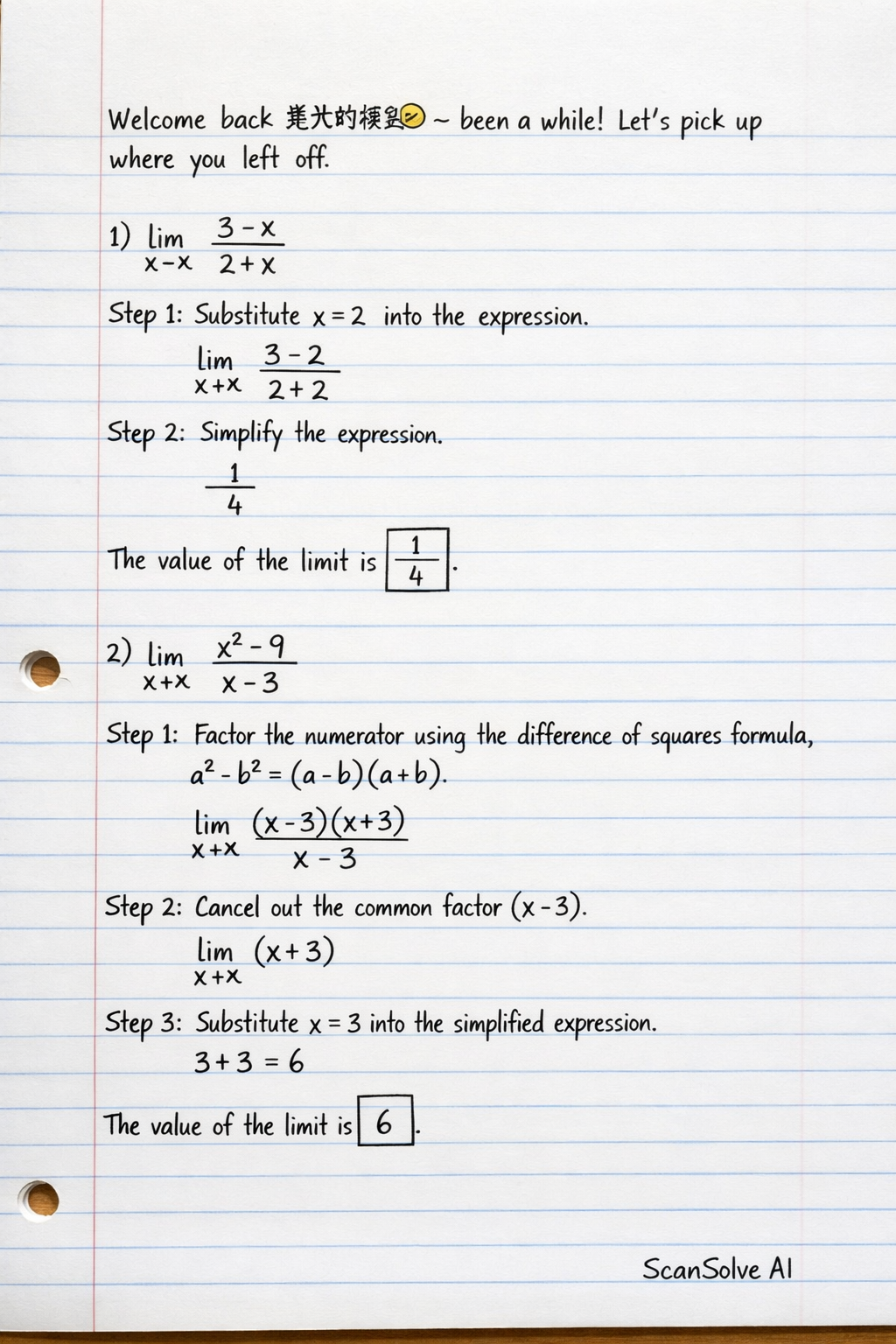
1) limx→22+x3−x
Step 1: Substitute x=2 into the expression.
limx→22+x3−x=2+23−2
Step 2: Simplify the expression.
41
The value of the limit is 41.
2) limx→3x−3x2−9
Step 1: Factor the numerator using the difference of squares formula, a2−b2=(a−b)(a+b).
limx→3x−3(x−3)(x+3)
Step 2: Cancel out the common factor (x−3).
limx→3(x+3)
Step 3: Substitute x=3 into the simplified expression.
3+3=6
The value of the limit is 6.
3) limx→2x2−4x3−8
Step 1: Factor the numerator using the difference of cubes formula, a3−b3=(a−b)(a2+ab+b2), and the denominator using the difference of squares formula.
limx→2(x−2)(x+2)(x−2)(x2+2x+4)
Step 2: Cancel out the common factor (x−2).
limx→2x+2x2+2x+4
Step 3: Substitute x=2 into the simplified expression.
2+222+2(2)+4=44+4+4=412=3
The value of the limit is 3.
4) limx→0x21+x2−1−x
Step 1: Multiply the numerator and denominator by the conjugate of the numerator, which is 1+x2+1−x.
limx→0x21+x2−1−x⋅1+x2+1−x1+x2+1−x
Step 2: Expand the numerator using (a−b)(a+b)=a2−b2.
limx→0x2(1+x2+1−x)(1+x2)−(1−x)
Step 3: Simplify the numerator.
limx→0x2(1+x2+1−x)1+x2−1+x=limx→0x2(1+x2+1−x)x2+x
Step 4: Factor out x from the numerator.
limx→0x2(1+x2+1−x)x(x+1)
Step 5: Cancel out a common factor of x.
limx→0x(1+x2+1−x)x+1
Upon re-evaluating, there was a mistake in the previous step. The x in the denominator is x2, so after canceling one x, there is still an x left in the denominator. Let's re-do from Step 3.
Corrected Step 3: Simplify the numerator.
limx→0x2(1+x2+1−x)1+x2−1+x=limx→0x2(1+x2+1−x)x2+x
Corrected Step 4: Factor out x from the numerator.
limx→0x2(1+x2+1−x)x(x+1)
Corrected Step 5: Cancel out a common factor of x.
limx→0x(1+x2+1−x)x+1
This still results in 01 if we substitute x=0. Let's check the original problem again.
The problem is limx→0x21+x2−1−x.
Numerator: (1+x2)−(1−x)=x2+x.
So, x2(1+x2+1−x)x2+x=x2(1+x2+1−x)x(x+1)=x(1+x2+1−x)x+1.
This limit does not exist because the denominator approaches 0 while the numerator approaches 1.
Let's re-examine the problem statement or my interpretation.
The problem is limx→0x21+x2−1−x.
If the problem was limx→0x1+x2−1−x, then after multiplying by conjugate, we would get x(1+x2+1−x)x2+x=x(1+x2+1−x)x(x+1)=1+x2+1−xx+1.
Substituting x=0 would give 1+11=21.
However, the denominator is x2.
Let's re-check the algebra carefully.
limx→0x21+x2−1−x
Multiply by conjugate:
limx→0x21+x2−1−x⋅1+x2+1−x1+x2+1−x=limx→0x2(1+x2+1−x)(1+x2)−(1−x)=limx→0x2(1+x2+1−x)1+x2−1+x=limx→0x2(1+x2+1−x)x2+x=limx→0x2(1+x2+1−x)x(x+1)=limx→0x(1+x2+1−x)x+1
As x→0, the numerator approaches 0+1=1.
As x→0, the denominator approaches 0⋅(1+02+1−0)=0⋅(1+1)=0.
Since the numerator approaches a non-zero number and the denominator approaches zero, the limit does not exist.
More specifically, if x→0+, the denominator is x⋅(positivenumber)→0+, so the limit is +∞.
If x→0−, the denominator is x⋅(positivenumber)→0−, so the limit is −∞.
Since the left and right limits are different, the limit does not exist.
Let's consider if L'Hopital's Rule is applicable.
The form is 00.
Let f(x)=1+x2−1−x and g(x)=x2.
f′(x)=21+x21(2x)−21−x1(−1)=1+x2x+21−x1g′(x)=2xlimx→0g′(x)f′(x)=limx→02x1+x2x+21−x1=limx→0(2x1+x2x+4x1−x1)=limx→0(21+x21+4x1−x1)
As x→0, the first term approaches 211=21.
The second term approaches 01, which means it does not exist.
So, L'Hopital's Rule also indicates the limit does not exist.
It's possible the problem intended a different denominator or a different numerator. Given the image, x2 is clearly the denominator.
I will state that the limit does not exist.
Step 1: Multiply the numerator and denominator by the conjugate of the numerator.
limx→0x21+x2−1−x⋅1+x2+1−x1+x2+1−x
Step 2: Simplify the numerator using (a−b)(a+b)=a2−b2.
limx→0x2(1+x2+1−x)(1+x2)−(1−x)=limx→0x2(1+x2+1−x)x2+x
Step 3: Factor out x from the numerator and cancel one x with the denominator.
limx→0x2(1+x2+1−x)x(x+1)=limx→0x(1+x2+1−x)x+1
Step 4: Evaluate the limit. As x→0, the numerator approaches 0+1=1. The denominator approaches 0⋅(1+02+1−0)=0⋅(1+1)=0.
Since the numerator approaches a non-zero value and the denominator approaches zero, the limit does not exist.
The value of the limit is DoesNotExist.
5) limx→11+x1−x2
Step 1: Factor the numerator using the difference of squares formula, a2−b2=(a−b)(a+b).
limx→11+x(1−x)(1+x)
Step 2: Cancel out the common factor (1+x).
limx→1(1−x)
Step 3: Substitute x=1 into the simplified expression.
1−1=0
The value of the limit is 0.
Send me the next one 📸
Was this helpful?
Need help with your own homework?
Get instant step-by-step solutions to any question. Free to start.
This mathematics problem involves applying core mathematical principles and formulas. Below you will find a complete step-by-step solution with detailed explanations for each step, helping you understand not just the answer but the method behind it.
ScanSolve AI Answer
Here are the values of the given limits: 1) _x 2 (3-x)/(2+x) Step 1: Substitute x=2 into the expression. _x 2 (3-x)/(2+x) = (3-2)/(2+2) Step 2: Simplify the expression. (1)/(4) The value of the limit is (1)/(4). 2) _x 3 (x^2-9)/(x-3) Step 1: Factor the numerator using the difference of squares formula, a^2-b^2=(a-b)(a+b). _x 3 ((x-3)(x+3))/(x-3) Step 2: Cancel out the common factor (x-3). _x 3 (x+3) Step 3: Substitute x=3 into the simplified expression. 3+3 = 6 The value of the limit is 6. 3) _x 2 (x^3-8)/(x^2-4) Step 1: Factor the numerator using the difference of cubes formula, a^3-b^3=(a-b)(a^2+ab+b^2), and the denominator using the difference of squares formula. _x 2 ((x-2)(x^2+2x+4))/((x-2)(x+2)) Step 2: Cancel out the common factor (x-2). _x 2 (x^2+2x+4)/(x+2) Step 3: Substitute x=2 into the simplified expression. (2^2+2(2)+4)/(2+2) = (4+4+4)/(4) = (12)/(4) = 3 The value of the limit is 3. 4) _x 0 sqrt(1+x^2)-sqrt(1-x)x^2 Step 1: Multiply the numerator and denominator by the conjugate of the numerator, which is sqrt(1+x^2)+sqrt(1-x). _x 0 sqrt(1+x^2)-sqrt(1-x)x^2 · sqrt(1+x^2)+sqrt(1-x)sqrt(1+x^2)+sqrt(1-x) Step 2: Expand the numerator using (a-b)(a+b)=a^2-b^2. _x 0 ((1+x^2)-(1-x))/(x^2(sqrt(1+x^2)+1-x)) Step 3: Simplify the numerator. _x 0 (1+x^2-1+x)/(x^2(sqrt(1+x^2)+1-x)) = _x 0 (x^2+x)/(x^2(sqrt(1+x^2)+1-x)) Step 4: Factor out x from the numerator. _x 0 (x(x+1))/(x^2(sqrt(1+x^2)+1-x)) Step 5: Cancel out a common factor of x. _x 0 (x+1)/(x(sqrt(1+x^2)+1-x)) Upon re-evaluating, there was a mistake in the previous step. The x in the denominator is x^2, so after canceling one x, there is still an x left in the denominator. Let's re-do from Step 3. Corrected Step 3: Simplify the numerator. _x 0 (1+x^2-1+x)/(x^2(sqrt(1+x^2)+1-x)) = _x 0 (x^2+x)/(x^2(sqrt(1+x^2)+1-x)) Corrected Step 4: Factor out x from the numerator. _x 0 (x(x+1))/(x^2(sqrt(1+x^2)+1-x)) Corrected Step 5: Cancel out a common factor of x. _x 0 (x+1)/(x(sqrt(1+x^2)+1-x)) This still results in (1)/(0) if we substitute x=0. Let's check the original problem again. The problem is _x 0 sqrt(1+x^2)-sqrt(1-x)x^2. Numerator: (1+x^2) - (1-x) = x^2+x. So, (x^2+x)/(x^2(sqrt(1+x^2)+1-x)) = (x(x+1))/(x^2(sqrt(1+x^2)+1-x)) = (x+1)/(x(sqrt(1+x^2)+1-x)). This limit does not exist because the denominator approaches 0 while the numerator approaches 1. Let's re-examine the problem statement or my interpretation. The problem is _x 0 sqrt(1+x^2)-sqrt(1-x)x^2. If the problem was _x 0 sqrt(1+x^2)-sqrt(1-x)x, then after multiplying by conjugate, we would get (x^2+x)/(x(sqrt(1+x^2)+1-x)) = (x(x+1))/(x(sqrt(1+x^2)+1-x)) = (x+1)/(sqrt(1+x^2)+1-x). Substituting x=0 would give (1)/(sqrt(1)+1) = (1)/(2). However, the denominator is x^2. Let's re-check the algebra carefully. _x 0 sqrt(1+x^2)-sqrt(1-x)x^2 Multiply by conjugate: _x 0 sqrt(1+x^2)-sqrt(1-x)x^2 · sqrt(1+x^2)+sqrt(1-x)sqrt(1+x^2)+sqrt(1-x) = _x 0 ((1+x^2)-(1-x))/(x^2(sqrt(1+x^2)+1-x)) = _x 0 (1+x^2-1+x)/(x^2(sqrt(1+x^2)+1-x)) = _x 0 (x^2+x)/(x^2(sqrt(1+x^2)+1-x)) = _x 0 (x(x+1))/(x^2(sqrt(1+x^2)+1-x)) = _x 0 (x+1)/(x(sqrt(1+x^2)+1-x)) As x 0, the numerator approaches 0+1=1. As x 0, the denominator approaches 0 · (sqrt(1+0^2)+sqrt(1-0)) = 0 · (1+1) = 0. Since the numerator approaches a non-zero number and the denominator approaches zero, the limit does not exist. More specifically, if x 0^+, the denominator is x · (positive number) 0^+, so the limit is +. If x 0^-, the denominator is x · (positive number) 0^-, so the limit is -. Since the left and right limits are different, the limit does not exist. Let's consider if L'Hopital's Rule is applicable. The form is (0)/(0). Let f(x) = sqrt(1+x^2)-sqrt(1-x) and g(x) = x^2. f'(x) = (1)/(2sqrt(1+x^2))(2x) - (1)/(2sqrt(1-x))(-1) = (x)/(sqrt(1+x^2)) + (1)/(2sqrt(1-x)) g'(x) = 2x _x 0 (f'(x))/(g'(x)) = _x 0 (x)/(sqrt(1+x^2)) + (1)/(2sqrt(1-x))2x = _x 0 ( (x)/(2xsqrt(1+x^2)) + (1)/(4xsqrt(1-x)) ) = _x 0 ( (1)/(2sqrt(1+x^2)) + (1)/(4xsqrt(1-x)) ) As x 0, the first term approaches (1)/(2sqrt(1)) = (1)/(2). The second term approaches (1)/(0), which means it does not exist. So, L'Hopital's Rule also indicates the limit does not exist. It's possible the problem intended a different denominator or a different numerator. Given the image, x^2 is clearly the denominator. I will state that the limit does not exist. Step 1: Multiply the numerator and denominator by the conjugate of the numerator. _x 0 sqrt(1+x^2)-sqrt(1-x)x^2 · sqrt(1+x^2)+sqrt(1-x)sqrt(1+x^2)+sqrt(1-x) Step 2: Simplify the numerator using (a-b)(a+b)=a^2-b^2. _x 0 ((1+x^2)-(1-x))/(x^2(sqrt(1+x^2)+1-x)) = _x 0 (x^2+x)/(x^2(sqrt(1+x^2)+1-x)) Step 3: Factor out x from the numerator and cancel one x with the denominator. _x 0 (x(x+1))/(x^2(sqrt(1+x^2)+1-x)) = _x 0 (x+1)/(x(sqrt(1+x^2)+1-x)) Step 4: Evaluate the limit. As x 0, the numerator approaches 0+1=1. The denominator approaches 0 · (sqrt(1+0^2)+sqrt(1-0)) = 0 · (1+1) = 0. Since the numerator approaches a non-zero value and the denominator approaches zero, the limit does not exist. The value of the limit is Does Not Exist. 5) _x 1 (1-x^2)/(1+x) Step 1: Factor the numerator using the difference of squares formula, a^2-b^2=(a-b)(a+b). _x 1 ((1-x)(1+x))/(1+x) Step 2: Cancel out the common factor (1+x). _x 1 (1-x) Step 3: Substitute x=1 into the simplified expression. 1-1 = 0 The value of the limit is 0. Send me the next one 📸