
We read your photo as:
Calculate the vector triple product (a x b) x c given vectors a = i + j + k, b = i + j, and c = i.
Mathematics
ScanSolve AI Answer
Answer
0
Step-by-step solution
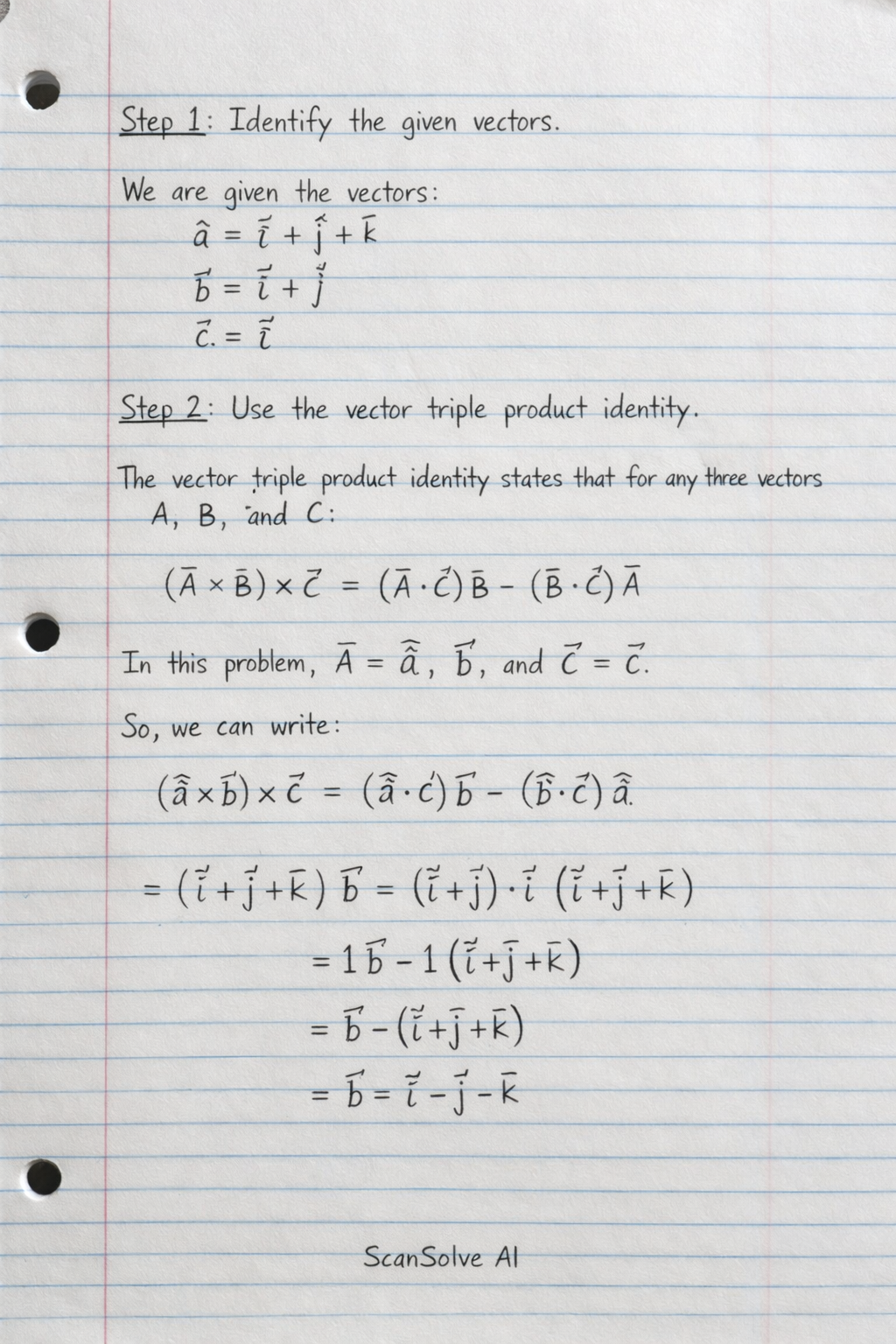
6 stepsIdentify the given vectors.
We are given the vectors:
Use the vector triple product identity.
The vector triple product identity states that for any three vectors , , and :
In this problem, , , and .
So, we can write:Calculate the dot products and .
First, calculate :
Next, calculate :
Substitute the dot products back into the identity.
Compare this result with the given equation.
We are given that .
Equating the two expressions for :Rearranging the terms to match the form :
By comparing the coefficients of and on both sides, we find:
Calculate the value of .
The value of is 0.
Was this helpful?
Try one yourself
A new problem that tests the same skill.
Still stuck on this one?
Ask a follow-up, and the answer starts from this question.
Got a different question?Ask your own question
More Mathematics Questions
QGiven vectors a = 2i + 5j − k and b = 3i − 2j + 4k, find a x b, b x a, and (a + b) x (a − b).QGiven vectors a = 2i + j − 3k, b = 4i − j + 2k, and c = i + 3j − k, find the vector AB x AC and the…QCalculate the scalar projection of vector a = 2i + 3j − 2k onto vector b = i + 2j − 3k.QCalculate the dot product of vectors A = 3i + 4j − k and B = −2i + 3j + k.QGiven the vectors a = 6i − j, b = 2i + 5j, c = −i − 4j. Calculate a + 2b − c, and R = a + b − c.
Browse by topic:Linear Algebra
Handwritten Step-by-Step Solution
Get this as a handwritten image on WhatsApp — like a tutor wrote it for you.
Try on WhatsApp