
We read your photo as:
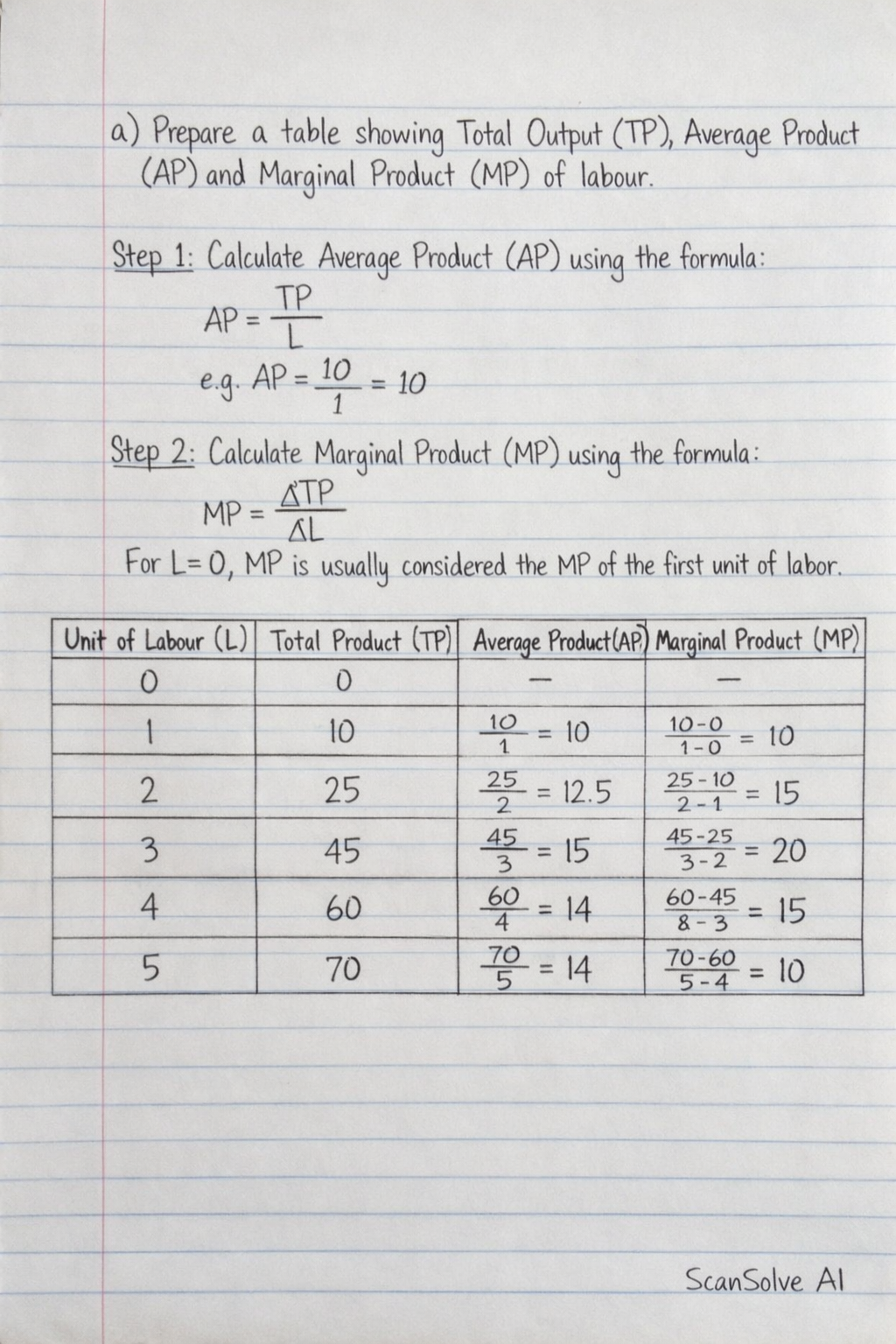
Calculate Average Product (AP) using the formula AP = (TP)/(L).
Mathematics
ScanSolve AI Answer
Step-by-step solution
2 stepsPart a· 2 steps
Prepare a table showing Total Output (TP), Average Product (AP) and Marginal Product (MP) of labour.
Calculate Average Product (AP) using the formula .
Calculate Marginal Product (MP) using the formula .
For , MP is usually considered the MP of the first unit of labor.
Unit of Labour (L) Total Product (TP) Average Product (AP) Marginal Product (MP) 0 0 - - 1 10 2 25 3 45 4 60 5 70 6 75 7 75 The completed table is:
Part b
Show (a) above in a combined diagram.
To show the data in a combined diagram:
- Draw a graph with the Units of Labour (L) on the horizontal (x) axis.
- Use the vertical (y) axis to represent Output for the Total Product (TP) curve and Product for the Average Product (AP) and Marginal Product (MP) curves. Typically, TP is plotted on the upper part of the graph, and AP/MP are plotted on the lower part, sharing the same x-axis.
- Plot the Total Product (TP) curve by connecting the (L, TP) points. This curve will initially increase at an increasing rate, then increase at a decreasing rate, reach a maximum, and then may decline.
- Plot the Average Product (AP) curve by connecting the (L, AP) points. This curve will typically rise, reach a maximum, and then fall.
- Plot the Marginal Product (MP) curve by connecting the (L, MP) points. This curve will typically rise, reach a maximum, then fall, intersect the AP curve at its maximum point, and can become zero or negative.
Key relationships to observe in the diagram:
- The MP curve intersects the AP curve at the maximum point of the AP curve (between L=3 and L=4, where AP is 15).
- When MP is greater than AP, AP is rising.
- When MP is less than AP, AP is falling.
- When MP is zero, TP is at its maximum (at L=7, TP is 75).
Was this helpful?
Still stuck on this one?
Ask a follow-up, and the answer starts from this question.
Got a different question?Ask your own question
More Mathematics Questions
QCalculate the Average Physical Product (APP) and Marginal Physical Product (MPP) using the provided…QCalculate the Average Product of Labour (APL) for 1, 3, and 4 employees, given their respective…QCalculate the Average Actual Profit.QExplain the three stages of production with a table and calculate AP and MP.QCalculate the sales proportion of Product ABC relative to the total category sales.
Handwritten Step-by-Step Solution
Get this as a handwritten image on WhatsApp — like a tutor wrote it for you.
Try on WhatsApp