We read your photo as:

Calculate the volume of the composite solid correct to two decimal places.

Mathematics

ScanSolve AI Answer

Answers

2 parts
a

29464.29 cm329464.29 \text{ cm}^3

b
7

Step-by-step solution

7 steps

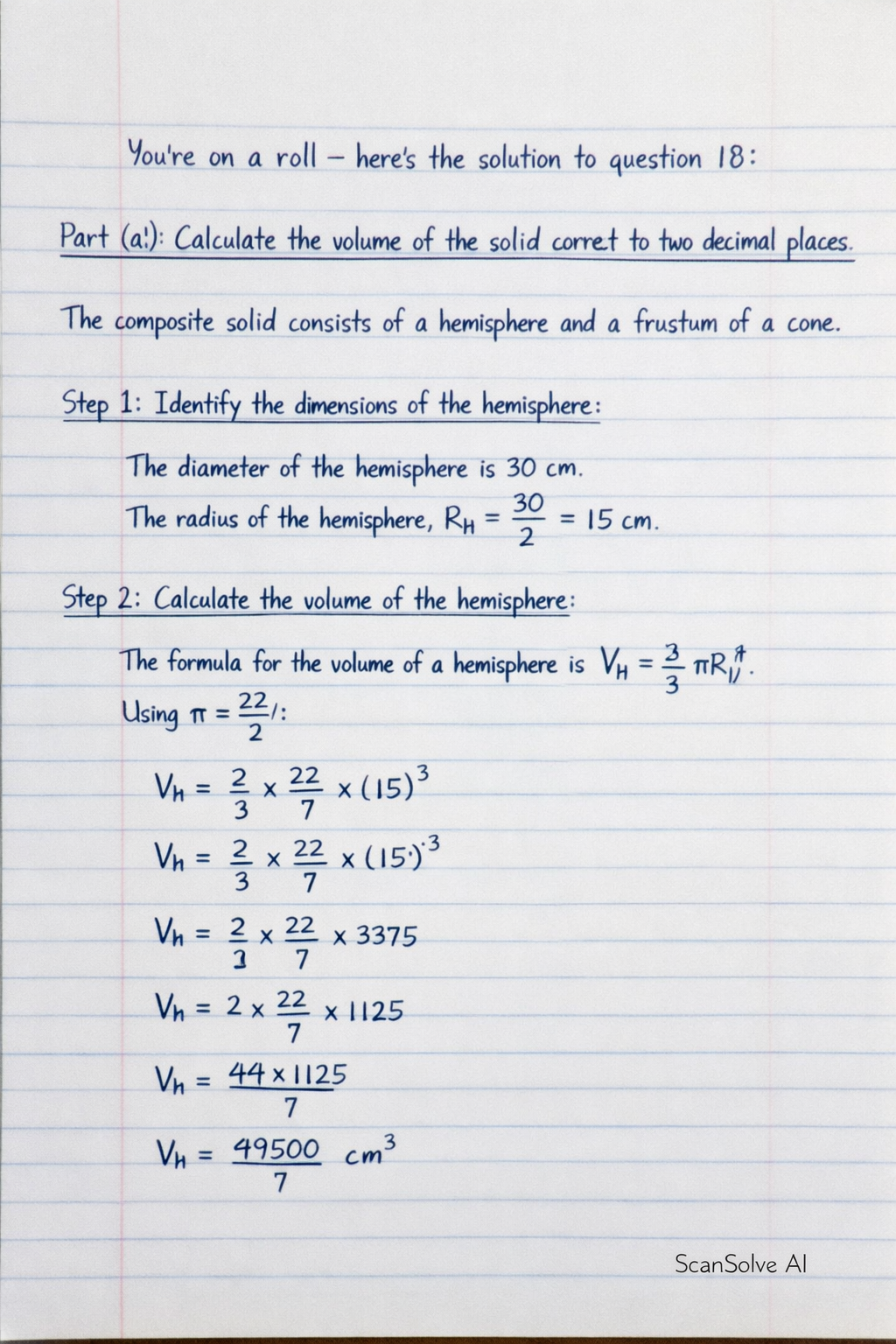
here's the solution to question 18:

Part a· 5 steps

Calculate the volume of the solid correct to two decimal places.

The composite solid consists of a hemisphere and a frustum of a cone.

  1. Identify the dimensions of the hemisphere.

    The diameter of the hemisphere is 30 cm.
    The radius of the hemisphere, RH=302=15R_H = \frac{30}{2} = 15 cm.

  2. Calculate the volume of the hemisphere.

    The formula for the volume of a hemisphere is VH=23πRH3V_H = \frac{2}{3} \pi R_H^3.
    Using π=227\pi = \frac{22}{7}:

    VH=23×227×(15)3V_H = \frac{2}{3} \times \frac{22}{7} \times (15)^3 VH=23×227×3375V_H = \frac{2}{3} \times \frac{22}{7} \times 3375 VH=2×227×1125V_H = 2 \times \frac{22}{7} \times 1125 VH=44×11257V_H = \frac{44 \times 1125}{7} VH=495007 cm3V_H = \frac{49500}{7} \text{ cm}^3
  3. Identify the dimensions of the frustum.

    The frustum is mounted on the hemisphere, so its bottom diameter is 30 cm.
    The radius of the bottom of the frustum, RB=302=15R_B = \frac{30}{2} = 15 cm.
    The radius of the top of the frustum, RT=10R_T = 10 cm.
    The entire solid has a vertical height of 60 cm.
    The height of the hemisphere is equal to its radius, RH=15R_H = 15 cm.
    The height of the frustum, hF=Total height−Height of hemisphereh_F = \text{Total height} - \text{Height of hemisphere}

    hF=60−15=45 cmh_F = 60 - 15 = 45 \text{ cm}
  4. Calculate the volume of the frustum.

    The formula for the volume of a frustum is VF=13πhF(RB2+RBRT+RT2)V_F = \frac{1}{3} \pi h_F (R_B^2 + R_B R_T + R_T^2).
    Using π=227\pi = \frac{22}{7}:

    VF=13×227×45×(152+15×10+102)V_F = \frac{1}{3} \times \frac{22}{7} \times 45 \times (15^2 + 15 \times 10 + 10^2) VF=13×227×45×(225+150+100)V_F = \frac{1}{3} \times \frac{22}{7} \times 45 \times (225 + 150 + 100) VF=227×15×(475)V_F = \frac{22}{7} \times 15 \times (475) VF=330×4757V_F = \frac{330 \times 475}{7} VF=1567507 cm3V_F = \frac{156750}{7} \text{ cm}^3
  5. Calculate the total volume of the solid.

    The total volume Vtotal=VH+VFV_{total} = V_H + V_F.

    Vtotal=495007+1567507V_{total} = \frac{49500}{7} + \frac{156750}{7} Vtotal=49500+1567507V_{total} = \frac{49500 + 156750}{7} Vtotal=2062507V_{total} = \frac{206250}{7} Vtotal≈29464.2857 cm3V_{total} \approx 29464.2857 \text{ cm}^3

    Rounding to two decimal places:
    The volume of the solid is 29464.29 cm3\boxed{29464.29 \text{ cm}^3}.

Part b7

The solid is melted and recast into cubes of side 16 cm. How many such cubes are realized?

  1. Calculate the volume of one cube.

    The side of the cube, s=16s = 16 cm.
    The volume of one cube, VC=s3V_C = s^3.

    VC=(16)3V_C = (16)^3 VC=16×16×16V_C = 16 \times 16 \times 16 VC=4096 cm3V_C = 4096 \text{ cm}^3
  2. Calculate the number of cubes.

    Number of cubes = Total volume of solidVolume of one cube\frac{\text{Total volume of solid}}{\text{Volume of one cube}}

    Number of cubes=20625074096\text{Number of cubes} = \frac{\frac{206250}{7}}{4096} Number of cubes=2062507×4096\text{Number of cubes} = \frac{206250}{7 \times 4096} Number of cubes=20625028672\text{Number of cubes} = \frac{206250}{28672} Number of cubes≈7.1933\text{Number of cubes} \approx 7.1933

    Since only whole cubes can be realized, we take the integer part.
    The number of cubes realized is 7\boxed{7}.

Was this helpful?

Try one yourself

A new problem that tests the same skill.

Still stuck on this one?

Ask a follow-up, and the answer starts from this question.

Got a different question?Ask your own question
Handwritten step-by-step solution preview

Handwritten Step-by-Step Solution

Get this as a handwritten image on WhatsApp — like a tutor wrote it for you.

Try on WhatsApp