This mathematics problem involves applying core mathematical principles and formulas. Below you will find a complete step-by-step solution with detailed explanations for each step, helping you understand not just the answer but the method behind it.
ScanSolve AI Answer
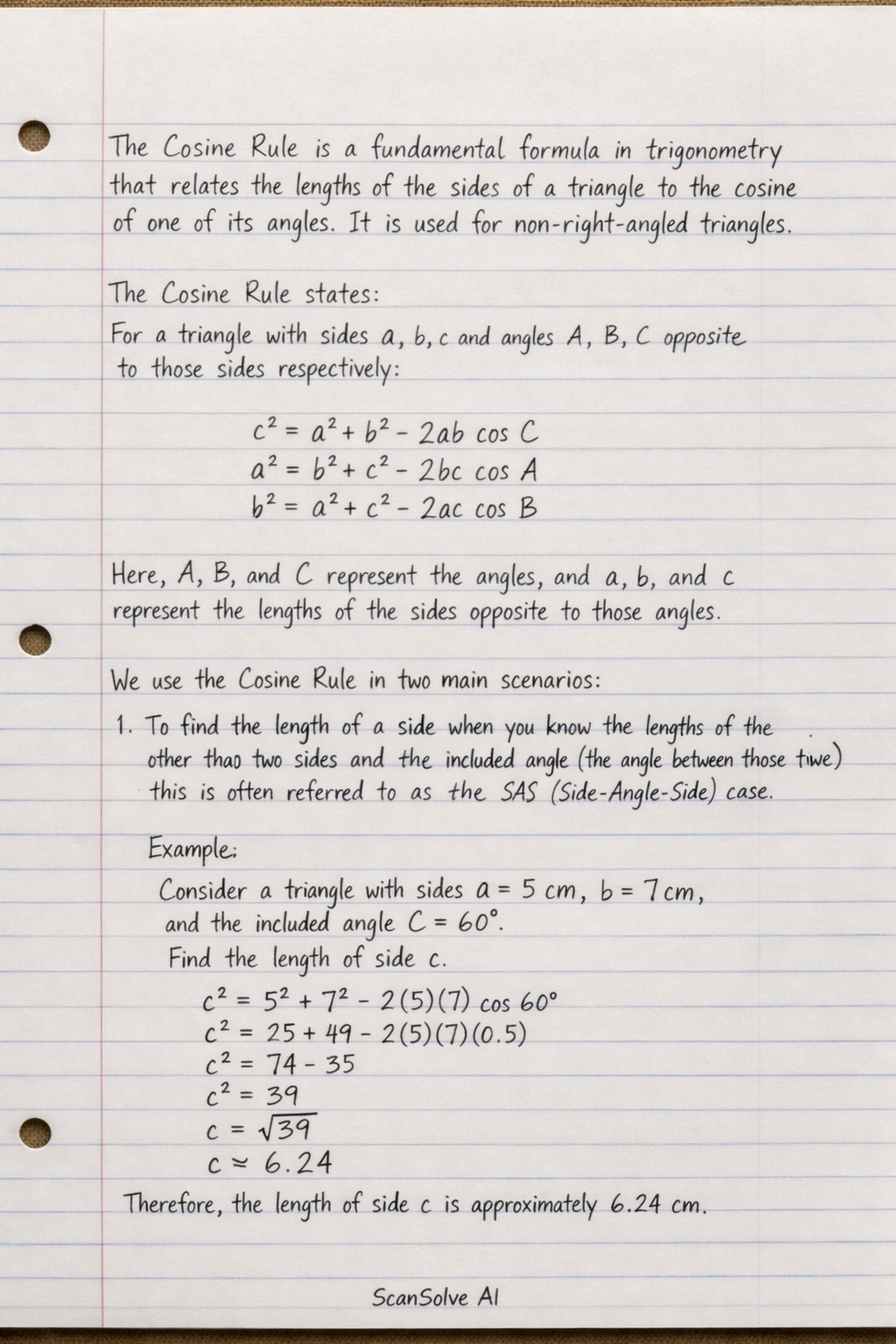
The Cosine Rule is a fundamental formula in trigonometry that relates the lengths of the sides of a triangle to the cosine of one of its angles. It is used for non-right-angled triangles.
The Cosine Rule states:
For a triangle with sides $a$, $b$, $c$ and angles $A$, $B$, $C$ opposite to those sides respectively:
$$c^2 = a^2 + b^2 - 2ab \cos C$$
Similarly, it can be written for other sides:
$$a^2 = b^2 + c^2 - 2bc \cos A$$
$$b^2 = a^2 + c^2 - 2ac \cos B$$
Here, $A$, $B$, and $C$ represent the angles, and $a$, $b$, and $c$ represent the lengths of the sides opposite to those angles.
We use the Cosine Rule in two main scenarios:
1. To find the length of a side when you know the lengths of the other two sides and the included angle (the angle between those two sides). This is often referred to as the SAS (Side-Angle-Side) case.
Example:
Consider a triangle with sides $a = 5 \, \text{cm}$, $b = 7 \, \text{cm}$, and the included angle $C = 60^\circ$. Find the length of side $c$.
Step 1: Write down the Cosine Rule for side $c$.
$$c^2 = a^2 + b^2 - 2ab \cos C$$
Step 2: Substitute the given values.
$$c^2 = (5)^2 + (7)^2 - 2(5)(7) \cos 60^\circ$$
Step 3: Calculate the values.
$$c^2 = 25 + 49 - 70 \times 0.5$$
$$c^2 = 74 - 35$$
$$c^2 = 39$$
Step 4: Solve for $c$.
$$c = \sqrt{39}$$
$$c \approx 6.245$$
The length of side $c$ is approximately $\boxed{6.25 \, \text{cm}}$ (to 3 significant figures).
2. To find the measure of an angle when you know the lengths of all three sides of the triangle. This is often referred to as the SSS (Side-Side-Side) case.
Example:
Consider a triangle with sides $a = 3 \, \text{cm}$, $b = 4 \, \text{cm}$, and $c = 5 \, \text{cm}$. Find the measure of angle $C$.
Step 1: Rearrange the Cosine Rule to solve for $\cos C$.
Starting from $c^2 = a^2 + b^2 - 2ab \cos C$:
$$2ab \cos C = a^2 + b^2 - c^2$$
$$\cos C = \frac{a^2 + b^2 - c^2}{2ab}$$
Step 2: Substitute the given values.
$$\cos C = \frac{(3)^2 + (4)^2 - (5)^2}{2(3)(4)}$$
Step 3: Calculate the value of $\cos C$.
$$\cos C = \frac{9 + 16 - 25}{24}$$
$$\cos C = \frac{25 - 25}{24}$$
$$\cos C = \frac{0}{24}$$
$$\cos C = 0$$
Step 4: Find the angle $C$ using the inverse cosine function.
$$C = \arccos(0)$$
$$C = 90^\circ$$
The measure of angle $C$ is $\boxed{90^\circ}$. (This particular example forms a right-angled triangle, which is a special case).
How do we use cosine rule in trigonometry
|Mathematics
ScanSolve AI Answer
The Cosine Rule is a fundamental formula in trigonometry that relates the lengths of the sides of a triangle to the cosine of one of its angles. It is used for non-right-angled triangles.
The Cosine Rule states:
For a triangle with sides a, b, c and angles A, B, C opposite to those sides respectively:
c2=a2+b2−2abcosC
Similarly, it can be written for other sides:
a2=b2+c2−2bccosAb2=a2+c2−2accosB
Here, A, B, and C represent the angles, and a, b, and c represent the lengths of the sides opposite to those angles.
We use the Cosine Rule in two main scenarios:
To find the length of a side when you know the lengths of the other two sides and the included angle (the angle between those two sides). This is often referred to as the SAS (Side-Angle-Side) case.
Example:
Consider a triangle with sides a=5cm, b=7cm, and the included angle C=60∘. Find the length of side c.
Step 1: Write down the Cosine Rule for side c.
c2=a2+b2−2abcosC
Step 2: Substitute the given values.
c2=(5)2+(7)2−2(5)(7)cos60∘
Step 3: Calculate the values.
c2=25+49−70×0.5c2=74−35c2=39
Step 4: Solve for c.
c=39c≈6.245
The length of side c is approximately 6.25cm (to 3 significant figures).
To find the measure of an angle when you know the lengths of all three sides of the triangle. This is often referred to as the SSS (Side-Side-Side) case.
Example:
Consider a triangle with sides a=3cm, b=4cm, and c=5cm. Find the measure of angle C.
Step 1: Rearrange the Cosine Rule to solve for cosC.
Starting from c2=a2+b2−2abcosC:
2abcosC=a2+b2−c2cosC=2aba2+b2−c2
Step 2: Substitute the given values.
cosC=2(3)(4)(3)2+(4)2−(5)2
Step 3: Calculate the value of cosC.
cosC=249+16−25cosC=2425−25cosC=240cosC=0
Step 4: Find the angle C using the inverse cosine function.
C=arccos(0)C=90∘
The measure of angle C is 90∘. (This particular example forms a right-angled triangle, which is a special case).
Need help with your own homework?
Get instant step-by-step solutions to any question. Free to start.