

This mathematics problem involves applying core mathematical principles and formulas. Below you will find a complete step-by-step solution with detailed explanations for each step, helping you understand not just the answer but the method behind it.
ScanSolve AI Answer
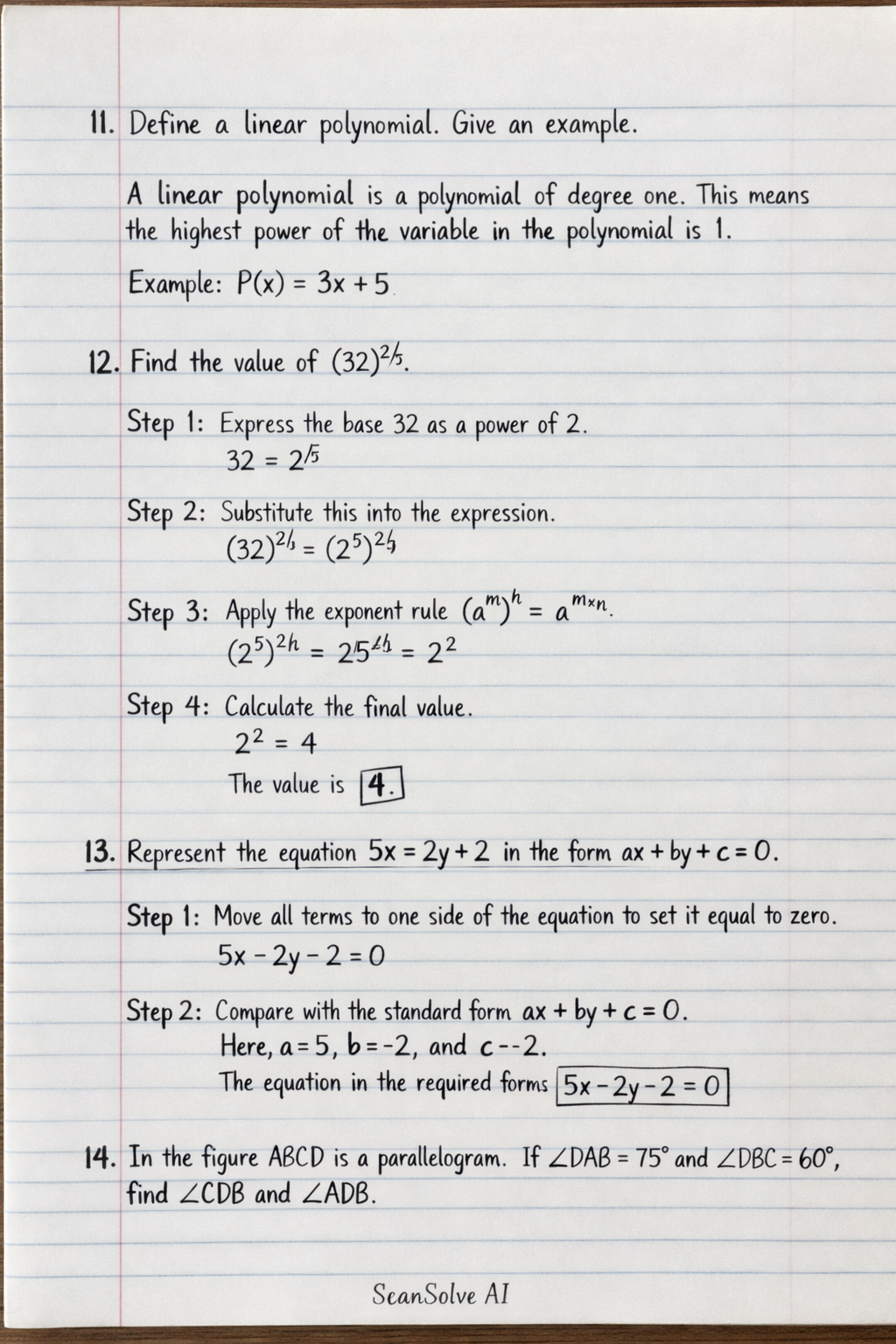
11. Define a linear polynomial. Give an example. A linear polynomial is a polynomial of degree one. This means the highest power of the variable in the polynomial is 1. Example: P(x) = 3x + 5 12. Find the value of (32)^(2)/(5). Step 1: Express the base 32 as a power of 2. 32 = 2^5 Step 2: Substitute this into the expression. (32)^(2)/(5) = (2^5)^(2)/(5) Step 3: Apply the exponent rule (a^m)^n = a^m × n. (2^5)^(2)/(5) = 2^5 × (2)/(5) = 2^2 Step 4: Calculate the final value. 2^2 = 4 The value is 4. 13. Represent the equation 5x = 2y + 2 in the form of ax + by + c = 0. Step 1: Move all terms to one side of the equation to set it equal to zero. 5x - 2y - 2 = 0 Step 2: Compare with the standard form ax + by + c = 0. Here, a=5, b=-2, and c=-2. The equation in the required form is 5x - 2y - 2 = 0. 14. In the figure ABCD is a parallelogram if DAB = 75^ and DBC = 60^, find CDB and ADB. Step 1: Use the property of alternate interior angles for parallel lines. In a parallelogram ABCD, side AD BC. When BD is a transversal, ADB = DBC (alternate interior angles). Given DBC = 60^. Therefore, ADB = 60^. Step 2: Use the property of adjacent angles in a parallelogram. Adjacent angles in a parallelogram are supplementary. DAB + ABC = 180^ Given DAB = 75^. 75^ + ABC = 180^ ABC = 180^ - 75^ ABC = 105^ Step 3: Find ABD. We know that ABC = ABD + DBC. 105^ = ABD + 60^ ABD = 105^ - 60^ ABD = 45^ Step 4: Use the property of alternate interior angles again. In a parallelogram ABCD, side AB DC. When BD is a transversal, CDB = ABD (alternate interior angles). Since ABD = 45^. Therefore, CDB = 45^. The values are CDB = 45^ and ADB = 60^. 15. The surface area of a sphere is 100 cm^2. Find its radius. Step 1: Write the formula for the surface area of a sphere. The surface area A of a sphere with radius r is given by: A = 4 r^2 Step 2: Substitute the given surface area into the formula. 100 cm^2 = 4 r^2 Step 3: Solve for r^2. Divide both sides by 4: (100)/(4) = r^2 25 = r^2 Step 4: Solve for r. r = sqrt(25) r = 5 cm The radius of the sphere is 5 cm. 16. Verify whether x = (4)/(5) is a zero of a polynomial p(x) = 5x - . Step 1: Substitute the given value of x into the polynomial. p((4)/(5)) = 5((4)/(5)) - Step 2: Simplify the expression. p((4)/(5)) = 4 - Step 3: Check if the result is zero. Since 4 - ≠ 0 (as ≈ 3.14159), x = (4)/(5) is not a zero of the polynomial. No, x = (4)/(5) is not a zero of p(x) = 5x - . 17. Express 1.27 in the form of (p)/(q). Step 1: Let x be the given repeating decimal. x = 1.272727... (1) Step 2: Since two digits are repeating, multiply equation (1) by 10^2 = 100. 100x = 127.272727... (2) Step 3: Subtract equation (1) from equation (2). 100x - x = 127.272727... - 1.272727... 99x = 126 Step 4: Solve for x. x = (126)/(99) Step 5: Simplify the fraction by dividing the numerator and denominator by their greatest common divisor, which is 9. x = (126 ÷ 9)/(99 ÷ 9) x = (14)/(11) The value of 1.27 in the form (p)/(q) is (14)/(11). 18. In the figure, O is the centre of the circle. If BOC = 100^, then find the value of x. Step 1: Identify the relationship between the angle at the center and the angle at the circumference. The angle subtended by an arc at the center is double the angle subtended by it at any point on the remaining part of the circle. Here, arc BC subtends BOC at the center O and BDC (which is x) at point D on the circumference. Step 2: Apply the theorem. BDC = (1)/(2) BOC Step 3: Substitute the given value of BOC. x = (1)/(2) × 100^ x = 50^ The value of x is 50^. 19. Verify which of the following are solutions of the equation x + 2y = 6. (a) (2, 2) (b) (0, 3) To verify, substitute the x and y values from each option into the equation x + 2y = 6. *a) For the point (2, 2): Substitute x=2 and y=2 into the equation: 2 + 2(2) = 6 2 + 4 = 6 6 = 6 Since the left side equals the right side, (2, 2) is a solution. *b) For the point (0, 3): Substitute x=0 and y=3 into the equation: 0 + 2(3) = 6 0 + 6 = 6 6 = 6 Since the left side equals the right side, (0, 3) is a solution. Both (a) and (b) are solutions to the equation x + 2y = 6. Both (a) (2, 2) and (b) (0, 3) are solutions.