Determine which of the following sequences are arithmetic progressions and find the next three terms for each AP: (i) 2, 4, 8, 16,... (ii) 2, 5/2, 3, 7/2,... (iii) -1.2, -3.2, -5.2, -7.2,...
|Mathematics
Determine which of the following sequences are arithmetic progressions and find the next three terms for each AP: (i) 2, 4, 8, 16,... (ii) 2, 5/2, 3, 7/2,... (iii) -1.2, -3.2, -5.2, -7.2,...
ScanSolve AI Answer
Answer
21
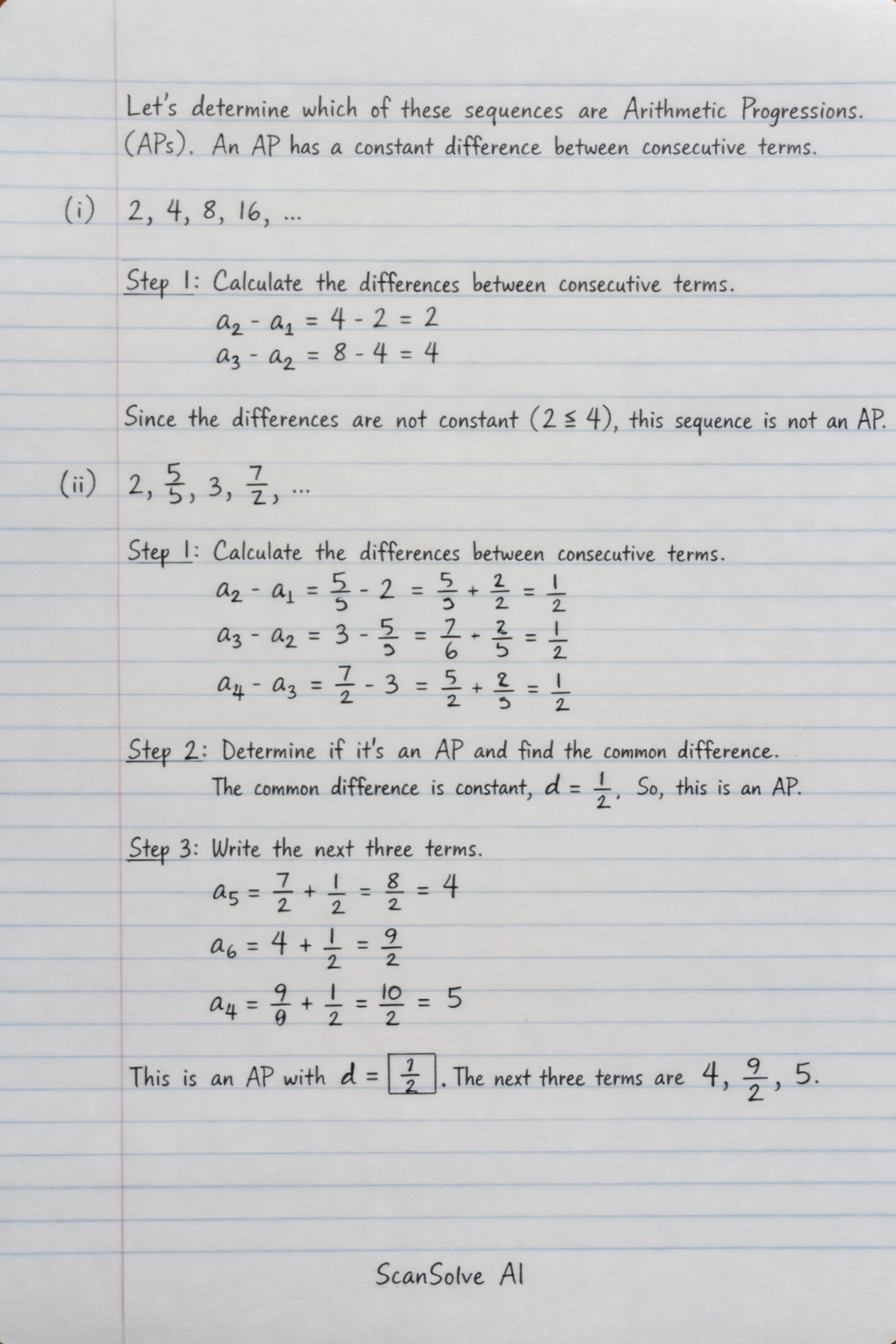
Let's determine which of these sequences are Arithmetic Progressions (APs). An AP has a constant difference between consecutive terms.
(i) 2,4,8,16,…
Step 1: Calculate the differences between consecutive terms.
a2−a1=4−2=2a3−a2=8−4=4
Since the differences are not constant (2=4), this sequence is not an AP.
(ii) 2,25,3,27,…
Step 1: Calculate the differences between consecutive terms.
a2−a1=25−2=25−24=21a3−a2=3−25=26−25=21a4−a3=27−3=27−26=21
Step 2: Determine if it's an AP and find the common difference.
The common difference is constant, d=21. So, this is an AP.
Step 3: Write the next three terms.
a5=27+21=28=4a6=4+21=29a7=29+21=210=5
This is an AP with d = \frac{1{2}}. The next three terms are 4,29,5.
(iii) −1.2,−3.2,−5.2,−7.2,…
Step 1: Calculate the differences between consecutive terms.
a2−a1=−3.2−(−1.2)=−3.2+1.2=−2.0a3−a2=−5.2−(−3.2)=−5.2+3.2=−2.0a4−a3=−7.2−(−5.2)=−7.2+5.2=−2.0
Step 2: Determine if it's an AP and find the common difference.
The common difference is constant, d=−2.0. So, this is an AP.
Step 3: Write the next three terms.
a5=−7.2+(−2.0)=−9.2a6=−9.2+(−2.0)=−11.2a7=−11.2+(−2.0)=−13.2
This is an AP with d=−2.0. The next three terms are −9.2,−11.2,−13.2.
(iv) −10,−6,−2,2,…
Step 1: Calculate the differences between consecutive terms.
a2−a1=−6−(−10)=−6+10=4a3−a2=−2−(−6)=−2+6=4a4−a3=2−(−2)=2+2=4
Step 2: Determine if it's an AP and find the common difference.
The common difference is constant, d=4. So, this is an AP.
Step 3: Write the next three terms.
a5=2+4=6a6=6+4=10a7=10+4=14
This is an AP with d=4. The next three terms are 6,10,14.
(v) 3,3+2,3+22,3+32,…
Step 1: Calculate the differences between consecutive terms.
a2−a1=(3+2)−3=2a3−a2=(3+22)−(3+2)=3+22−3−2=2a4−a3=(3+32)−(3+22)=3+32−3−22=2
Step 2: Determine if it's an AP and find the common difference.
The common difference is constant, d=2. So, this is an AP.
Step 3: Write the next three terms.
a5=(3+32)+2=3+42a6=(3+42)+2=3+52a7=(3+52)+2=3+62
This is an AP with d=2. The next three terms are 3+42,3+52,3+62.
(vi) 0.2,0.22,0.222,0.2222,…
Step 1: Calculate the differences between consecutive terms.
a2−a1=0.22−0.2=0.02a3−a2=0.222−0.22=0.002
Since the differences are not constant (0.02=0.002), this sequence is not an AP.
(vii) 0,−4,−8,−12,…
Step 1: Calculate the differences between consecutive terms.
a2−a1=−4−0=−4a3−a2=−8−(−4)=−8+4=−4a4−a3=−12−(−8)=−12+8=−4
Step 2: Determine if it's an AP and find the common difference.
The common difference is constant, d=−4. So, this is an AP.
Step 3: Write the next three terms.
a5=−12+(−4)=−16a6=−16+(−4)=−20a7=−20+(−4)=−24
This is an AP with d=−4. The next three terms are −16,−20,−24.
(viii) −21,−21,−21,−21,…
Step 1: Calculate the differences between consecutive terms.
a2−a1=−21−(−21)=0a3−a2=−21−(−21)=0a4−a3=−21−(−21)=0
Step 2: Determine if it's an AP and find the common difference.
The common difference is constant, d=0. So, this is an AP.
Step 3: Write the next three terms.
a5=−21+0=−21a6=−21+0=−21a7=−21+0=−21
This is an AP with d=0. The next three terms are −21,−21,−21.
Last free one today — make it count tomorrow, or type /upgrade for unlimited.
Was this helpful?
Need help with your own homework?
Get instant step-by-step solutions to any question. Free to start.
An AP has a constant difference between consecutive terms. (i) 2, 4, 8, 16, Step 1: Calculate the differences between consecutive terms.
Determine which of the following sequences are arithmetic progressions and find the next three terms for each AP: (i) 2, 4, 8, 16,... (ii) 2, 5/2, 3, 7/2,... (iii) -1.2, -3.2, -5.2, -7.2,...
This mathematics problem involves applying core mathematical principles and formulas. Below you will find a complete step-by-step solution with detailed explanations for each step, helping you understand not just the answer but the method behind it.
ScanSolve AI Answer
Let's determine which of these sequences are Arithmetic Progressions (APs). An AP has a constant difference between consecutive terms. (i) 2, 4, 8, 16, Step 1: Calculate the differences between consecutive terms. a_2 - a_1 = 4 - 2 = 2 a_3 - a_2 = 8 - 4 = 4 Since the differences are not constant (2 ≠ 4), this sequence is not an AP. (ii) 2, (5)/(2), 3, (7)/(2), Step 1: Calculate the differences between consecutive terms. a_2 - a_1 = (5)/(2) - 2 = (5)/(2) - (4)/(2) = (1)/(2) a_3 - a_2 = 3 - (5)/(2) = (6)/(2) - (5)/(2) = (1)/(2) a_4 - a_3 = (7)/(2) - 3 = (7)/(2) - (6)/(2) = (1)/(2) Step 2: Determine if it's an AP and find the common difference. The common difference is constant, d = (1)/(2). So, this is an AP. Step 3: Write the next three terms. a_5 = (7)/(2) + (1)/(2) = (8)/(2) = 4 a_6 = 4 + (1)/(2) = (9)/(2) a_7 = (9)/(2) + (1)/(2) = (10)/(2) = 5 This is an AP with d = (1)/(2). The next three terms are 4, (9)/(2), 5. (iii) -1.2, -3.2, -5.2, -7.2, Step 1: Calculate the differences between consecutive terms. a_2 - a_1 = -3.2 - (-1.2) = -3.2 + 1.2 = -2.0 a_3 - a_2 = -5.2 - (-3.2) = -5.2 + 3.2 = -2.0 a_4 - a_3 = -7.2 - (-5.2) = -7.2 + 5.2 = -2.0 Step 2: Determine if it's an AP and find the common difference. The common difference is constant, d = -2.0. So, this is an AP. Step 3: Write the next three terms. a_5 = -7.2 + (-2.0) = -9.2 a_6 = -9.2 + (-2.0) = -11.2 a_7 = -11.2 + (-2.0) = -13.2 This is an AP with d = -2.0. The next three terms are -9.2, -11.2, -13.2. (iv) -10, -6, -2, 2, Step 1: Calculate the differences between consecutive terms. a_2 - a_1 = -6 - (-10) = -6 + 10 = 4 a_3 - a_2 = -2 - (-6) = -2 + 6 = 4 a_4 - a_3 = 2 - (-2) = 2 + 2 = 4 Step 2: Determine if it's an AP and find the common difference. The common difference is constant, d = 4. So, this is an AP. Step 3: Write the next three terms. a_5 = 2 + 4 = 6 a_6 = 6 + 4 = 10 a_7 = 10 + 4 = 14 This is an AP with d = 4. The next three terms are 6, 10, 14. (v) 3, 3+sqrt(2), 3+2sqrt(2), 3+3sqrt(2), Step 1: Calculate the differences between consecutive terms. a_2 - a_1 = (3+sqrt(2)) - 3 = sqrt(2) a_3 - a_2 = (3+2sqrt(2)) - (3+sqrt(2)) = 3+2sqrt(2) - 3 - sqrt(2) = sqrt(2) a_4 - a_3 = (3+3sqrt(2)) - (3+2sqrt(2)) = 3+3sqrt(2) - 3 - 2sqrt(2) = sqrt(2) Step 2: Determine if it's an AP and find the common difference. The common difference is constant, d = sqrt(2). So, this is an AP. Step 3: Write the next three terms. a_5 = (3+3sqrt(2)) + sqrt(2) = 3+4sqrt(2) a_6 = (3+4sqrt(2)) + sqrt(2) = 3+5sqrt(2) a_7 = (3+5sqrt(2)) + sqrt(2) = 3+6sqrt(2) This is an AP with d = sqrt(2). The next three terms are 3+4sqrt(2), 3+5sqrt(2), 3+6sqrt(2). (vi) 0.2, 0.22, 0.222, 0.2222, Step 1: Calculate the differences between consecutive terms. a_2 - a_1 = 0.22 - 0.2 = 0.02 a_3 - a_2 = 0.222 - 0.22 = 0.002 Since the differences are not constant (0.02 ≠ 0.002), this sequence is not an AP. (vii) 0, -4, -8, -12, Step 1: Calculate the differences between consecutive terms. a_2 - a_1 = -4 - 0 = -4 a_3 - a_2 = -8 - (-4) = -8 + 4 = -4 a_4 - a_3 = -12 - (-8) = -12 + 8 = -4 Step 2: Determine if it's an AP and find the common difference. The common difference is constant, d = -4. So, this is an AP. Step 3: Write the next three terms. a_5 = -12 + (-4) = -16 a_6 = -16 + (-4) = -20 a_7 = -20 + (-4) = -24 This is an AP with d = -4. The next three terms are -16, -20, -24. (viii) -(1)/(2), -(1)/(2), -(1)/(2), -(1)/(2), Step 1: Calculate the differences between consecutive terms. a_2 - a_1 = -(1)/(2) - (-(1)/(2)) = 0 a_3 - a_2 = -(1)/(2) - (-(1)/(2)) = 0 a_4 - a_3 = -(1)/(2) - (-(1)/(2)) = 0 Step 2: Determine if it's an AP and find the common difference. The common difference is constant, d = 0. So, this is an AP. Step 3: Write the next three terms. a_5 = -(1)/(2) + 0 = -(1)/(2) a_6 = -(1)/(2) + 0 = -(1)/(2) a_7 = -(1)/(2) + 0 = -(1)/(2) This is an AP with d = 0. The next three terms are -(1)/(2), -(1)/(2), -(1)/(2). Last free one today — make it count tomorrow, or type /upgrade for unlimited.