We read your photo as:

William earns straight commission as a real-estate agent. Last month his total sales were R971 168, 00. If William earns a 3% rate of commission, what was his total income last month?

Mathematics

ScanSolve AI Answer

Step-by-step solution

30 steps

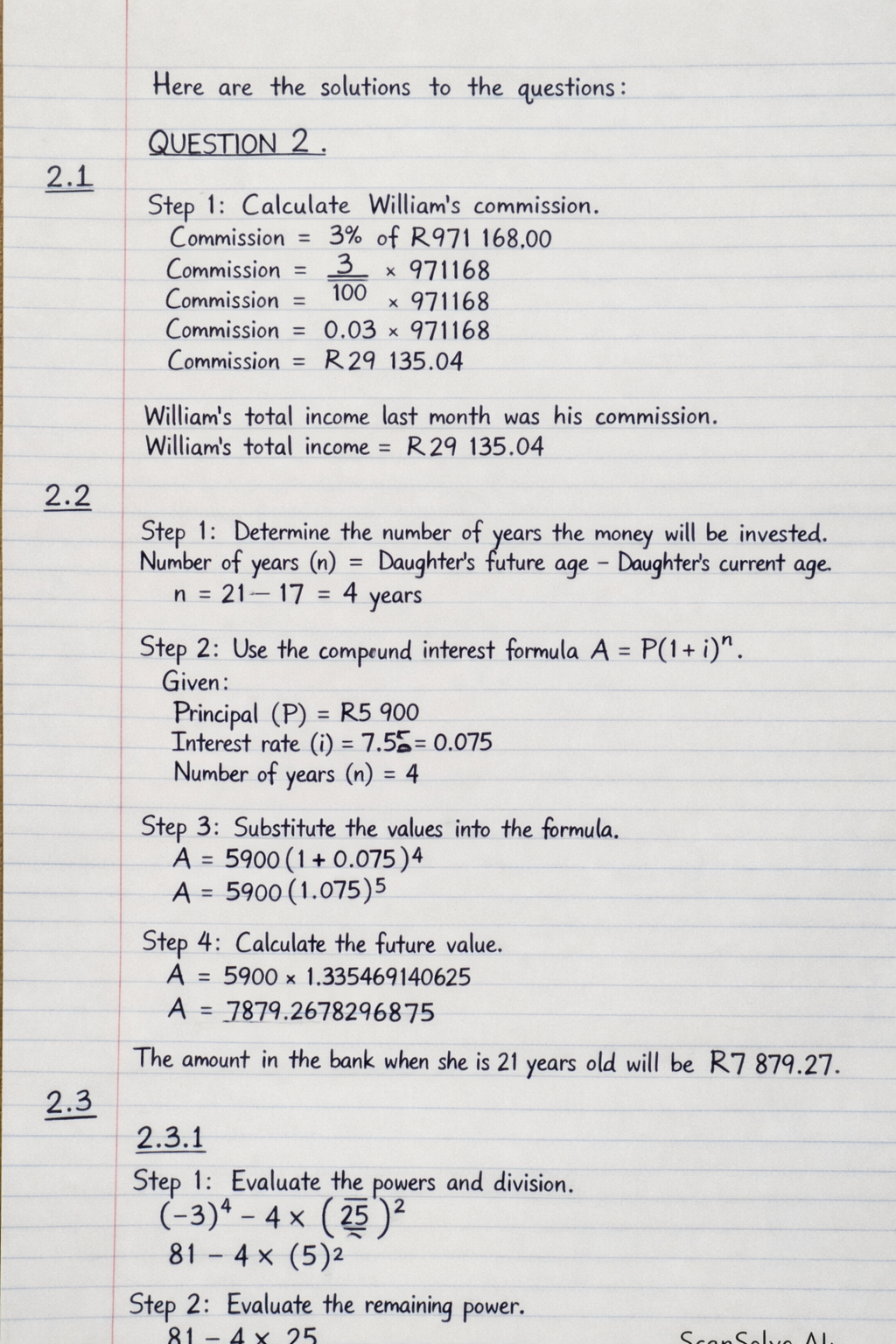
Here are the solutions to the questions:

QUESTION 2

2.1

  1. Calculate William's commission.

    Commission = 3% of R971 168.00
    Commission = 3100×971168\frac{3}{100} \times 971168
    Commission = 0.03×9711680.03 \times 971168
    Commission = R29 135.04

    William's total income last month was his commission.
    William's total income = R29 135.04

    2.2

  2. Determine the number of years the money will be invested.

    Number of years (nn) = Daughter's future age - Daughter's current age
    n=21−17=4n = 21 - 17 = 4 years

  3. Use the compound interest formula A=P(1+i)nA = P(1 + i)^n.

    Given:
    Principal (PP) = R5 900
    Interest rate (ii) = 7.5% = 0.075
    Number of years (nn) = 4

  4. Substitute the values into the formula.

    A=5900(1+0.075)4A = 5900(1 + 0.075)^4
    A=5900(1.075)4A = 5900(1.075)^4

  5. Calculate the future value.

    A=5900×1.335469140625A = 5900 \times 1.335469140625
    A=7879.2678296875A = 7879.2678296875

    The amount in the bank when she is 21 years old will be R7 879.27.

    2.3
    2.3.1

  6. Evaluate the powers and division.

    (−3)4−4×(255)2(-3)^4 - 4 \times \left(\frac{25}{5}\right)^2 81−4×(5)281 - 4 \times (5)^2
  7. Evaluate the remaining power.

    81−4×2581 - 4 \times 25
  8. Perform the multiplication.

    81−10081 - 100
  9. Perform the subtraction.

    −19-19

    The value is −19\boxed{-19}.

    2.3.2

  10. Simplify the terms inside the parenthesis.

    (9+125524−81)2\left(\frac{\sqrt{9} + \sqrt{\frac{125}{5}}}{2^4 - \sqrt{81}}\right)^2 (3+2516−9)2\left(\frac{3 + \sqrt{25}}{16 - 9}\right)^2
  11. Continue simplifying the terms.

    (3+57)2\left(\frac{3 + 5}{7}\right)^2 (87)2\left(\frac{8}{7}\right)^2
  12. Square the fraction.

    8272\frac{8^2}{7^2} 6449\frac{64}{49}

    The value is 6449\boxed{\frac{64}{49}}.

    QUESTION 3

    3.1
    3.1.1

  13. Apply the power rule (am)n=amn(a^m)^n = a^{mn} and (ab)n=anbn(ab)^n = a^n b^n.

    −3(y−1x2)−3×(yx)−5-3(y^{-1}x^2)^{-3} \times (yx)^{-5} −3(y(−1)×(−3)x2×(−3))×(y−5x−5)-3(y^{(-1) \times (-3)} x^{2 \times (-3)}) \times (y^{-5}x^{-5}) −3(y3x−6)×(y−5x−5)-3(y^3 x^{-6}) \times (y^{-5}x^{-5})
  14. Multiply the terms, combining like bases using aman=am+na^m a^n = a^{m+n}.

    −3y3+(−5)x−6+(−5)-3 y^{3+(-5)} x^{-6+(-5)} −3y−2x−11-3 y^{-2} x^{-11}
  15. Express with positive exponents.

    −3y2x11\boxed{-\frac{3}{y^2 x^{11}}}

    3.1.2

  16. Simplify the term 1a−2\frac{1}{a^{-2}} to a2a^2.

    (a2+a2a2×a2)−2\left(\frac{a^2 + a^2}{a^2 \times a^2}\right)^{-2}
  17. Simplify the numerator and denominator inside the parenthesis.

    (2a2a2+2)−2\left(\frac{2a^2}{a^{2+2}}\right)^{-2} (2a2a4)−2\left(\frac{2a^2}{a^4}\right)^{-2}
  18. Simplify the fraction inside the parenthesis using aman=am−n\frac{a^m}{a^n} = a^{m-n}.

    (2a2−4)−2\left(2a^{2-4}\right)^{-2} (2a−2)−2\left(2a^{-2}\right)^{-2}
  19. Apply the outer power of −2-2.

    2−2(a−2)−22^{-2} (a^{-2})^{-2} 2−2a(−2)×(−2)2^{-2} a^{(-2) \times (-2)} 2−2a42^{-2} a^4
  20. Express with positive exponents.

    a422\frac{a^4}{2^2} a44\boxed{\frac{a^4}{4}}

    3.1.3

  21. Expand the product of the two binomials (x−4)(2x+3y)(x-4)(2x+3y) using the FOIL method.

    3(x⋅2x+x⋅3y−4⋅2x−4⋅3y)3(x \cdot 2x + x \cdot 3y - 4 \cdot 2x - 4 \cdot 3y) 3(2x2+3xy−8x−12y)3(2x^2 + 3xy - 8x - 12y)
  22. Distribute the 3 to each term inside the parenthesis.

    3×2x2+3×3xy−3×8x−3×12y3 \times 2x^2 + 3 \times 3xy - 3 \times 8x - 3 \times 12y 6x2+9xy−24x−36y\boxed{6x^2 + 9xy - 24x - 36y}

    3.1.4

  23. Factor out the common term in the numerator of the first fraction.

    2x(x−1)x×1x2−2x+1\frac{2x(x - 1)}{x} \times \frac{1}{x^2 - 2x + 1}
  24. Simplify the first fraction by cancelling xx.

    2(x−1)×1x2−2x+12(x - 1) \times \frac{1}{x^2 - 2x + 1}
  25. Factor the denominator of the second fraction, which is a perfect square trinomial (x−1)2(x-1)^2.

    2(x−1)×1(x−1)22(x - 1) \times \frac{1}{(x - 1)^2}
  26. Multiply the terms and simplify by cancelling (x−1)(x-1).

    2(x−1)(x−1)2\frac{2(x - 1)}{(x - 1)^2} 2x−1\frac{2}{x - 1}

    The simplified expression is 2x−1\boxed{\frac{2}{x - 1}}.

    3.2
    3.2.1

  27. Recognize the expression as a difference of squares, a2−b2=(a−b)(a+b)a^2 - b^2 = (a-b)(a+b).

    Here, a2=16y2  ⟹  a=16y2=4ya^2 = 16y^2 \implies a = \sqrt{16y^2} = 4y.
    And b2=p2  ⟹  b=p2=pb^2 = p^2 \implies b = \sqrt{p^2} = p.

  28. Apply the difference of squares formula.

    (4y−p)(4y+p)\boxed{(4y - p)(4y + p)}

    3.2.2

  29. Factor the quadratic trinomial x2+9x+14x^2 + 9x + 14.

    We need to find two numbers that multiply to 14 and add up to 9.
    These numbers are 2 and 7 (2×7=142 \times 7 = 14 and 2+7=92 + 7 = 9).

  30. Write the factored form.

    (x+2)(x+7)\boxed{(x + 2)(x + 7)}
Was this helpful?

Still stuck on this one?

Ask a follow-up, and the answer starts from this question.

Got a different question?Ask your own question
Handwritten step-by-step solution preview

Handwritten Step-by-Step Solution

Get this as a handwritten image on WhatsApp — like a tutor wrote it for you.

Try on WhatsApp