
We read your photo as:
Calculate with units of length. Will practice doing calculations with units of length. Remember to convert to the same unit before you calculate.
ScanSolve AI Answer
Step-by-step solution
24 steps3:
1. Round off these lengths to the nearest and .
- a)
To the nearest , look at the units digit (6).
Since , round up the tens digit.
To the nearest , look at the tens digit (6).
Since , round up the hundreds digit.
- b)
To the nearest , look at the units digit (5).
Since , round up the tens digit.
To the nearest , look at the tens digit (3).
Since , round down.
- c)
To the nearest , look at the units digit (8).
Since , round up the tens digit.
To the nearest , look at the tens digit (0).
Since , round down.
2. Round off these lengths to the nearest .
- a)
To the nearest , look at the hundreds digit (5).
Since , round up the thousands digit.
- b)
To the nearest , look at the hundreds digit (5).
Since , round up the thousands digit.
- c)
To the nearest , look at the hundreds digit (4).
Since , round down.
3. Do these calculations.
- a)
Add the two lengths.
$$ 32456 \text{ m} + 12123 \text{ m} = \boxed{44579 \text{ m}} $$- b)
Convert to metres ().
$$ 9 \text{ km} = 9 \times 1000 \text{ m} = 9000 \text{ m} $$Subtract the lengths.
$$ 9000 \text{ m} - 7367 \text{ m} = \boxed{1633 \text{ m}} $$- c)
Convert all lengths to centimetres ().
$$ 34 \frac{1}{2} \text{ cm} = 34.5 \text{ cm} $$ $$ 500 \text{ mm} = \frac{500}{10} \text{ cm} = 50 \text{ cm} $$Add the lengths.
$$ 34.5 \text{ cm} + 12 \text{ cm} + 50 \text{ cm} = \boxed{96.5 \text{ cm}} $$- d)
Add the fractions with the same denominator.
$$ \frac{1}{8} \text{ m} + \frac{2}{8} \text{ m} = \frac{1+2}{8} \text{ m} = \boxed{\frac{3}{8} \text{ m}} $$4. Do these calculations.
- a)
Multiply the values.
$$ 340 \text{ m} \times 12 = \boxed{4080 \text{ m}} $$- b)
Multiply the values.
$$ 224 \text{ km} \times 15 = \boxed{3360 \text{ km}} $$- c)
Divide the values.
$$ 440 \text{ m} \div 20 = \boxed{22 \text{ m}} $$- d)
Divide the values.
$$ 345 \text{ cm} \div 5 = \boxed{69 \text{ cm}} $$5. How many quarters of a metre are there in ?
Convert the mixed number to an improper fraction.
A quarter of a metre is .
To find how many quarters are in , divide by .
There are quarters of a metre.
6. The odometers recorded the following distances from the odometers of her aunts and uncles.
- Order the distances the cars have travelled from the shortest to the longest distance.
Compare the given distances.
$$ 11961 \text{ km}, 12374 \text{ km}, 25135 \text{ km}, 60901 \text{ km}, 78345 \text{ km} $$- Estimate and then calculate the total distance that all the cars have travelled.
Estimate* the total distance by rounding each distance to the nearest thousand kilometres.
$$ 12374 \text{ km} \approx 12000 \text{ km} $$ $$ 25135 \text{ km} \approx 25000 \text{ km} $$ $$ 60901 \text{ km} \approx 61000 \text{ km} $$ $$ 78345 \text{ km} \approx 78000 \text{ km} $$ $$ 11961 \text{ km} \approx 12000 \text{ km} $$ Estimated total: $12000 + 25000 + 61000 + 78000 + 12000 = \boxed{188000 \text{ km}}$Calculate* the exact total distance by adding all the given distances.
$$
12374 \text{ km} + 25135 \text{ km} + 60901 \text{ km} + 78345 \text{ km} + 11961 \text{ km} = \boxed{188716 \text{ km}}
$$
Still stuck on this one?
Ask a follow-up, and the answer starts from this question.
More Mathematics Questions
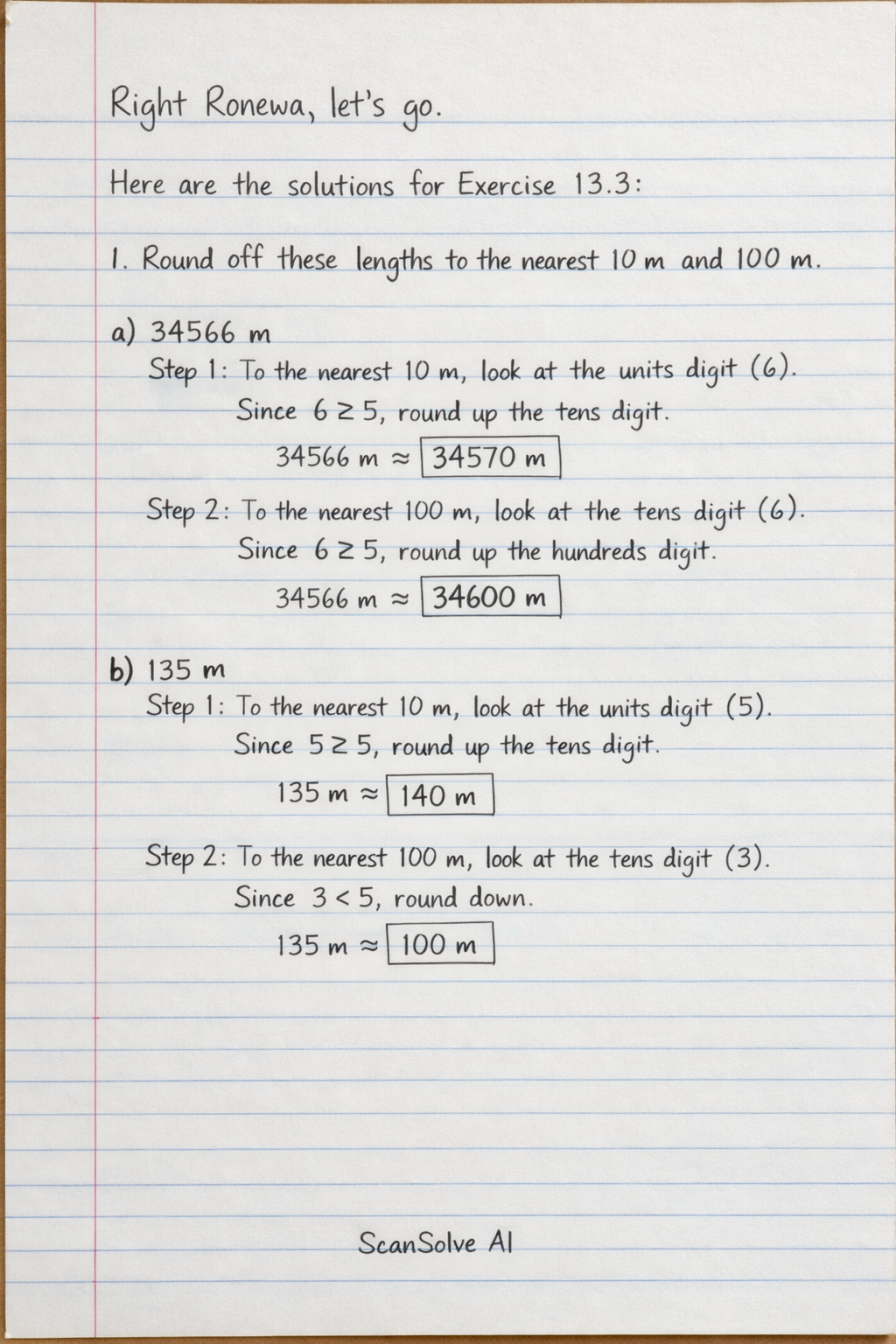
Handwritten Step-by-Step Solution
Get this as a handwritten image on WhatsApp — like a tutor wrote it for you.
Try on WhatsApp