

This mathematics problem involves applying core mathematical principles and formulas. Below you will find a complete step-by-step solution with detailed explanations for each step, helping you understand not just the answer but the method behind it.
ScanSolve AI Answer
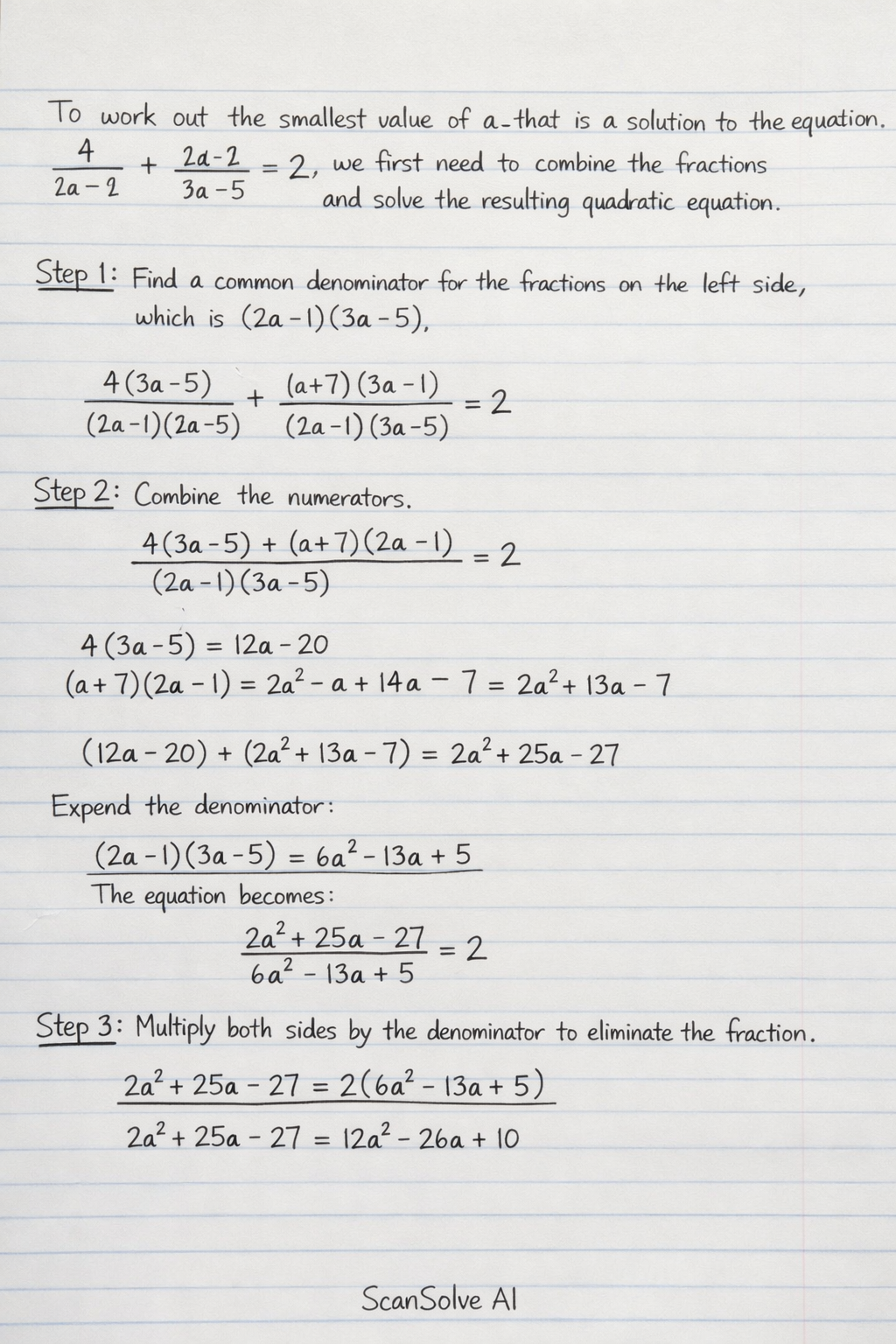
To work out the smallest value of a that is a solution to the equation (4)/(2a - 1) + (a + 7)/(3a - 5) = 2, we first need to combine the fractions and solve the resulting quadratic equation. Step 1: Find a common denominator for the fractions on the left side, which is (2a - 1)(3a - 5). (4(3a - 5))/((2a - 1)(3a - 5)) + ((a + 7)(2a - 1))/((2a - 1)(3a - 5)) = 2 Step 2: Combine the numerators. (4(3a - 5) + (a + 7)(2a - 1))/((2a - 1)(3a - 5)) = 2 Expand the terms in the numerator: 4(3a - 5) = 12a - 20 (a + 7)(2a - 1) = 2a^2 - a + 14a - 7 = 2a^2 + 13a - 7 Sum of numerators: (12a - 20) + (2a^2 + 13a - 7) = 2a^2 + 25a - 27 Expand the terms in the denominator: (2a - 1)(3a - 5) = 6a^2 - 10a - 3a + 5 = 6a^2 - 13a + 5 The equation becomes: (2a^2 + 25a - 27)/(6a^2 - 13a + 5) = 2 Step 3: Multiply both sides by the denominator to eliminate the fraction. 2a^2 + 25a - 27 = 2(6a^2 - 13a + 5) 2a^2 + 25a - 27 = 12a^2 - 26a + 10 Step 4: Rearrange the equation into the standard quadratic form Ax^2 + Bx + C = 0. Subtract 2a^2, 25a, and -27 from both sides: 0 = 12a^2 - 2a^2 - 26a - 25a + 10 + 27 0 = 10a^2 - 51a + 37 Step 5: Solve the quadratic equation 10a^2 - 51a + 37 = 0 using the quadratic formula a = -B ± sqrt(B^2 - 4AC)2A. Here, A = 10, B = -51, C = 37. a = -(-51) ± sqrt((-51)^2 - 4(10)(37))2(10) a = 51 ± sqrt(2601 - 1480)20 a = 51 ± sqrt(1121)20 Step 6: Calculate the two possible values for a and round to 2 decimal places. First, calculate the square root: sqrt(1121) ≈ 33.481338 a_1 = (51 + 33.481338)/(20) = (84.481338)/(20) ≈ 4.2240669 a_2 = (51 - 33.481338)/(20) = (17.518662)/(20) ≈ 0.8759331 Step 7: Identify the smallest value and round it to 2 decimal places. Comparing a_1 ≈ 4.22 and a_2 ≈ 0.88, the smallest value is 0.8759331. Rounding to 2 decimal places, this is 0.88. a = 0.88 3 done, 2 left today. You're making progress.