

This mathematics problem involves applying core mathematical principles and formulas. Below you will find a complete step-by-step solution with detailed explanations for each step, helping you understand not just the answer but the method behind it.
ScanSolve AI Answer
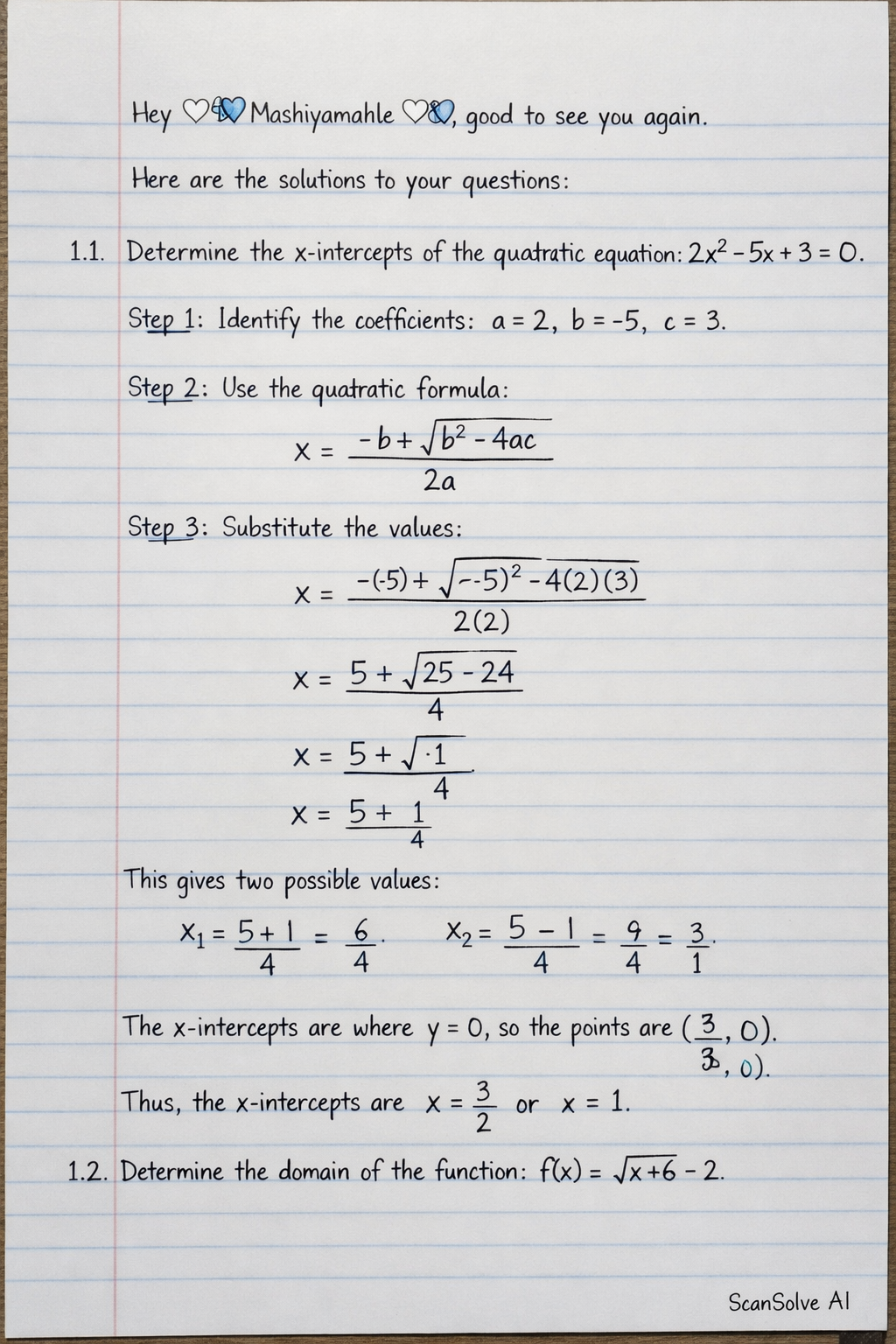
Here are the solutions to your questions: 1.1 Determine the x-intercepts of the quadratic equation: 2x^2 - 5x + 3 = 0 Step 1: Identify the coefficients of the quadratic equation ax^2 + bx + c = 0. For 2x^2 - 5x + 3 = 0, we have a=2, b=-5, and c=3. Step 2: Use the quadratic formula to find the values of x. The quadratic formula is x = -b ± sqrt(b^2 - 4ac)2a. Step 3: Substitute the values of a, b, and c into the formula and simplify. x = -(-5) ± sqrt((-5)^2 - 4(2)(3))2(2) x = 5 ± sqrt(25 - 24)4 x = 5 ± sqrt(1)4 x = (5 ± 1)/(4) This gives two possible values for x: x_1 = (5 + 1)/(4) = (6)/(4) = (3)/(2) x_2 = (5 - 1)/(4) = (4)/(4) = 1 The x-intercepts are where y=0, so the points are ((3)/(2), 0) and (1, 0). The x-intercepts are x = (3)/(2) or x = 1. 1.2 Determine the domain of the function: f(x) = sqrt(x+6) - 2 Step 1: For a square root function, the expression under the square root must be greater than or equal to zero. In this function, the expression under the square root is x+6. Step 2: Set up the inequality. x+6 0 Step 3: Solve the inequality for x. x -6 Step 4: Express the domain in interval notation. The domain is all real numbers greater than or equal to -6. The domain is [-6, ). Send me the next one 📸