
We read your photo as:
Solve y=x+1 and x²+y=7.
ScanSolve AI Answer
Answer
Use the left and right arrow keys to trace the curve, up and down to jump between key points, and plus and minus to zoom.
| Point | x | y |
|---|---|---|
| x-intercept | −1 | 0 |
| y-intercept | 0 | 1 |
Step-by-step solution
27 stepsPart 10· 4 steps
Solve and .
Substitute the first equation into the second equation.
Simplify and rearrange the equation into a standard quadratic form.
Factor the quadratic equation.
This gives two possible values for : or .
Substitute these values back into the equation to find the corresponding values.
For :
So, one solution is .
For :
So, the other solution is .
The solutions are and .
The correct option is C.
Part 11· 3 steps
varies directly as . If when , find when .
Write the direct variation equation.
where is the constant of proportionality.
Use the given values ( when ) to find .
Use the value of to find when .
The correct option is C.
Part 12· 3 steps
varies inversely as . If when , find when .
Write the inverse variation equation.
where is the constant of proportionality.
Use the given values ( when ) to find .
Use the value of to find when .
The correct option is A.
Part 13· 2 steps
Find the 12th term of the arithmetic progression 5, 8, 11, ...
Identify the first term () and the common difference ().
The first term .
The common difference .Use the formula for the -th term of an arithmetic progression, , to find the 12th term ().
The correct option is A.
Part 14· 2 steps
Find the sum of the first 10 terms of the arithmetic progression 2, 5, 8, ...
Identify the first term (), the common difference (), and the number of terms ().
The first term .
The common difference .
The number of terms .Use the formula for the sum of the first terms of an arithmetic progression, .
The correct option is A.
Part 15· 2 steps
Find the 5th term of the geometric progression 3, 6, 12, ...
Identify the first term () and the common ratio ().
The first term .
The common ratio .Use the formula for the -th term of a geometric progression, , to find the 5th term ().
The correct option is A.
Part 16· 2 steps
Find the sum of the first 4 terms of the geometric progression 2, 6, 18, ...
Identify the first term (), the common ratio (), and the number of terms ().
The first term .
The common ratio .
The number of terms .Use the formula for the sum of the first terms of a geometric progression, .
The correct option is A.
Part 17· 2 steps
Find the gradient of the line through $(2, 3)$ and $(6, 11)$.
Label the coordinates of the two points.
Let and .
Use the formula for the gradient (slope) of a line, .
The correct option is C.
Part 18· 2 steps
Find the distance between and .
Label the coordinates of the two points.
Let and .
Use the distance formula, .
The distance is 5 units.
The correct option is D.
Part 19· 3 steps
Find the equation of the line with gradient 3 passing through $(1, 2)$.
Use the point-slope form of a linear equation, .
Given gradient and point .
Substitute the values into the formula.
Simplify the equation to the slope-intercept form ().
The correct option is B.
Part 20· 2 steps
Evaluate .
Recall the standard trigonometric values for and .
Add the values.
The correct option is D.
Try one yourself
A new problem that tests the same skill.
Still stuck on this one?
Ask a follow-up, and the answer starts from this question.
More Mathematics Questions
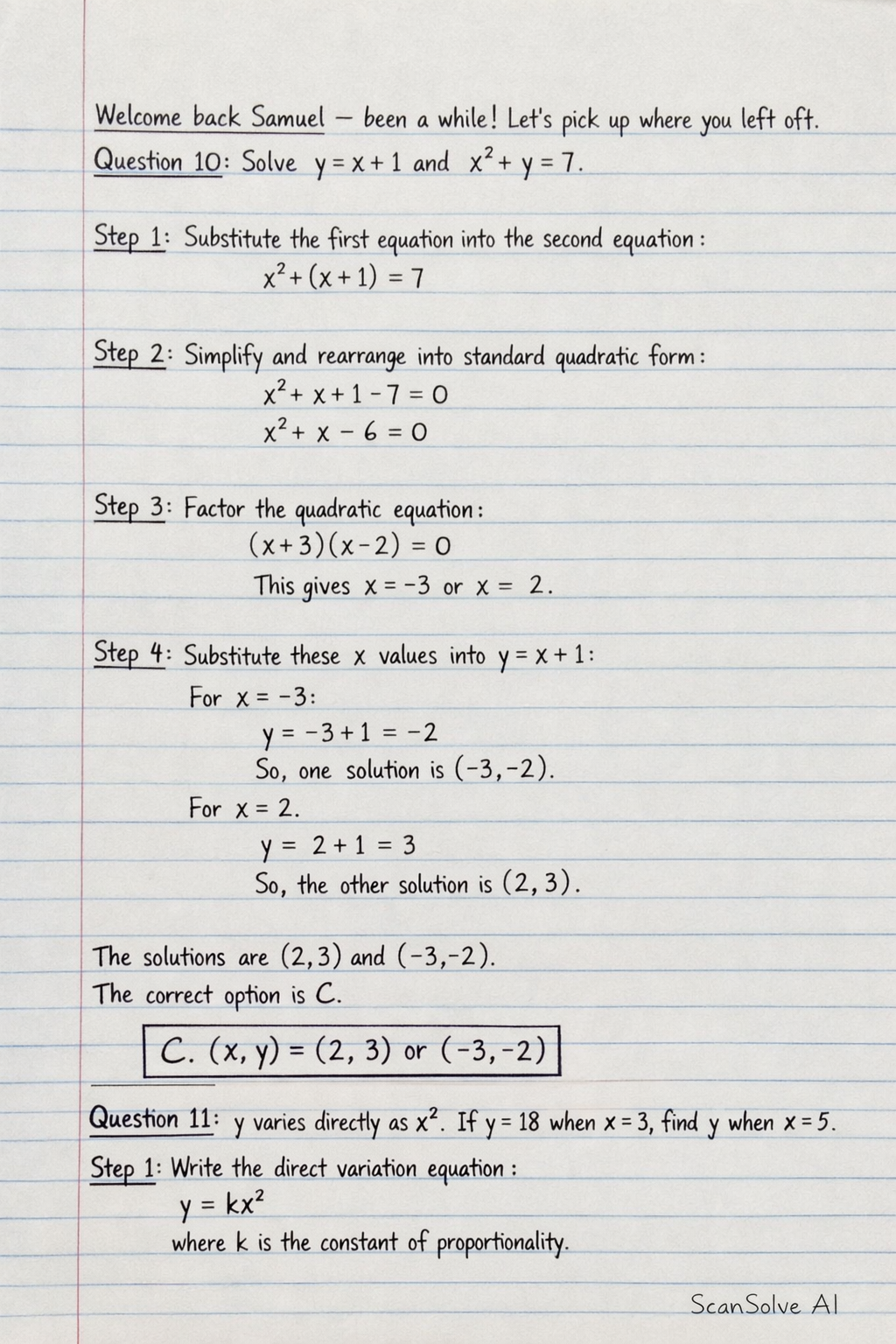
Handwritten Step-by-Step Solution
Get this as a handwritten image on WhatsApp — like a tutor wrote it for you.
Try on WhatsApp