Calculate the yearly income of three workers (Aku, Brako, Dagadu), find the difference between Aku and Dagadu's income, and their total income. Illustrate info in a diagram.
|Mathematics
Calculate the yearly income of three workers (Aku, Brako, Dagadu), find the difference between Aku and Dagadu's income, and their total income. Illustrate info in a diagram.
ScanSolve AI Answer
Answer
GH¢ 60,000.00
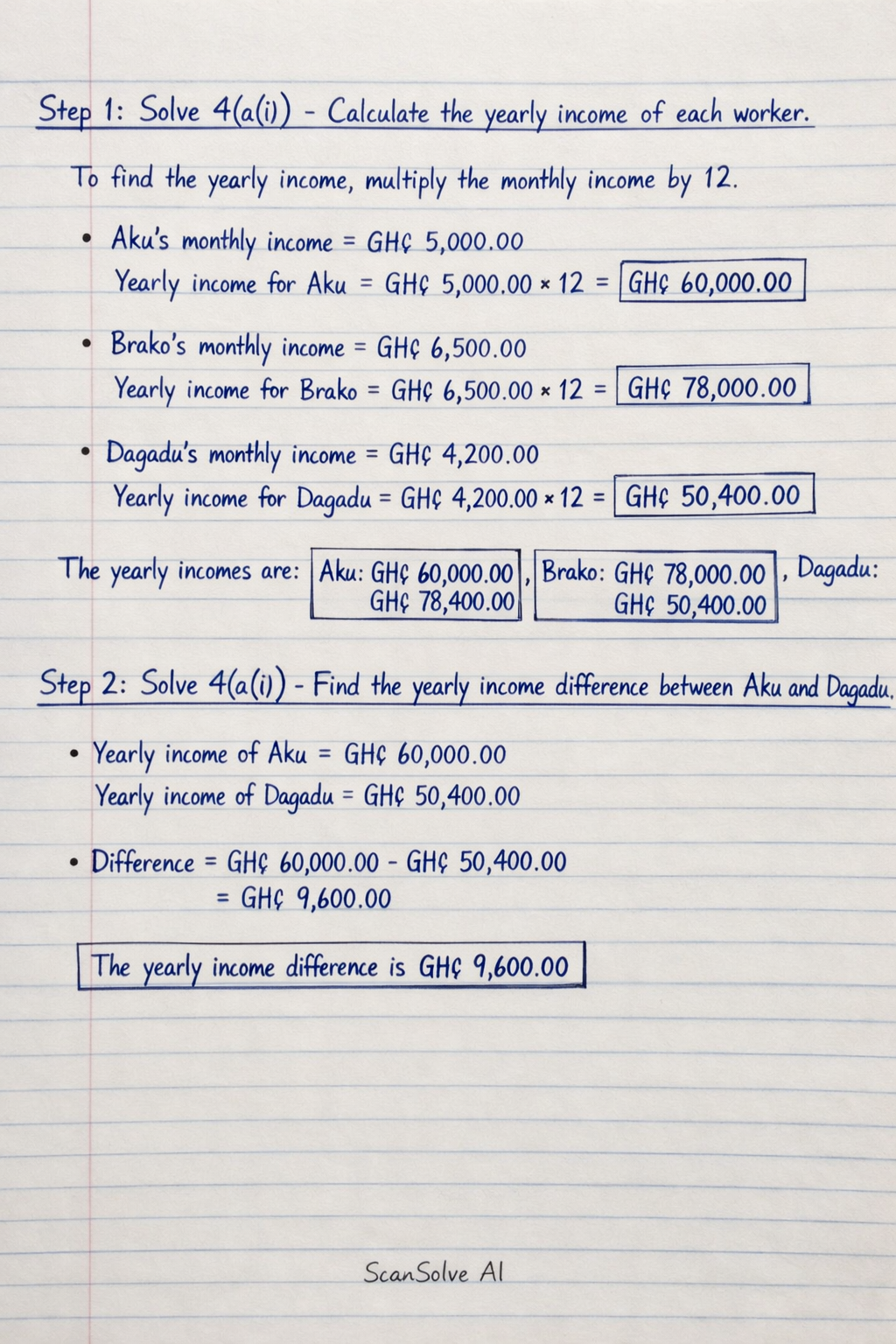
Step 1: Solve 4(a)(i) - Calculate the yearly income of each worker.
To find the yearly income, multiply the monthly income by 12.
Aku's monthly income = GH¢ 5,000.00
Yearly income for Aku = GH¢ 5,000.00×12=GH¢60,000.00
Brako's monthly income = GH¢ 6,500.00
Yearly income for Brako = GH¢ 6,500.00×12=GH¢78,000.00
Dagadu's monthly income = GH¢ 4,200.00
Yearly income for Dagadu = GH¢ 4,200.00×12=GH¢50,400.00
The yearly incomes are: Aku: GH¢60,000.00, Brako: GH¢78,000.00, Dagadu: GH¢50,400.00.
Step 2: Solve 4(a)(ii) - Find the yearly income difference between Aku and Dagadu.
Yearly income of Aku = GH¢ 60,000.00
Yearly income of Dagadu = GH¢ 50,400.00
Difference = GH¢ 60,000.00−GH¢50,400.00=GH¢9,600.00
The yearly income difference is GH¢9,600.00.
Step 3: Solve 4(a)(iii) - Find the total yearly income of all three workers.
Total yearly income = Aku's yearly income + Brako's yearly income + Dagadu's yearly income
Total yearly income = GH¢ 60,000.00+GH¢78,000.00+GH¢50,400.00=GH¢188,400.00
The total yearly income is GH¢188,400.00.
Step 4: Solve 4(b)(i) - Illustrate the information in a diagram.
The situation forms a right-angled triangle where:
The ladder is the hypotenuse.
The distance from the foot of the ladder to the base of the building is the adjacent side (5 m).
The height of the window is the opposite side.
The angle between the ladder and the horizontal ground is 60∘.
Diagram: \\
/| \\
/ | \\
L / | H \\
/ | \\
/____| \\
5m \\
Angle at base = 60^\circ
Where L is the length of the ladder and H is the height of the window.
Step 5: Solve 4(b)(ii)(a) - Find the length of the ladder.
We have the adjacent side (5 m) and the angle (60∘), and we need to find the hypotenuse (length of the ladder). We use the cosine function:
cos(θ)=hypotenuseadjacentcos(60∘)=Lengthofladder5
Given cos(60∘)=21:
21=Lengthofladder5Lengthofladder=5×2=10m
The length of the ladder is 10.0m (to one decimal place).
Step 6: Solve 4(b)(ii)(b) - Find the distance between the window and the foot of the building.
This is the height of the window (opposite side). We have the adjacent side (5 m) and the angle (60∘). We use the tangent function:
tan(θ)=adjacentoppositetan(60∘)=5Heightofwindow
Given tan(60∘)=1.732:
1.732=5HeightofwindowHeightofwindow=1.732×5=8.66m
To one decimal place, the distance is 8.7m.
Step 7: Solve 5(a) - Simplify 18−1272.
First, simplify each surd:
72=36×2=6218=9×2=3212=4×3=23
Substitute these into the expression:
32−2362
To rationalize the denominator, multiply the numerator and denominator by the conjugate of the denominator, which is 32+23:
32−2362×32+2332+23
Numerator:
62(32+23)=(62×32)+(62×23)=(18×2)+(126)=36+126
Denominator (difference of squares, (A−B)(A+B)=A2−B2):
(32)2−(23)2=(9×2)−(4×3)=18−12=6
So the expression becomes:
636+126=636+6126=6+26
The simplified expression is 6+26.
Step 8: Solve 5(b) - Solve 21(2x+1)≥31x+109.
First, distribute the 21 on the left side:
x+21≥31x+109
To eliminate the fractions, find the least common multiple (LCM) of the denominators 2,3,10, which is 30. Multiply every term by 30:
30(x)+30(21)≥30(31x)+30(109)30x+15≥10x+27
Subtract 10x from both sides:
20x+15≥27
Subtract 15 from both sides:
20x≥12
Divide by 20:
x≥2012
Simplify the fraction:
x≥53
The solution is x≥53.
Step 9: Solve 5(c) - Calculate the total distance covered by the athlete.
The athlete runs 4 times around a circular track with radius r=70 m.
The distance for one lap is the circumference of the circle, C=2πr.
C=2×722×70mC=2×22×10m=440m
The total distance covered for 4 laps is:
Totaldistance=4×C=4×440m=1760m
The total distance covered is 1760m.
Step 10: Solve 6(a) - Construct a frequency distribution table for the shoe sizes.
First, list all the shoe sizes given:
6, 4, 7, 5, 5, 6
4, 5, 5, 4, 6, 7
5, 6, 4, 6, 7, 5
6, 4, 7, 5, 4, 6
5, 5, 4, 6, 7, 5
Count the frequency of each unique shoe size:
Size 4: 7 times
Size 5: 11 times
Size 6: 9 times
Size 7: 6 times
| Shoe Size | Frequency |
| :-------- | :-------- |
| 4 | 7 |
| 5 | 11 |
| 6 | 9 |
| 7 | 6 |
The frequency distribution table is as shown above.
Step 11: Solve 6(b)(i) and 6(b)(ii) - Which size should be purchased in large quantities and why?
The size that should be purchased in large quantities is the one with the highest frequency (the mode).
From the table, shoe size 5 has the highest frequency of 11.
6(b)(i) Which size should be purchased in large quantities?Size5
6(b)(ii) Give reason for the answer in (b)(i):Itisthemostfrequentshoesizeamongthelearners.
Step 12: Solve 6(b)(iii) and 6(b)(iv) - Which size will be purchased in less quantities and why?
The size that will be purchased in less quantities is the one with the lowest frequency.
From the table, shoe size 7 has the lowest frequency of 6.
6(b)(iii) Which size will be purchased in less quantities?Size7
6(b)(iv) Give reason for the answer in (b)(iii): $\boxed{\text{It is the least frequent shoe size among the
Was this helpful?
Need help with your own homework?
Get instant step-by-step solutions to any question. Free to start.
Solve 4(a)(i) - Calculate the yearly income of each worker. To find the yearly income, multiply the monthly income by 12.
Calculate the yearly income of three workers (Aku, Brako, Dagadu), find the difference between Aku and Dagadu's income, and their total income. Illustrate info in a diagram.
This mathematics problem involves applying core mathematical principles and formulas. Below you will find a complete step-by-step solution with detailed explanations for each step, helping you understand not just the answer but the method behind it.
ScanSolve AI Answer
Step 1: Solve 4(a)(i) - Calculate the yearly income of each worker. To find the yearly income, multiply the monthly income by 12. Aku's monthly income = GH¢ 5,000.00 Yearly income for Aku = GH¢ 5,000.00 × 12 = GH¢ 60,000.00 Brako's monthly income = GH¢ 6,500.00 Yearly income for Brako = GH¢ 6,500.00 × 12 = GH¢ 78,000.00 Dagadu's monthly income = GH¢ 4,200.00 Yearly income for Dagadu = GH¢ 4,200.00 × 12 = GH¢ 50,400.00 The yearly incomes are: Aku: GH¢ 60,000.00, Brako: GH¢ 78,000.00, Dagadu: GH¢ 50,400.00. Step 2: Solve 4(a)(ii) - Find the yearly income difference between Aku and Dagadu. Yearly income of Aku = GH¢ 60,000.00 Yearly income of Dagadu = GH¢ 50,400.00 Difference = GH¢ 60,000.00 - GH¢ 50,400.00 = GH¢ 9,600.00 The yearly income difference is GH¢ 9,600.00. Step 3: Solve 4(a)(iii) - Find the total yearly income of all three workers. Total yearly income = Aku's yearly income + Brako's yearly income + Dagadu's yearly income Total yearly income = GH¢ 60,000.00 + GH¢ 78,000.00 + GH¢ 50,400.00 = GH¢ 188,400.00 The total yearly income is GH¢ 188,400.00. Step 4: Solve 4(b)(i) - Illustrate the information in a diagram. The situation forms a right-angled triangle where: The ladder is the hypotenuse. The distance from the foot of the ladder to the base of the building is the adjacent side (5 m). The height of the window is the opposite side. The angle between the ladder and the horizontal ground is 60^. Diagram: \\ /| \\ / | \\ L / | H \\ / | \\ /____| \\ 5m \\ Angle at base = 60^ Where L is the length of the ladder and H is the height of the window. Step 5: Solve 4(b)(ii)(a) - Find the length of the ladder. We have the adjacent side (5 m) and the angle (60^), and we need to find the hypotenuse (length of the ladder). We use the cosine function: () = adjacenthypotenuse (60^) = (5)/(Length of ladder) Given (60^) = (1)/(2): (1)/(2) = (5)/(Length of ladder) Length of ladder = 5 × 2 = 10 m The length of the ladder is 10.0 m (to one decimal place). Step 6: Solve 4(b)(ii)(b) - Find the distance between the window and the foot of the building. This is the height of the window (opposite side). We have the adjacent side (5 m) and the angle (60^). We use the tangent function: () = oppositeadjacent (60^) = Height of window5 Given (60^) = 1.732: 1.732 = Height of window5 Height of window = 1.732 × 5 = 8.66 m To one decimal place, the distance is 8.7 m. Step 7: Solve 5(a) - Simplify sqrt(72)sqrt(18) - sqrt(12). First, simplify each surd: sqrt(72) = sqrt(36 × 2) = 6sqrt(2) sqrt(18) = sqrt(9 × 2) = 3sqrt(2) sqrt(12) = sqrt(4 × 3) = 2sqrt(3) Substitute these into the expression: 6sqrt(2)3sqrt(2) - 2sqrt(3) To rationalize the denominator, multiply the numerator and denominator by the conjugate of the denominator, which is 3sqrt(2) + 2sqrt(3): 6sqrt(2)3sqrt(2) - 2sqrt(3) × 3sqrt(2) + 2sqrt(3)3sqrt(2) + 2sqrt(3) Numerator: 6sqrt(2)(3sqrt(2) + 2sqrt(3)) = (6sqrt(2) × 3sqrt(2)) + (6sqrt(2) × 2sqrt(3)) = (18 × 2) + (12sqrt(6)) = 36 + 12sqrt(6) Denominator (difference of squares, (A-B)(A+B) = A^2 - B^2): (3sqrt(2))^2 - (2sqrt(3))^2 = (9 × 2) - (4 × 3) = 18 - 12 = 6 So the expression becomes: 36 + 12sqrt(6)6 = (36)/(6) + 12sqrt(6)6 = 6 + 2sqrt(6) The simplified expression is 6 + 2sqrt(6). Step 8: Solve 5(b) - Solve (1)/(2)(2x+1) (1)/(3)x + (9)/(10). First, distribute the (1)/(2) on the left side: x + (1)/(2) (1)/(3)x + (9)/(10) To eliminate the fractions, find the least common multiple (LCM) of the denominators 2, 3, 10, which is 30. Multiply every term by 30: 30(x) + 30((1)/(2)) 30((1)/(3)x) + 30((9)/(10)) 30x + 15 10x + 27 Subtract 10x from both sides: 20x + 15 27 Subtract 15 from both sides: 20x 12 Divide by 20: x (12)/(20) Simplify the fraction: x (3)/(5) The solution is x (3)/(5). Step 9: Solve 5(c) - Calculate the total distance covered by the athlete. The athlete runs 4 times around a circular track with radius r = 70 m. The distance for one lap is the circumference of the circle, C = 2 r. C = 2 × (22)/(7) × 70 m C = 2 × 22 × 10 m = 440 m The total distance covered for 4 laps is: Total distance = 4 × C = 4 × 440 m = 1760 m The total distance covered is 1760 m. Step 10: Solve 6(a) - Construct a frequency distribution table for the shoe sizes. First, list all the shoe sizes given: 6, 4, 7, 5, 5, 6 4, 5, 5, 4, 6, 7 5, 6, 4, 6, 7, 5 6, 4, 7, 5, 4, 6 5, 5, 4, 6, 7, 5 Count the frequency of each unique shoe size: Size 4: 7 times Size 5: 11 times Size 6: 9 times Size 7: 6 times | Shoe Size | Frequency | | :-------- | :-------- | | 4 | 7 | | 5 | 11 | | 6 | 9 | | 7 | 6 | The frequency distribution table is as shown above. Step 11: Solve 6(b)(i) and 6(b)(ii) - Which size should be purchased in large quantities and why? The size that should be purchased in large quantities is the one with the highest frequency (the mode). From the table, shoe size 5 has the highest frequency of 11. 6(b)(i) Which size should be purchased in large quantities? Size 5 6(b)(ii) Give reason for the answer in (b)(i): It is the most frequent shoe size among the learners. Step 12: Solve 6(b)(iii) and 6(b)(iv) - Which size will be purchased in less quantities and why? The size that will be purchased in less quantities is the one with the lowest frequency. From the table, shoe size 7 has the lowest frequency of 6. 6(b)(iii) Which size will be purchased in less quantities? Size 7 6(b)(iv) Give reason for the answer in (b)(iii): $It is the least frequent shoe size among the