
What do you understand by unbiased estimate of population variance B) an infinite population consists of the number 1,2,3 A) write down the population mean of the sample B) calculate the population variance C) random sample of size 2 are obtained the population D) write down all possible sample of sin 2 taken with replacement E) obtain the expected value of the mean and the population variance.
ScanSolve AI Answer
Step-by-step solution
8 stepsHere are the answers to your questions:
A) What do you understand by unbiased estimate of population variance?
An unbiased estimate of population variance is a sample statistic that, on average, equals the true population variance. If you were to take many samples from a population and calculate this estimate for each sample, the average of all these estimates would be equal to the actual population variance. The formula for an unbiased estimate of population variance is .
B) An infinite population consists of the number 1, 2, 3.
A) Write down the population mean of the population.
List the population values.
The population consists of the numbers $1, 2, 3$.
Calculate the population mean ().
B) Calculate the population variance.
Use the population mean from part A ().
Calculate the squared differences from the mean.
Calculate the population variance ().
C) Random sample of size 2 are obtained from the population.
This is an introductory statement for the following parts.D) Write down all possible samples of size 2 taken with replacement.
The population is and the sample size is .
The possible samples taken with replacement are:E) Obtain the expected value of the mean and the variance of the sample means.
List the sample means for each sample from part D.
For each sample , the sample mean is .
Calculate the expected value of the sample means ().
This is the mean of all possible sample means.
(Note: This is equal to the population mean , as expected.)
Calculate the variance of the sample means ().
This is the variance of the sampling distribution of the mean.
Using :
(Alternatively, .)
Still stuck on this one?
Ask a follow-up, and the answer starts from this question.
More Mathematics Questions
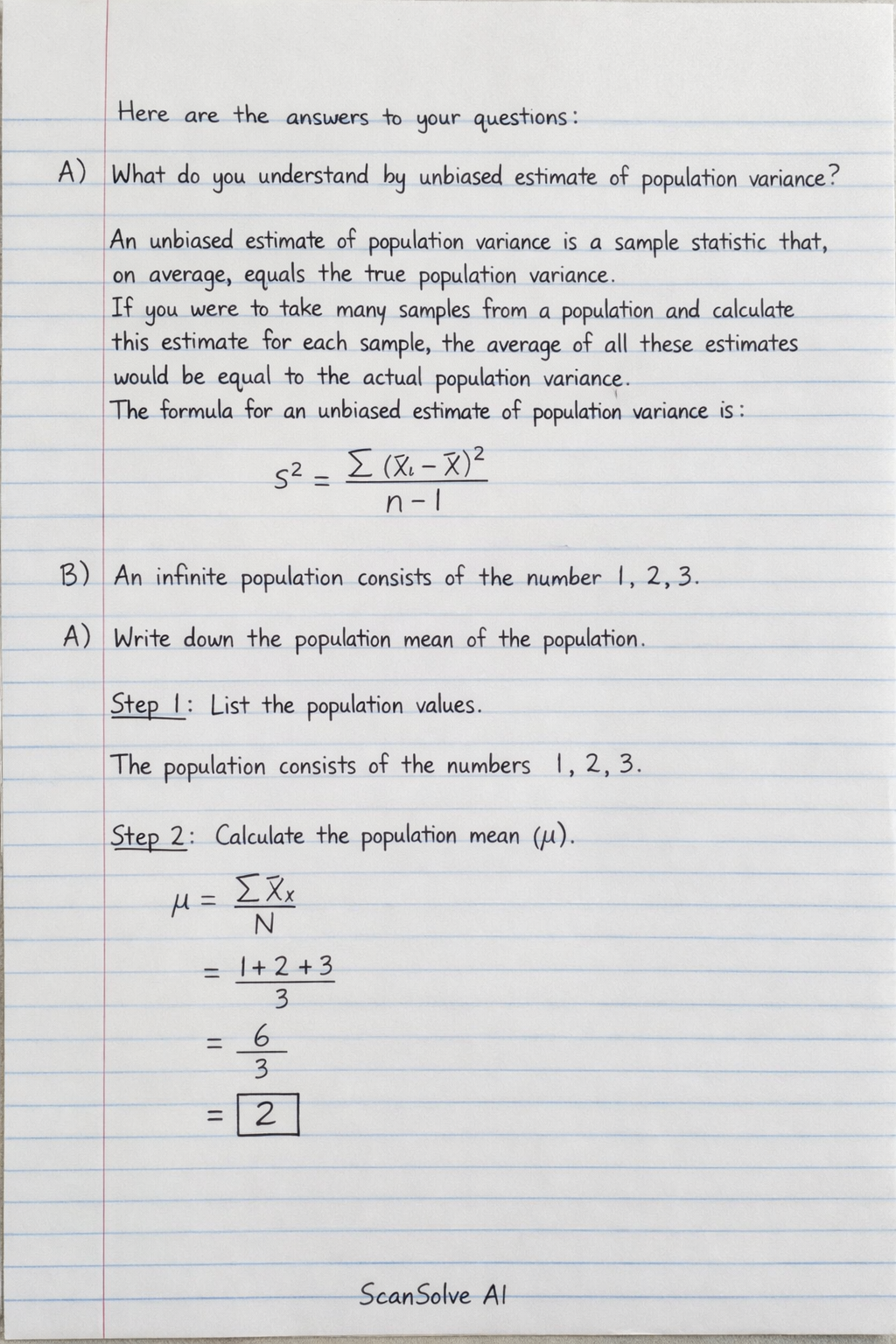
Handwritten Step-by-Step Solution
Get this as a handwritten image on WhatsApp — like a tutor wrote it for you.
Try on WhatsApp