
We read your photo as:
Your Answer (Major Economic Problem): "education inequality and inaccessible opportunities" and "education is not available for everyone. Inaccessible Education."
ScanSolve AI Answer
Let's check your answers:
Q1.b.
- Your Answer (Major Economic Problem): "education inequality and inaccessible opportunities" and "education is not available for everyone. Inaccessible Education."
- ✅ Correct. This accurately identifies the major economic problem shown in the picture.
- Your Answer (One Possible Solution): "(make educational more accessible, make more institutions, make near rural areas)."
- ✅ Correct. This is a valid and effective solution to the problem.
Q1.c.
-
Your Answers:
- "Railways are easy to transport bulk materials."
- "Railways are less-cost effective."
- "fast than roadways to transport early & safely."
- "railways are environmental friendly."
-
❌ Incorrect. The question asks why railways are safer than roadways. Your points 1, 2, and 4 describe other characteristics (transport capacity, cost-effectiveness, environmental impact) rather than safety. Point 3 mentions "safely" but combines it with "fast," which isn't the primary safety advantage.
- Correct reasons for safety:
- Dedicated tracks: Trains run on their own tracks, minimizing collisions with other vehicles or pedestrians.
- Advanced signaling and control systems: Railways have sophisticated systems to manage train movements, reducing human error and preventing accidents.
- Correct reasons for safety:
Q2.a.
-
Your Answer: "birth rates high as 1st stage and death rates fell." (with "declining" written above birth rates).
-
❌ Partially Correct. You correctly identified that death rates fell. However, the term "declining" for birth rates contradicts "high as 1st stage." In the Mid-Transition stage (Stage 2/early Stage 3), birth rates typically remain high or begin to decline slowly, while death rates fall rapidly, leading to significant population growth. Your answer is a bit contradictory and not fully precise.
- Correct indication: Death rates decline significantly, while birth rates remain high or decline slowly, leading to rapid population growth.
Q2.b.
- Your Answers (Death rates fell):
- "due to improvement in medical facilities by government."
- "due to improvement in food production."
- ✅ Correct. Both of these are valid government steps that lead to a reduction in death rates. (The "Birth rates" section you wrote was not asked for in the question and was correctly marked out).
Still stuck on this one?
Ask a follow-up, and the answer starts from this question.
More Mathematics Questions
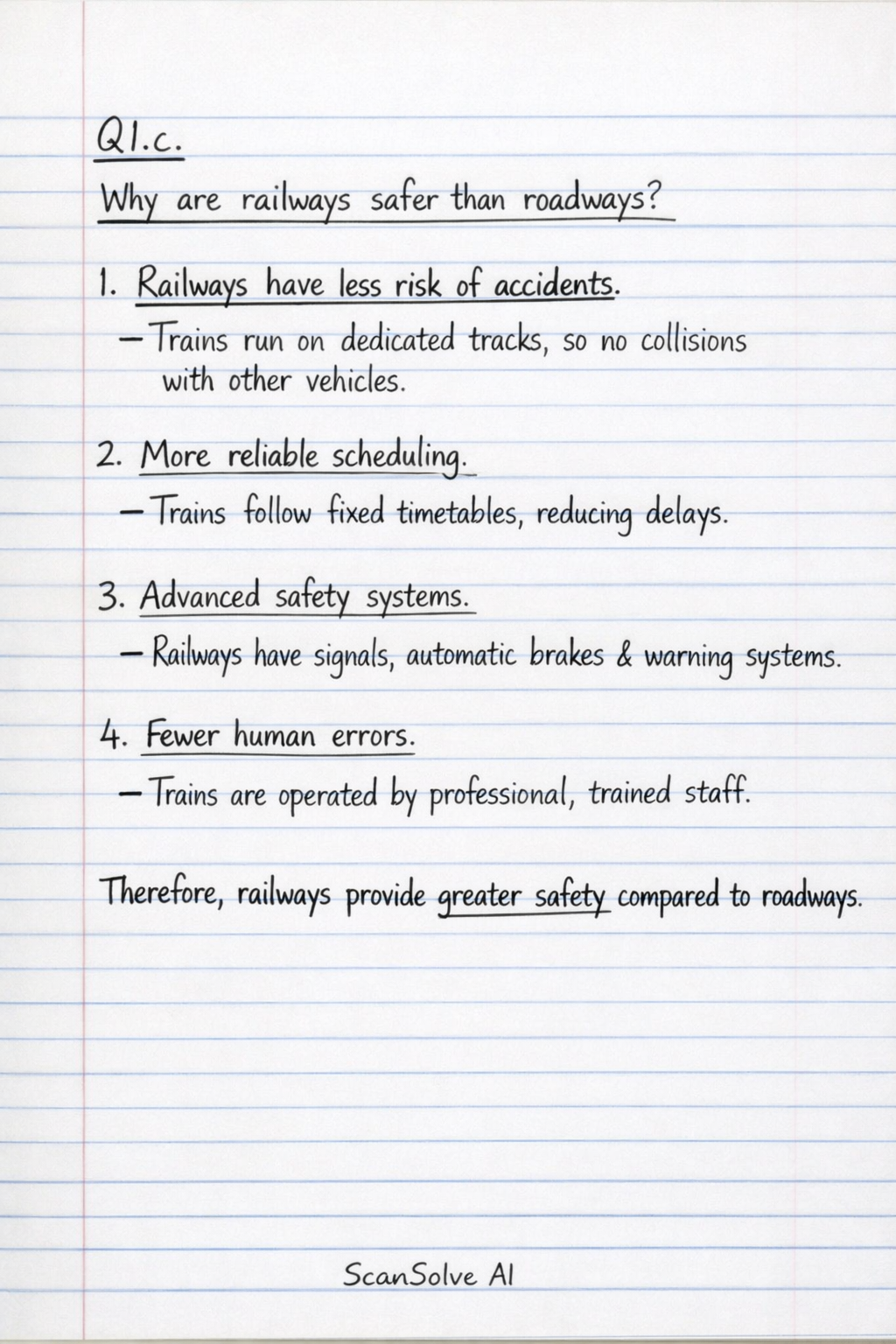
Handwritten Step-by-Step Solution
Get this as a handwritten image on WhatsApp — like a tutor wrote it for you.
Try on WhatsApp