
We read your photo as:
Major Economic Problem: The picture illustrates inaccessible education and inequality of opportunity*. This is an economic problem because a lack of access to quality education leads to a l
ScanSolve AI Answer
Here are the solutions to the questions:
Q1.b.
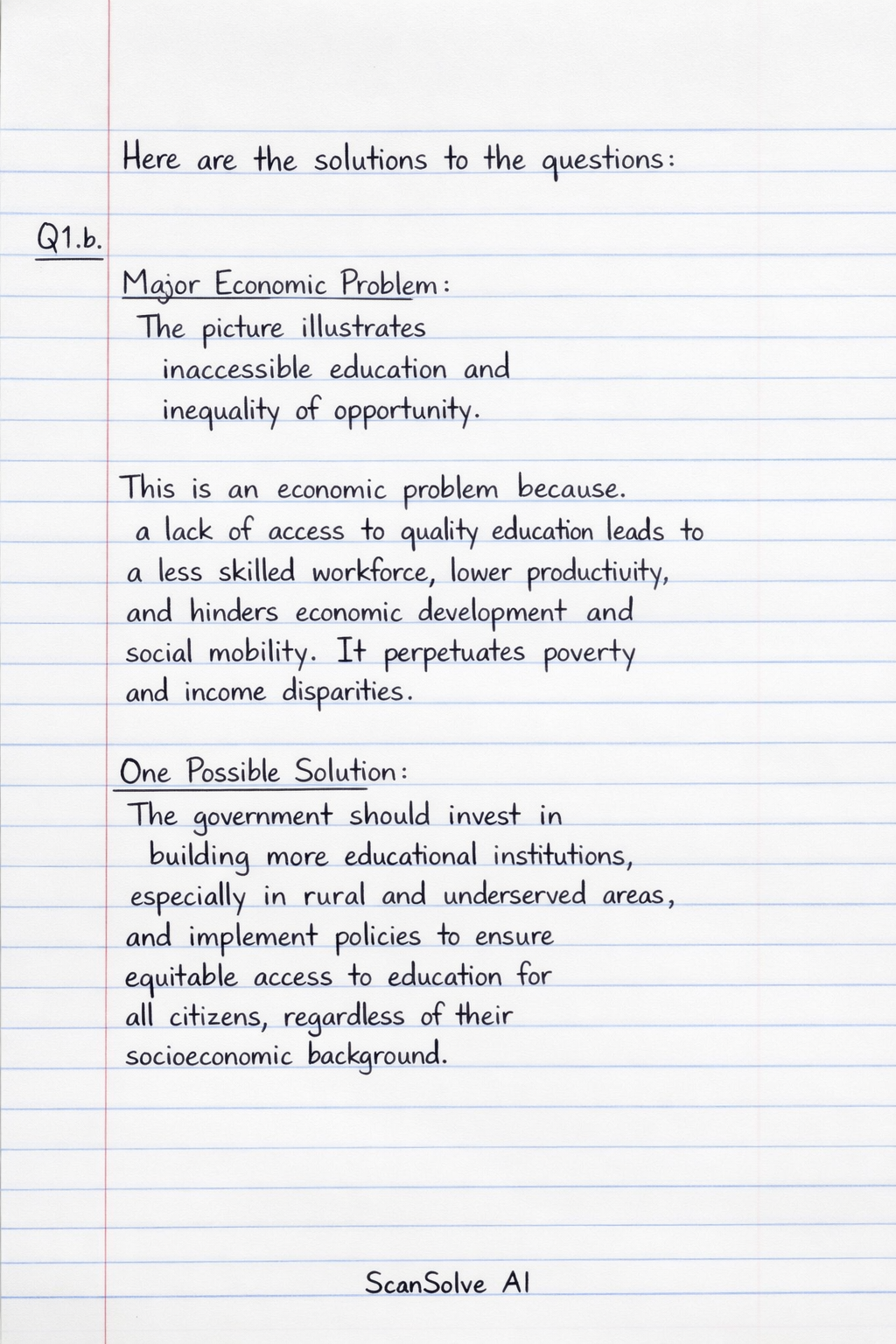
- Major Economic Problem: The picture illustrates inaccessible education and inequality of opportunity. This is an economic problem because a lack of access to quality education leads to a less skilled workforce, lower productivity, and hinders economic development and social mobility. It perpetuates poverty and income disparities.
- One Possible Solution: The government should invest in building more educational institutions, especially in rural and underserved areas, and implement policies to ensure equitable access to education for all citizens, regardless of their socioeconomic background.
Q1.c.
Railways are considered a safer means of transportation compared to roadways due to the following two points:
- Dedicated infrastructure: Trains operate on exclusive tracks, which significantly reduces the risk of collisions with other vehicles or pedestrians that are common on shared roadways.
- Controlled environment and signaling: Railways utilize sophisticated signaling systems and centralized control, allowing for precise management of train movements and reducing human error, thereby enhancing safety.
Q2.a.
The Mid-Transition stage (typically Stage 2 or early Stage 3) on the Demographic Transition Model indicates a period where death rates decline significantly due to improvements in healthcare, sanitation, and food supply, while birth rates remain high or begin to decline slowly. This results in a rapid increase in population growth.
Q2.b.
Two government steps that helped Pakistan reach this stage (primarily by causing death rates to fall):
- Improvement in medical facilities and public health: Government initiatives to expand healthcare access, provide vaccinations, and improve sanitation and clean water supply led to a reduction in disease and mortality.
- Increased food production and distribution: Policies aimed at enhancing agricultural output and ensuring better food security helped reduce malnutrition and famine, contributing to lower death rates.
Still stuck on this one?
Ask a follow-up, and the answer starts from this question.
More Mathematics Questions
Handwritten Step-by-Step Solution
Get this as a handwritten image on WhatsApp — like a tutor wrote it for you.
Try on WhatsApp