
We read your photo as:
Find your own patterns or relations in and among the sequences in Table 1. Can you explain why they happen with a picture or otherwise?
ScanSolve AI Answer
Step-by-step solution
2 stepsThe image shows question number 8, which asks to "Find your own patterns or relations in and among the sequences in Table 1. Can you explain why they happen with a picture or otherwise?".
Table 1 is not provided in the image or previous messages. Therefore, I cannot identify specific patterns from it. However, I can demonstrate how to find and explain patterns using the sequence from our previous interaction: .
Identify patterns and relations for the sequence .
- The terms are known as centered hexagonal numbers.
- The general term can be expressed in two ways: This was derived by finding the second differences of the sequence.
- Another pattern for the general term is that each term is the difference of two consecutive cubes: Let's verify this: For : . For : . For : . This form is equivalent to the first form:
- The sum of the first terms of this sequence is .
Explain why these patterns happen.
The most significant explanation comes from the pattern .
When we sum the terms using this form, we get a telescoping sum:Let's write out the first few terms of the sum:
Notice that most of the terms cancel out:
The remains.
The from the first term cancels with the from the second term.
The from the second term cancels with the from the third term.
This pattern continues until the term.
The only terms that do not cancel are the first part of the first term () and the last part of the last term ().This explains why the sum of the first centered hexagonal numbers is always .
Still stuck on this one?
Ask a follow-up, and the answer starts from this question.
More Mathematics Questions
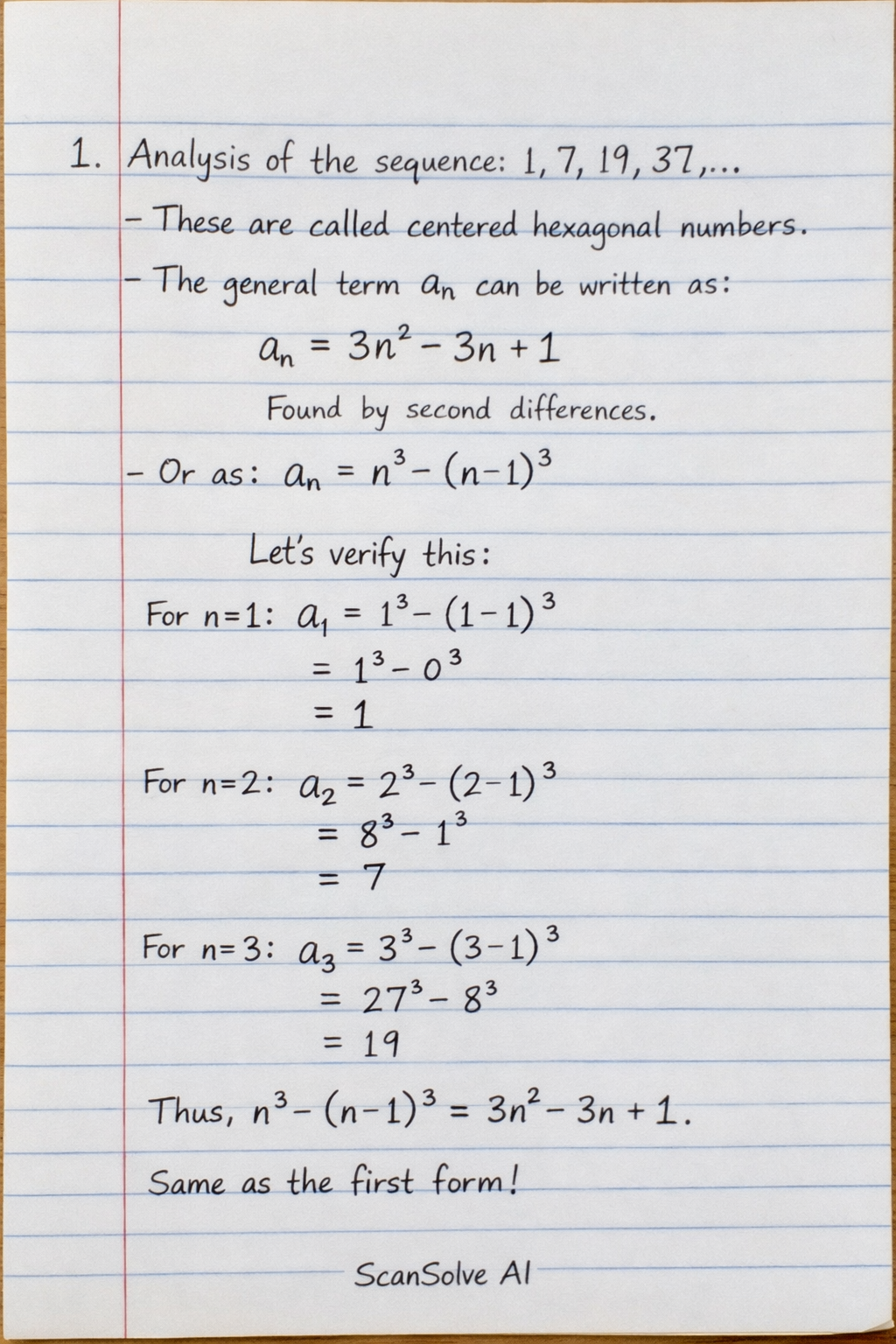
Handwritten Step-by-Step Solution
Get this as a handwritten image on WhatsApp — like a tutor wrote it for you.
Try on WhatsApp