
1.;A capacitor has a capacitance of 8.0 microFarad with air between its plates. Determine its capacitance when a dielectric with dielectric constant 6.0 is placed between its plates. 2. What is the charge on a 300 pF capacitor when it is charged to a voltage of 1.0 kV? 3. A certain parallel-plate capacitor consists of two plates, each with area 200 cm² , separated by a 0.40 cm air gap. (a) Compute its capacitance. (b) If the capacitor is connected across a 500 V source, find the charge on it, the energy stored in it, and the value of E between the plates. (c) If a liquid with K = 2.60 is poured between the plates so as to fill the air gap, how much additional charge will flow onto the capacitor from the 500 V source?
ScanSolve AI Answer
Step-by-step solution
14 stepsHere are the solutions to your capacitor problems.
1. A capacitor has a capacitance of 8.0 microFarad with air between its plates. Determine its capacitance when a dielectric with dielectric constant 6.0 is placed between its plates.
Identify the given values.
Initial capacitance with air, .
Dielectric constant, .Use the formula for capacitance with a dielectric.
The capacitance with a dielectric is given by .
Substitute the values and calculate the new capacitance.
The capacitance with the dielectric is .
2. What is the charge on a 300 pF capacitor when it is charged to a voltage of 1.0 kV?
Identify the given values and convert units to SI units.
Capacitance, .
Voltage, .Use the formula relating charge, capacitance, and voltage.
The charge on a capacitor is given by .
Substitute the values and calculate the charge.
The charge on the capacitor is .
3. A certain parallel-plate capacitor consists of two plates, each with area 200 cm² , separated by a 0.40 cm air gap.
(a) Compute its capacitance.
(b) If the capacitor is connected across a 500 V source, find the charge on it, the energy stored in it, and the value of E between the plates.
(c) If a liquid with K = 2.60 is poured between the plates so as to fill the air gap, how much additional charge will flow onto the capacitor from the 500 V source?
Given values:
Area, .
Separation, .
Permittivity of free space, .
Voltage, .
Dielectric constant, .(a) Compute its capacitance.
Use the formula for the capacitance of a parallel-plate capacitor with air.
Substitute the values and calculate the capacitance.
The capacitance is (or ).
(b) If the capacitor is connected across a 500 V source, find the charge on it, the energy stored in it, and the value of E between the plates.
Calculate the charge on the capacitor.
The charge on the capacitor is .
Calculate the energy stored in the capacitor.
The energy stored in the capacitor is .
Calculate the electric field between the plates.
The electric field between the plates is .
(c) If a liquid with K = 2.60 is poured between the plates so as to fill the air gap, how much additional charge will flow onto the capacitor from the 500 V source?
Calculate the new capacitance with the dielectric.
Calculate the new charge on the capacitor with the dielectric.
The voltage source remains .
Calculate the additional charge that flows onto the capacitor.
The additional charge that will flow onto the capacitor is .
Still stuck on this one?
Ask a follow-up, and the answer starts from this question.
More Physics Questions
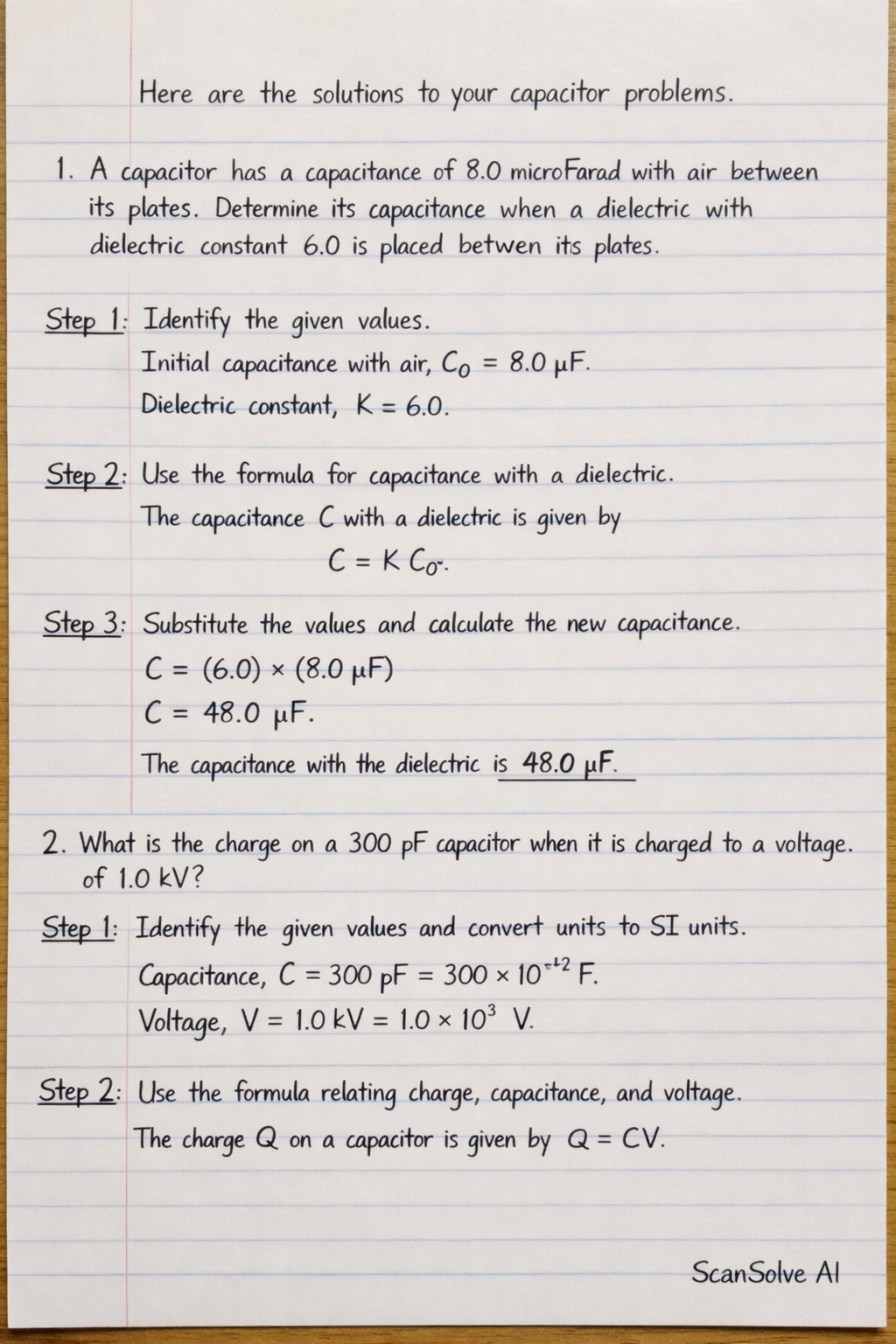
Handwritten Step-by-Step Solution
Get this as a handwritten image on WhatsApp — like a tutor wrote it for you.
Try on WhatsApp