
We read your photo as:
Up-field refers to signals appearing at lower chemical shift values (higher magnetic field strength) due to increased electron shielding, while down-field refers to signals at higher chemical
Physics
ScanSolve AI Answer
Here are the answers to the questions:
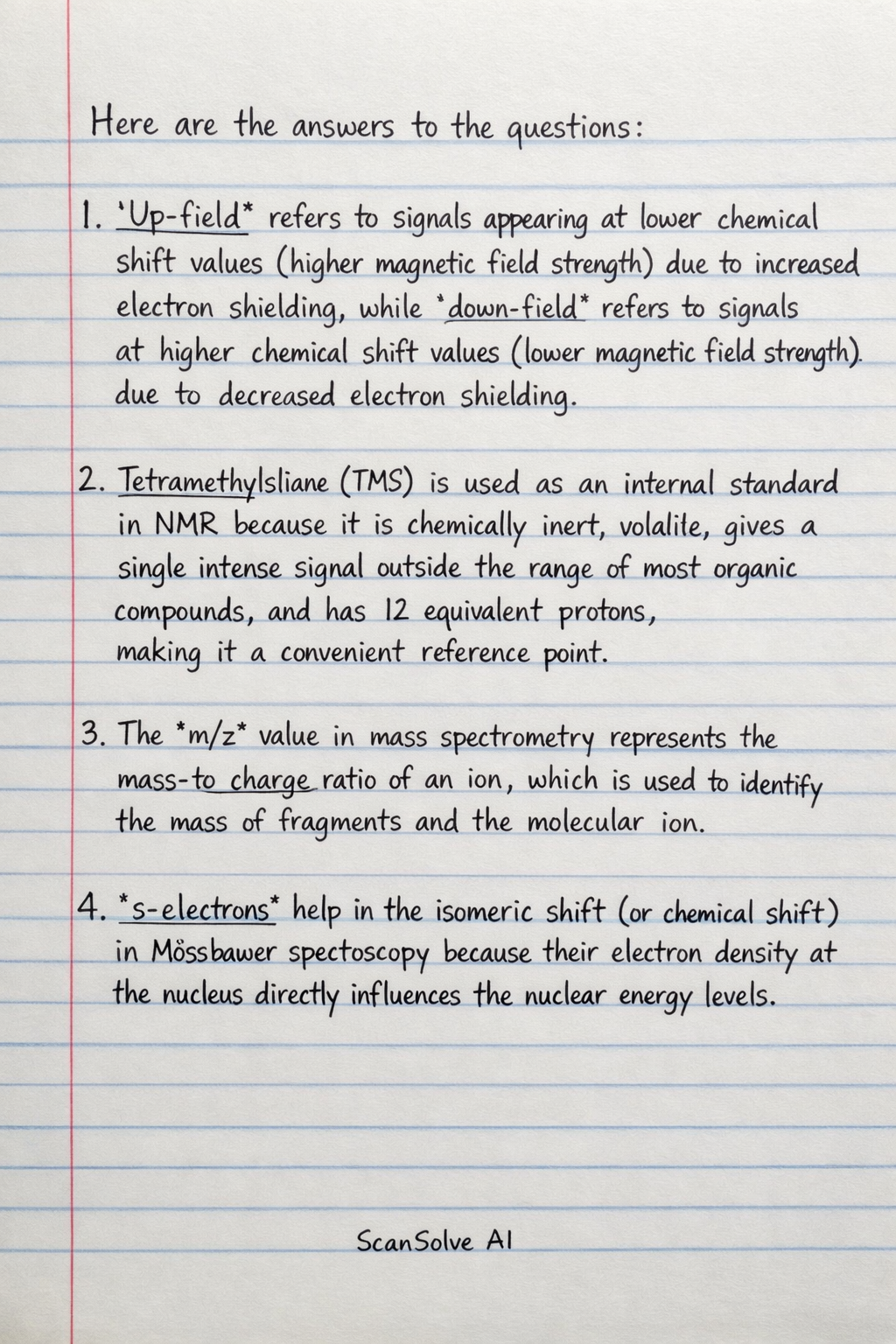
- Up-field refers to signals appearing at lower chemical shift values (higher magnetic field strength) due to increased electron shielding, while down-field refers to signals at higher chemical shift values (lower magnetic field strength) due to decreased electron shielding.
- Tetramethylsilane (TMS) is used as an internal standard in NMR because it is chemically inert, volatile, gives a single intense signal outside the range of most organic compounds, and has 12 equivalent protons, making it a convenient reference point.
- The m/z value in mass spectrometry represents the mass-to-charge ratio of an ion, which is used to identify the mass of fragments and the molecular ion.
- s-electrons help in the isomeric shift (or chemical shift) in Mössbauer spectroscopy because their electron density at the nucleus directly influences the nuclear energy levels.
- Applications of ESR spectroscopy include the detection and characterization of free radicals, transition metal ions, and other species containing unpaired electrons in various chemical and biological systems.
- Chemical shift is the difference in the resonance frequency of a nucleus in a specific chemical environment compared to a standard reference compound, expressed in parts per million (ppm), providing information about the electronic surroundings of the nucleus.
Was this helpful?
Still stuck on this one?
Ask a follow-up, and the answer starts from this question.
Got a different question?Ask your own question
More Physics Questions
QEPR spectroscopy is often performed at low temperatures to increase the population difference…QWhy does the -OH proton in 1H-NMR produce a broad signal?QSo generally paramagnetic and ferromagnetic attract to magnetic fields due to the presence of…QThe dimensions of magnetic field areQThe -OH proton in ^1H-NMR produces a broad signal primarily due to rapid proton exchange with other…
Browse by topic:Electromagnetism
Handwritten Step-by-Step Solution
Get this as a handwritten image on WhatsApp — like a tutor wrote it for you.
Try on WhatsApp