
We read your photo as:
1a) Atoms rarely exist independently because they achieve a more stable, lower-energy state by forming chemical bonds with other atoms. This bonding allows atoms to complete their valence electro
ScanSolve AI Answer
1a) Atoms rarely exist independently because they achieve a more stable, lower-energy state by forming chemical bonds with other atoms. This bonding allows atoms to complete their valence electron shells, typically reaching an octet configuration similar to noble gases. The formation of these bonds releases energy, making the resulting molecules or extended structures more stable than isolated atoms.
1b) Chemical bonds are classified into two main types:
- Primary Bonds: These are strong intramolecular forces holding atoms together within a molecule or crystal. They involve the sharing or transfer of electrons, such as ionic, covalent, and metallic bonds.
- Secondary Bonds: These are weaker intermolecular forces existing between molecules. They arise from electrostatic attractions between temporary or permanent dipoles, including van der Waals forces and hydrogen bonds.
2a)
- Bond Energy: The energy required to break one mole of a specific bond in the gaseous state, indicating the bond's strength.
- Bond Length: The average distance between the nuclei of two bonded atoms in a molecule, typically measured in picometers.
2b) Wave-particle duality is a quantum mechanical concept stating that particles, such as electrons and photons, exhibit both wave-like properties (like diffraction) and particle-like properties (like definite position). This means that the classical distinction between waves and particles is not absolute at the quantum level.
3a)
- Heisenberg's Uncertainty Principle: It is impossible to simultaneously know with perfect accuracy both the exact position and the exact momentum of a particle. Measuring one property more precisely inherently makes the other less certain, as expressed by .
- Pauli's Exclusion Principle: No two electrons in an atom can have the exact same set of four quantum numbers. This principle dictates that an atomic orbital can hold a maximum of two electrons, provided they have opposite spins.
3b)
- N-type Semiconductor: Formed by doping with pentavalent impurities, it has electrons as majority charge carriers. The Fermi level () is shifted upwards, closer to the conduction band ().
- P-type Semiconductor: Formed by doping with trivalent impurities, it has holes as majority charge carriers. The Fermi level () is shifted downwards, closer to the valence band ().
Fermi level positions:
For N-type:
For P-type:
Still stuck on this one?
Ask a follow-up, and the answer starts from this question.
More Physics Questions
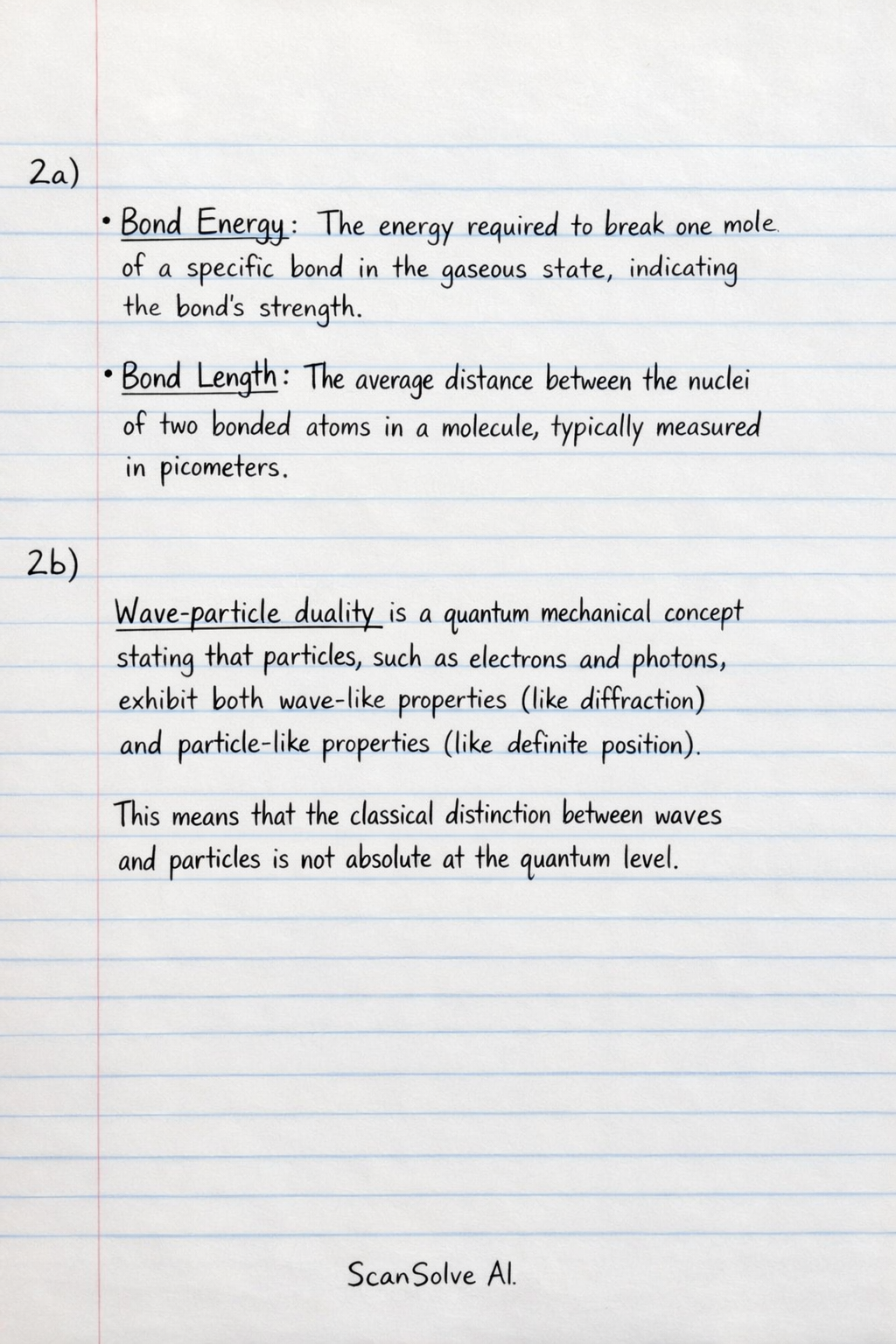
Handwritten Step-by-Step Solution
Get this as a handwritten image on WhatsApp — like a tutor wrote it for you.
Try on WhatsApp