

This physics problem tests your understanding of fundamental physical laws and their applications. The step-by-step solution below breaks down the problem using relevant equations and physical reasoning.
ScanSolve AI Answer
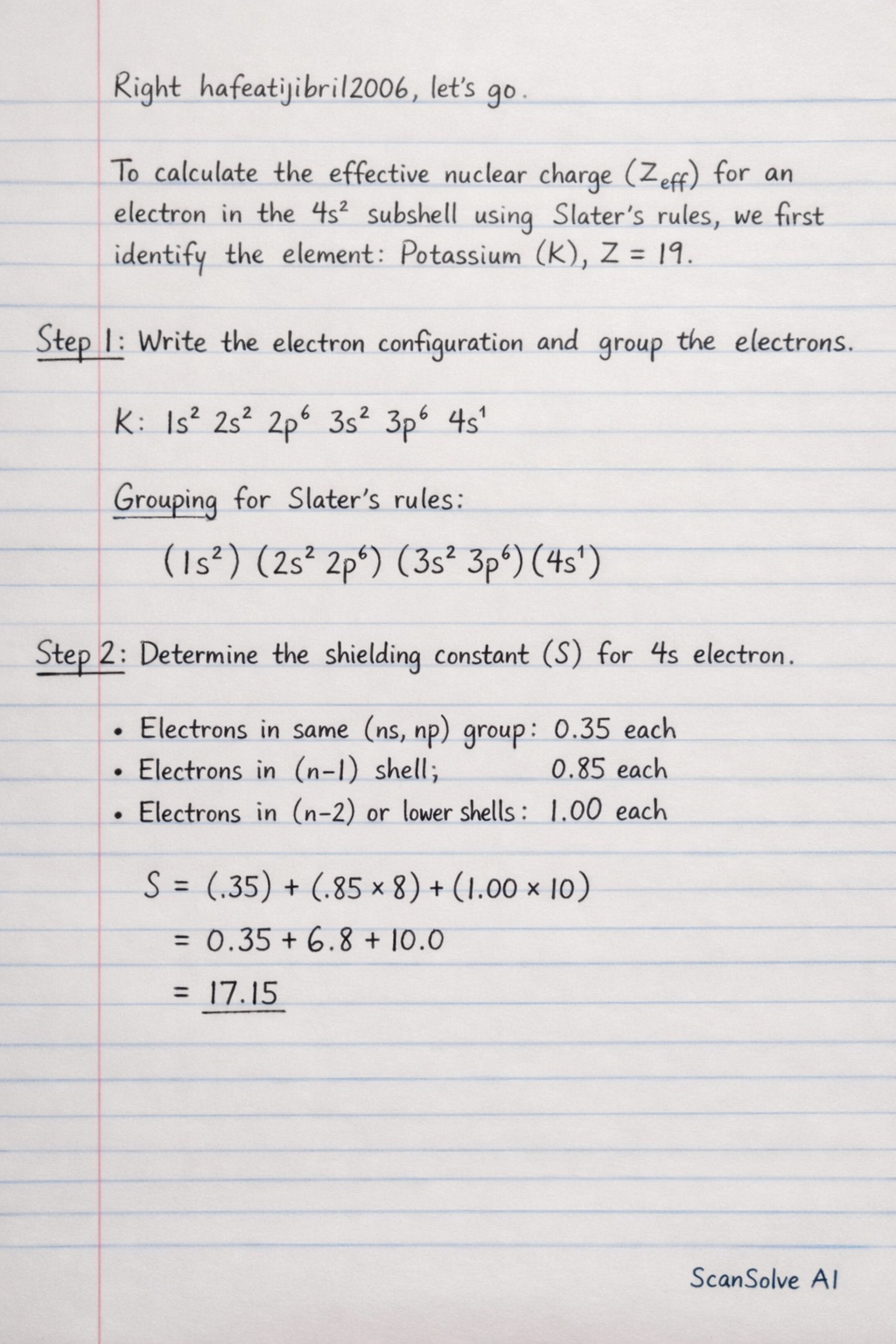
Right hafsatjibril2006, let's go. To calculate the effective nuclear charge (Z_eff) for an electron in the 4s1 subshell using Slater's rules, we first need to identify the element and its electron configuration. The 4s1 subshell indicates that the element is Potassium (K), which has an atomic number (Z) of 19. Step 1: Write the electron configuration and group the electrons according to Slater's rules. The electron configuration for Potassium (K) is 1s^2 2s^2 2p^6 3s^2 3p^6 4s^1. Grouping for Slater's rules: (1s^2) (2s^2 2p^6) (3s^2 3p^6) (4s^1) Step 2: Determine the shielding constant (S) for the 4s electron. The rules for calculating S for an (ns, np) electron are: • Electrons in the same (ns, np) group contribute 0.35 each. • Electrons in the (n-1) shell contribute 0.85 each. • Electrons in the (n-2) or lower shells contribute 1.00 each. For the 4s electron: • Electrons in the same (4s) group: There are no other electrons in the 4s subshell. Contribution = 0 × 0.35 = 0 • Electrons in the (n-1) shell (3rd shell, 3s^2 3p^6): There are 2+6=8 electrons. Contribution = 8 × 0.85 = 6.80 • Electrons in the (n-2) shell (2nd shell, 2s^2 2p^6): There are 2+6=8 electrons. Contribution = 8 × 1.00 = 8.00 • Electrons in the (n-3) shell (1st shell, 1s^2): There are 2 electrons. Contribution = 2 × 1.00 = 2.00 Total shielding constant (S): S = 0 + 6.80 + 8.00 + 2.00 = 16.80 Step 3: Calculate the effective nuclear charge (Z_eff). The formula for effective nuclear charge is Z_eff = Z - S. For Potassium, the atomic number (Z) is 19. Z_eff = 19 - 16.80 Z_eff = 2.20 The effective nuclear charge for an electron in the 4s1 subshell of Potassium is 2.20. Send me the next one 📸