
We read your photo as:
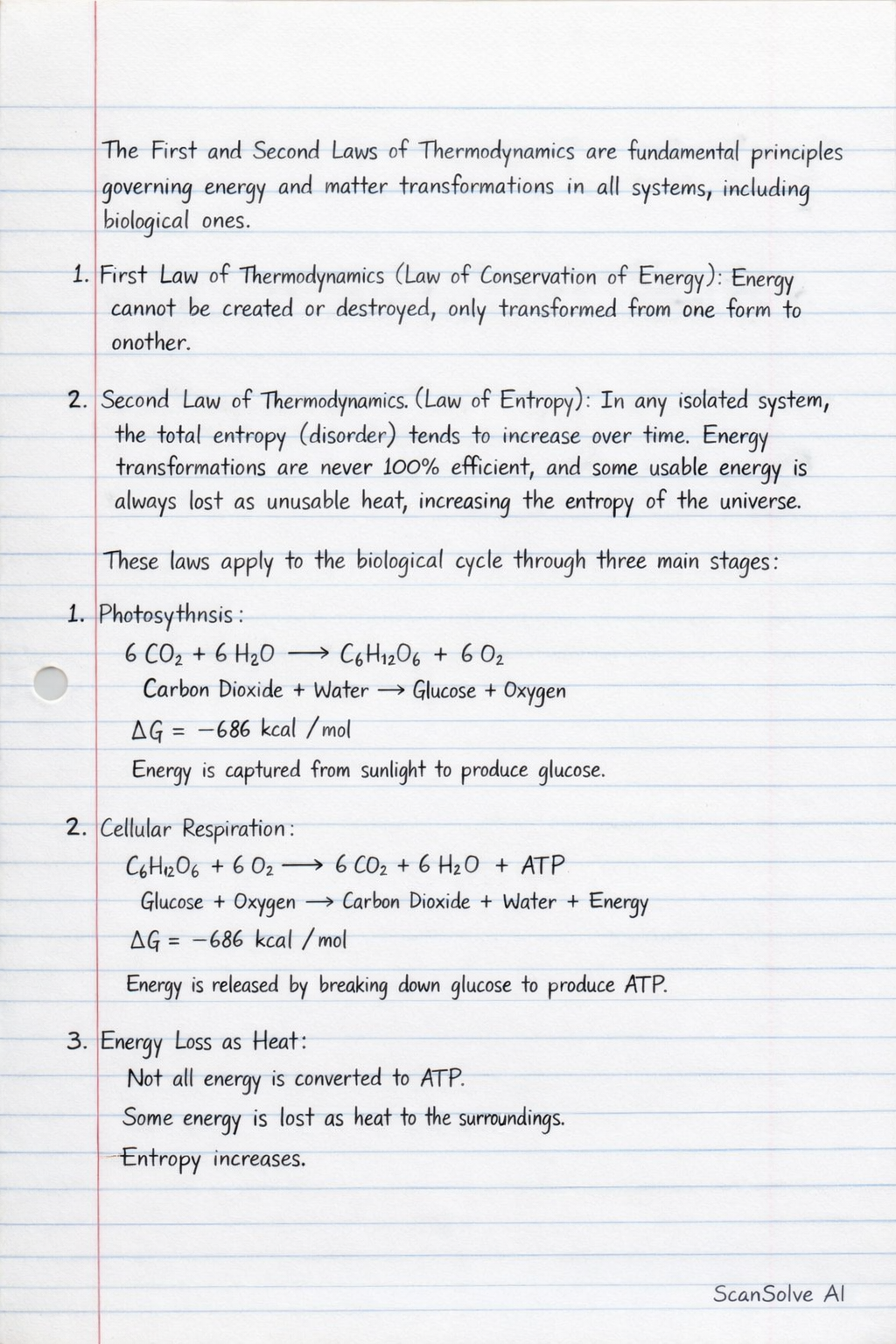
The First and Second Laws of Thermodynamics are fundamental principles governing energy and matter transformations in all systems, including biological ones.
Physics
ScanSolve AI Answer
The First and Second Laws of Thermodynamics are fundamental principles governing energy and matter transformations in all systems, including biological ones.
- First Law of Thermodynamics (Law of Conservation of Energy): Energy cannot be created or destroyed, only transformed from one form to another.
- Second Law of Thermodynamics (Law of Entropy): In any isolated system, the total entropy (disorder) tends to increase over time. Energy transformations are never 100% efficient, and some usable energy is always lost as unusable heat, increasing the entropy of the universe.
These laws apply to the biological cycle through three main stages:
-
Energy Input/Capture:
- First Law: Organisms, primarily producers, capture energy from the environment (e.g., plants convert solar energy into chemical energy via photosynthesis). The total energy remains constant, simply changing from light energy to chemical energy stored in organic molecules.
- Second Law: While photosynthesis creates highly ordered organic molecules from less ordered inorganic ones (, ), this local decrease in entropy is driven by the sun's energy, which itself is undergoing entropy increase. The overall entropy of the universe still increases.
-
Energy Transformation/Utilization:
- First Law: Organisms convert the captured chemical energy into other forms to power life processes (e.g., ATP synthesis, muscle contraction, nerve impulses). The total energy within the organism and its surroundings remains conserved.
- Second Law: During metabolic processes like cellular respiration, chemical energy is converted into usable forms (ATP) and work, but a significant portion is inevitably lost as heat. This heat dissipates into the environment, increasing the overall entropy of the surroundings. Living systems maintain their internal order by constantly increasing the disorder of their environment.
-
Energy Dissipation/Release:
- First Law: When organisms die, the chemical energy stored in their biomass is released back into the environment through decomposition. This energy is not destroyed but transformed, often into heat and simpler chemical forms.
- Second Law: Decomposition breaks down complex organic matter into simpler inorganic molecules, significantly increasing the disorder (entropy) of the ecosystem. The heat released during this process further contributes to the overall increase in environmental entropy.
Was this helpful?
Still stuck on this one?
Ask a follow-up, and the answer starts from this question.
Got a different question?Ask your own question
More Physics Questions
QWhat is the first law of thermodynamics?QFirst law of thermodynamicsQ1st law of thermodynamics??QQ5a.) State the first law of Thermodynamics and represent it with an Equation. b.) Give two(2)…QState the First Law of Thermodynamics and definitions for an ideal gas.
Browse by topic:Thermodynamics
Handwritten Step-by-Step Solution
Get this as a handwritten image on WhatsApp — like a tutor wrote it for you.
Try on WhatsApp