
We read your photo as:
The figure shows a velocity-time graph for a car.
ScanSolve AI Answer
Answer
Step-by-step solution
3 stepsHere's the solution to question 6:
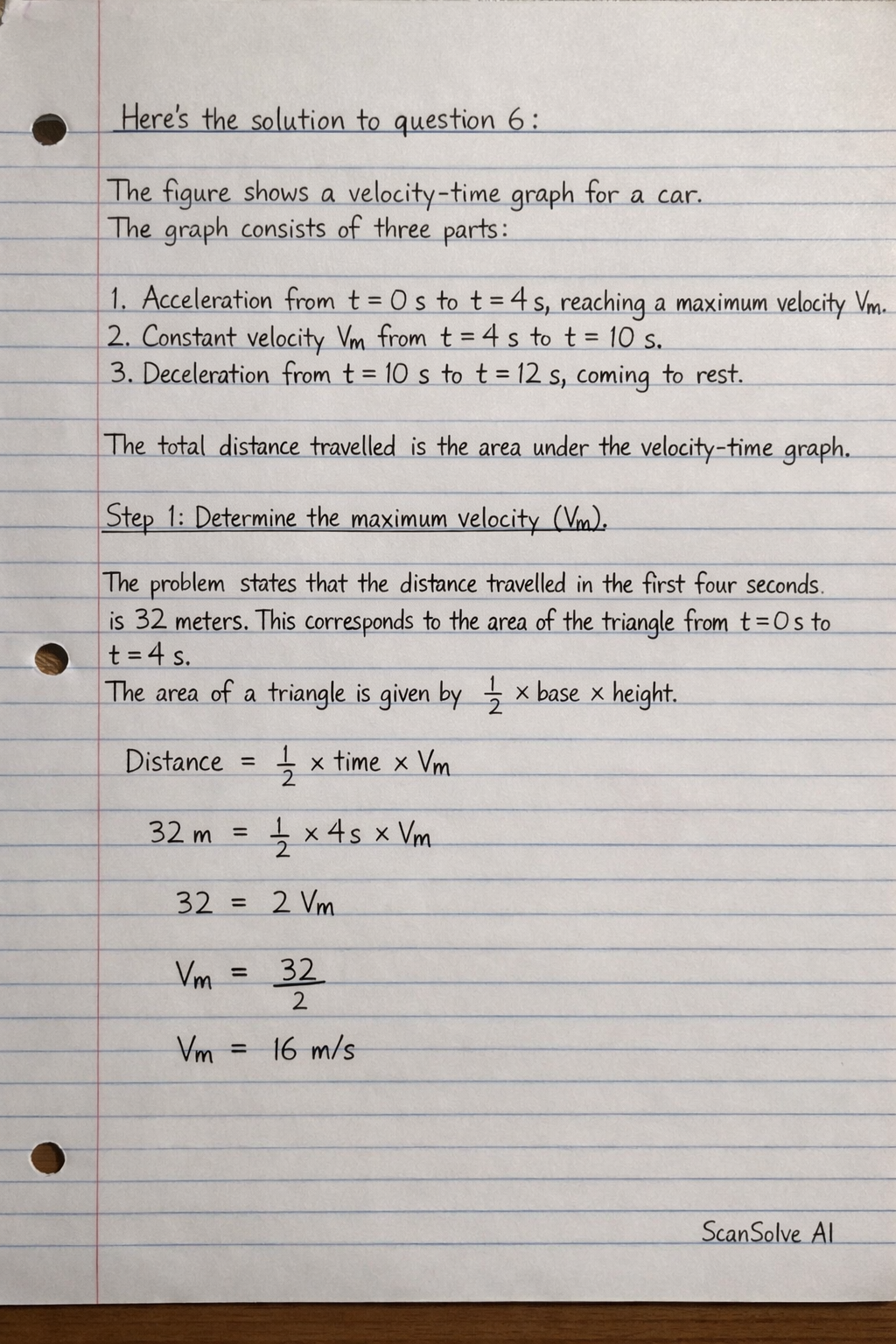
The figure shows a velocity-time graph for a car.
The graph consists of three parts:
- Acceleration from s to s, reaching a maximum velocity .
- Constant velocity from s to s.
- Deceleration from s to s, coming to rest.
The total distance travelled is the area under the velocity-time graph.
Determine the maximum velocity ().
The problem states that the distance travelled in the first four seconds is 32 meters. This corresponds to the area of the triangle from s to s.
The area of a triangle is given by .Calculate the total distance travelled for the whole journey.
The total distance is the area of the entire trapezium.
The area of a trapezium is given by .
In this graph:- The parallel sides are the time durations at the top and bottom of the trapezium.
- The top parallel side (constant velocity duration) is from s to s, so its length is s.
- The bottom parallel side (total time duration) is from s to s, so its length is s.
- The height of the trapezium is the maximum velocity m/s.
Calculate the average velocity for the whole journey.
Average velocity is defined as total distance divided by total time.
The average velocity for the whole journey is .
Try one yourself
A new problem that tests the same skill.
Still stuck on this one?
Ask a follow-up, and the answer starts from this question.
More Physics Questions
Handwritten Step-by-Step Solution
Get this as a handwritten image on WhatsApp — like a tutor wrote it for you.
Try on WhatsApp