
We read your photo as:
Observe the characteristics of Wave 1 and Wave 2.
ScanSolve AI Answer
Step-by-step solution
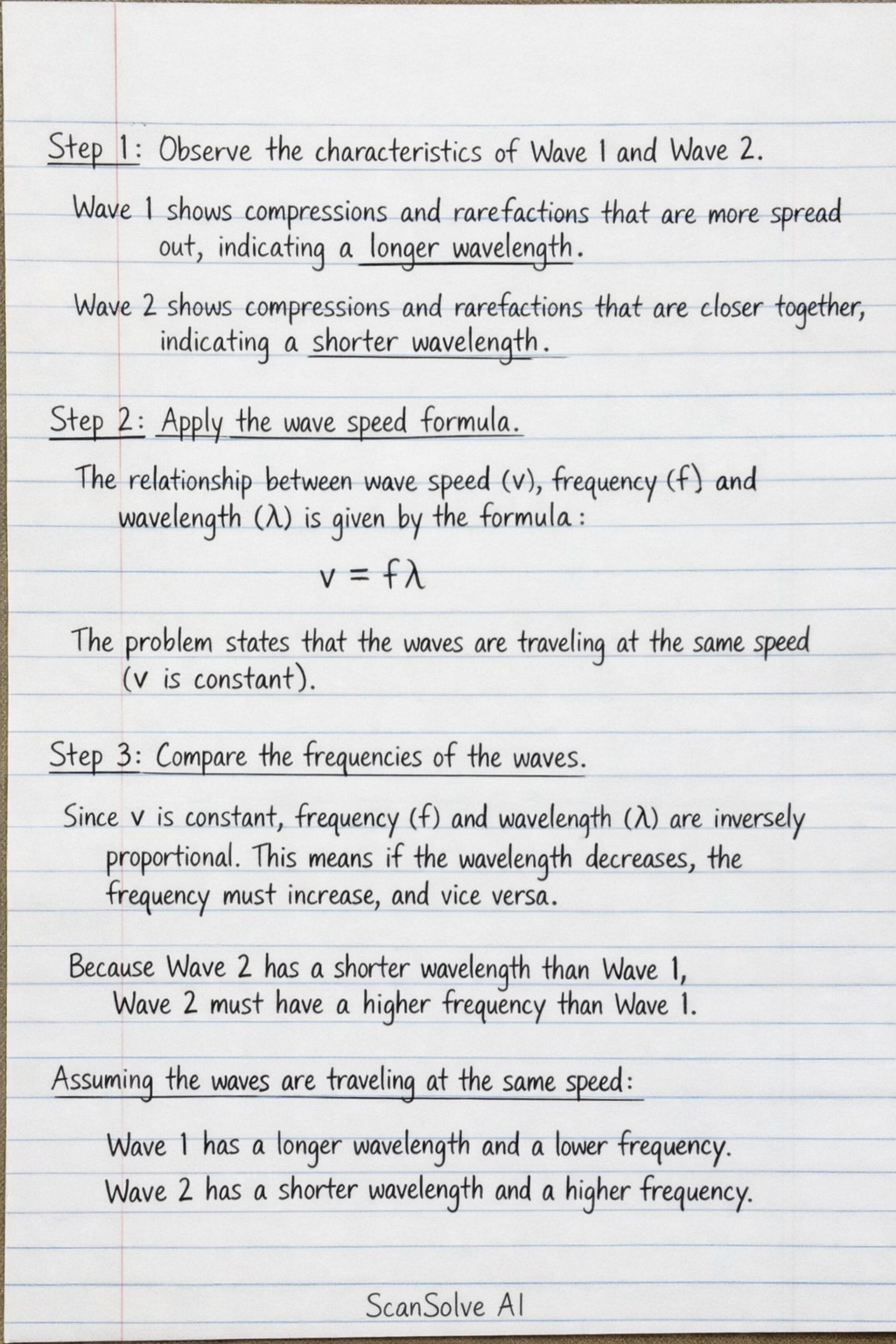
3 stepsObserve the characteristics of Wave 1 and Wave 2.
Wave 1 shows compressions and rarefactions that are more spread out, indicating a longer wavelength.
Wave 2 shows compressions and rarefactions that are closer together, indicating a shorter wavelength.Apply the wave speed formula.
The relationship between wave speed (), frequency (), and wavelength () is given by the formula:
The problem states that the waves are traveling at the same speed ( is constant).
Compare the frequencies of the waves.
Since is constant, frequency () and wavelength () are inversely proportional. This means if the wavelength decreases, the frequency must increase, and vice versa.
Because Wave 2 has a shorter wavelength than Wave 1, Wave 2 must have a higher frequency than Wave 1.Assuming the waves are traveling at the same speed:
Wave 1 has a longer wavelength and a lower frequency.
Wave 2 has a shorter wavelength and a higher frequency.The question is incomplete, but based on the visual information and the assumption of equal speed, the primary difference is in their wavelengths and consequently their frequencies.
Still stuck on this one?
Ask a follow-up, and the answer starts from this question.
More Physics Questions
Handwritten Step-by-Step Solution
Get this as a handwritten image on WhatsApp — like a tutor wrote it for you.
Try on WhatsApp